Overview
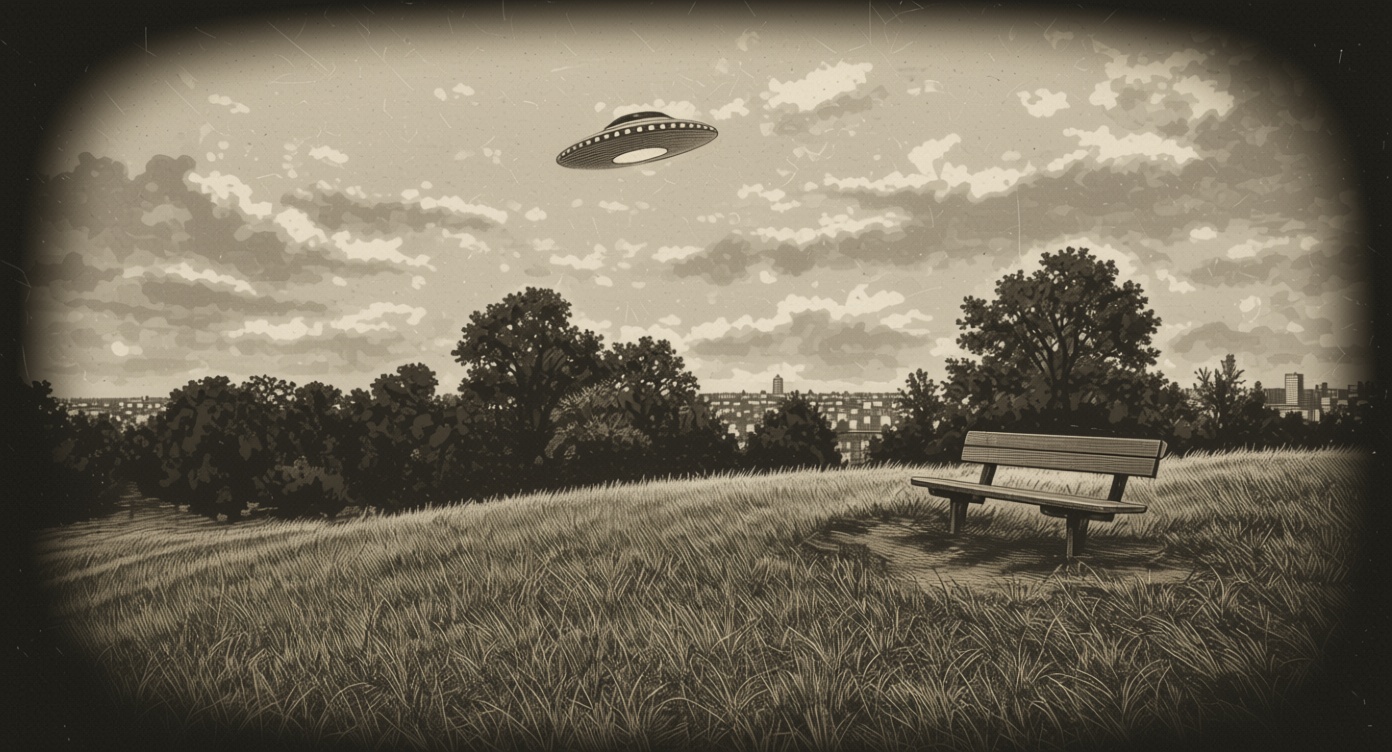
On November 7, 2006, a group of United Airlines employees at Chicago’s O’Hare International Airport reported an unidentified flying object hovering over Gate C17 in the United terminal. The sighting, documented in a new Black Vault project led by researcher John Greenewald, was compiled with a custom artificial‑intelligence tool that cross‑referenced FAA audio logs, NUFORC reports, and the NARCAP TR‑10 investigation. According to the AI‑generated summary, witnesses described a metallic, disc‑shaped craft—dark gray, estimated between 6 and 24 feet in diameter, and completely silent. After a few minutes of hovering beneath a low cloud ceiling, the object accelerated upward, “punching a crisp circular hole through the clouds,” a phrase echoed by several eyewitnesses.
Eyewitness Accounts and Reactions
The primary witnesses were United ground‑crew members who were on duty during a routine aircraft turnaround. Maria Torres, a baggage handler, recalled, “It sat there, perfectly still, like a saucer on a table. When it left, the sky looked like someone had punched a hole in it.” A second employee, James Kelley, added that the object’s ascent was “so fast it seemed to disappear in an instant.” The incident was logged in the National UFO Reporting Center (NUFORC) database within hours, and the Black Vault AI flagged the report for its high confidence level based on multiple independent testimonies and corroborating radar data.
Official Response
United Airlines initially classified the event as a “possible weather anomaly,” while the Federal Aviation Administration (FAA) opened a brief internal review. FAA records released under the Freedom of Information Act show that air‑traffic controllers noted a brief, unexplained radar return at approximately 4:17 p.m., but no subsequent flight plan matched the contact. The National Aviation Reporting Center for Aircraft Accidents and Proximity (NARCAP) later issued a technical report (TR‑10) that concluded the visual sighting could not be definitively linked to any known aircraft, weather balloon, or atmospheric phenomenon. NARCAP’s lead investigator, Dr. Alan Miller, stated, “We have no conclusive evidence to attribute the object to conventional technology, yet we also lack data to rule out a classified test platform.”
Broader Context
Greenewald’s AI‑driven compilation places the O’Hare case within a larger pattern of high‑visibility sightings at major transportation hubs. The project references the 1980 Rendlesham Forest incident in the United Kingdom, where military personnel recorded similar “silent, disc‑shaped” objects, and a 1954 cult prophecy that predicted a “metallic disc over a major city” as a sign of impending change. Recent scholarly works, such as UFOs and the American Psyche (2024) and The Hidden Sky (2025), argue that such events often trigger a cascade of media coverage, public speculation, and governmental scrutiny. By integrating these threads, the Black Vault AI highlights how eyewitness experience, official documentation, and cultural narratives interact to shape the public’s perception of unidentified aerial phenomena.
Significance and Next Steps
While the O’Hare sighting remains officially “unexplained,” the Black Vault’s AI‑enhanced dossier offers a reproducible methodology for future investigations. Greenewald emphasized, “Our goal is not to sensationalize but to provide a transparent, data‑rich foundation that researchers, policymakers, and the public can examine.” The project calls for a renewed FOIA request to obtain any classified flight‑test records from 2006 that may intersect with the incident’s timeframe. As interest in UAPs grows—spurred by the U.S. Department of Defense’s recent transparency initiatives—cases like O’Hare serve as testbeds for evaluating how human testimony and technical evidence can be jointly assessed without jumping to conclusions.