Overview
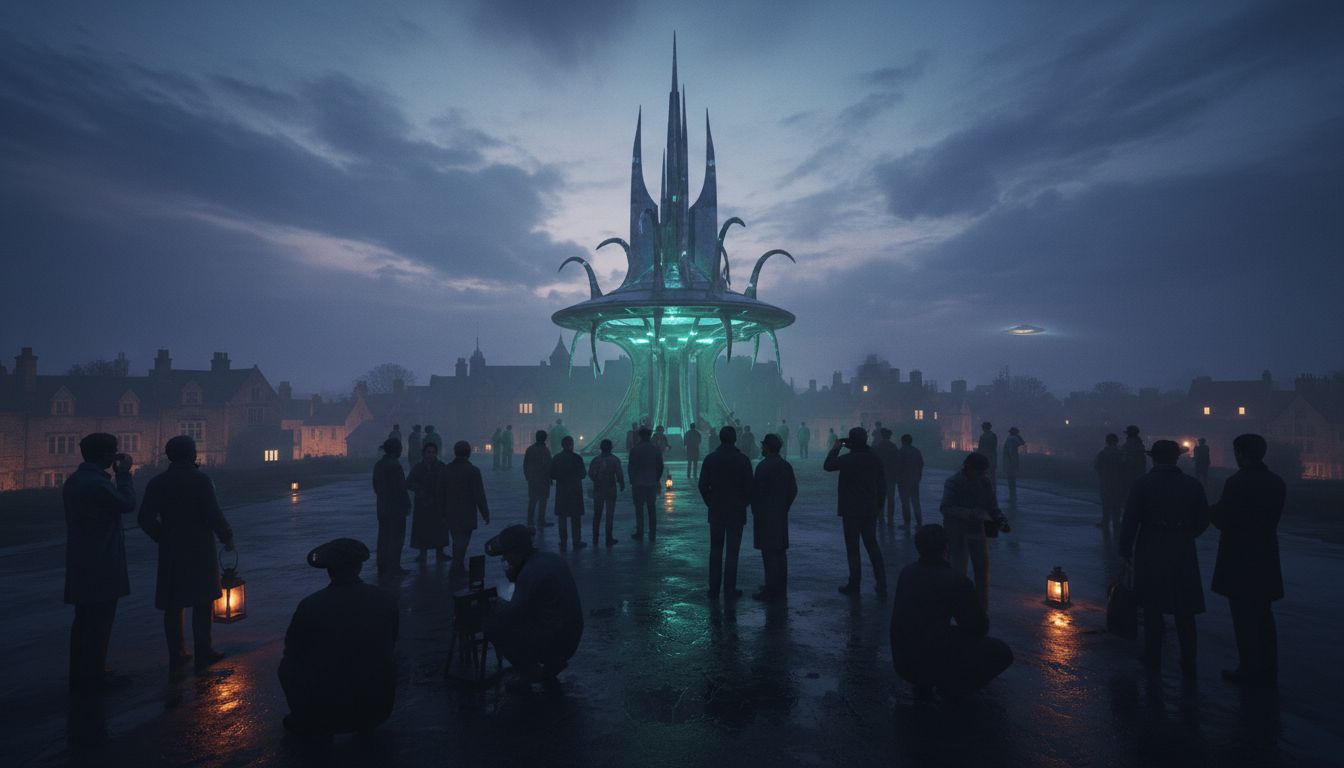
Sixty years after the first reports of strange lights and sounds in the Wiltshire town of Warminster, the phenomenon known locally as “the Warminster Thing” remains a defining part of the community’s identity. Beginning with a series of unexplained noises in 1965 that later evolved into visual sightings, the town has become a magnet for UFO enthusiasts, researchers and curious visitors. This year the story was given a public art tribute: a large mural depicting an alien and a flying saucer was unveiled in a town car park, funded entirely by a £1,500 crowd‑sourced campaign that raised the money in just five days.
A Half‑Century of Sightings
The original incidents were reported in local newspapers in the mid‑1960s, describing “unusual happenings” over the rural landscape surrounding Warminster. Over the following decades, eyewitness accounts shifted from mysterious sounds to distinct visual phenomena—bright orbs, disc‑shaped objects and, on occasion, close‑range encounters. By the 1980s, the sightings had become a regular talking point among residents, especially the younger generation who would camp on nearby hills hoping to “be taken away by aliens,” as former teenager‑turned‑artist Paul Boswell recalled.
Boswell, who created the new mural, said, “We used to go up on Cley Hill and sort of do UFO spotting. It used to be a thing. We’d sleep out there all night expecting to be taken away by aliens.” His memories illustrate how the sightings transitioned from a fringe curiosity into a shared cultural experience.
Community Memory and Documentation
The town’s information centre, managed by Lesley Blain from 2005 to 2015, served as an unofficial archive for the Warminster Thing. Visitors from across the globe would drop in to request any material the centre held, and a dedicated file was maintained for public perusal. Blain, now a moderator of the local social‑media group Heart of Warminster, said the phenomenon still generates strong online engagement: “Whenever anything goes up on the page about The Thing, there is a big response.”
She added, “I think it’s a little bit like magic. If you really knew what was going on, it would take the interest out of it. I’m happy for it to be a mystery, I’m happy to enjoy it.” The mural’s rapid fundraising—£1,500 collected in five days from local donors—demonstrates that the community continues to rally around the legend, treating it as both heritage and entertainment.
The Landscape of Observation
Three sites dominate the local map of sightings. Cley Hill, an Iron Age hill‑fort with sweeping views of the countryside, is the most frequently cited location. Adjacent elevations—Cradle Hill and Middle Hill (also known as Starr Hill)—lie close to a military training area, prompting speculation that some lights may be linked to defence exercises. Signage on the footpaths warns walkers that military drills can occur, yet the military has not publicly clarified its activities in the area.
Researchers and skeptics alike note that the proximity of these installations complicates attempts to separate genuine aerial phenomena from routine exercises. Nonetheless, the hilltops remain popular with amateur astronomers and UFO‑watch groups, who continue to log observations through local forums and the information centre’s historic archive.
Personal Reflections and the Way Forward
For longtime residents, the Warminster Thing is less a sensational mystery than a backdrop to everyday life. Katrina Collett, who grew up in the town and left in the 1990s, described it as “just part of everybody’s day‑to‑day life.” She recalled nights spent with friends, armed radios in hand, scanning the hills for any sign of activity. “The sightings would match up,” she said, underscoring how collective observation reinforced the narrative.
As Warminster marks six decades of UFO fascination, the town’s approach remains measured. Local authorities have neither confirmed nor denied any extraordinary events, and the mural—while eye‑catching—serves more as a cultural marker than a claim of proof. The ongoing dialogue, captured in community archives, social media, and public art, ensures that the Warminster Thing will continue to be a point of curiosity, conversation, and, for many, a touch of local magic.


