Overview
In the winter of 1959 a rescued Persian cat named Thomas captured the imagination of a small West Virginia community when a patch of fur on her shoulders began to resemble a pair of wings. The feline, living in the town of Pinesville, was observed unfurling the feather‑like growth, though she never achieved lift‑off. The phenomenon, documented by noted ufologist John A. Keel in a 1968 manuscript and later incorporated into his book Strange Creatures From Time and Space, has resurfaced as one of the most curious animal anomalies recorded in modern folklore.
The Incident
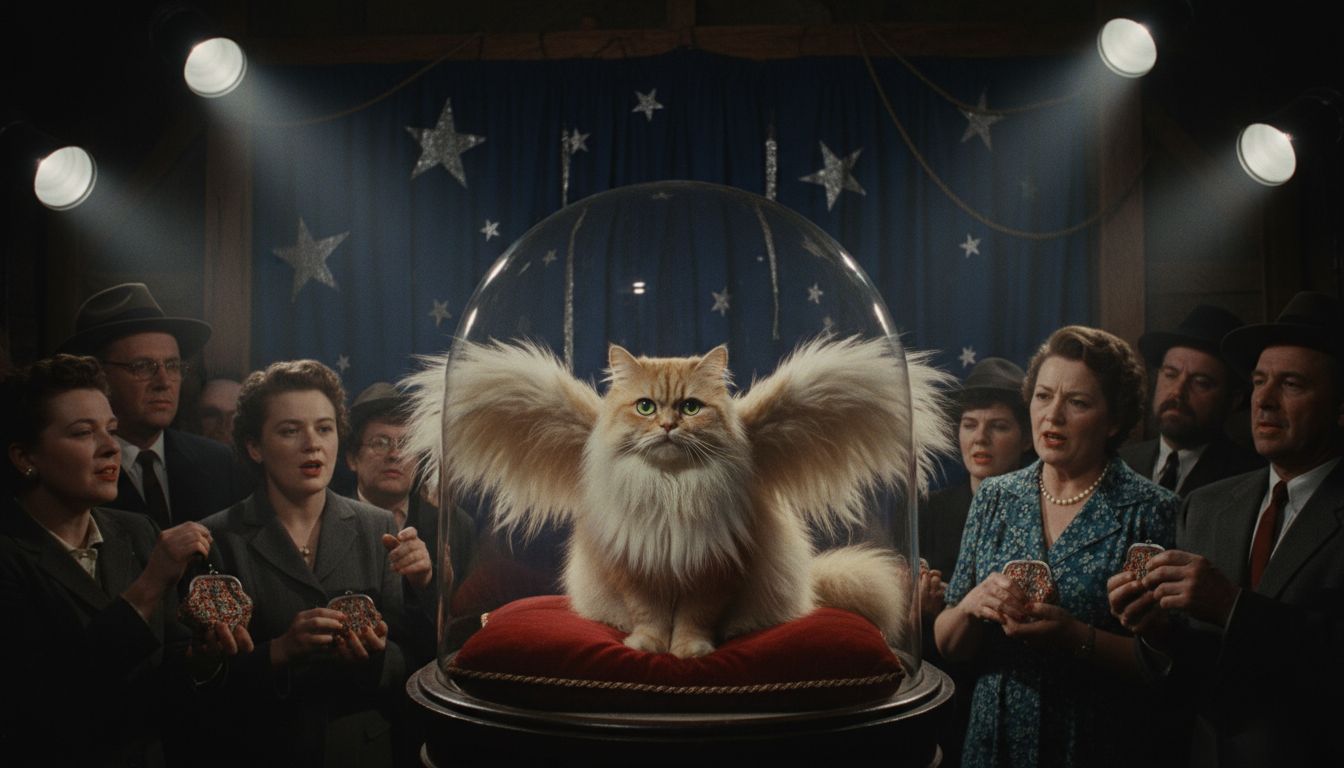
Thomas was found abandoned near the outskirts of Pinesville and taken in by a local family who named her after the beloved cat in the classic novel The Cat Who…. By early 1960, the cat’s shoulder‑coat had thickened into a distinct, wing‑shaped tuft. According to the family’s recollection, “when she was startled or excited, the fur would rise and spread like a small banner,” creating a visual effect that resembled a pair of wings. Veterinary examinations at the time could not explain the growth; no skeletal or muscular structures supported true flight, and the cat remained firmly grounded. Over the next several months the “wings” persisted, drawing curious neighbors and, eventually, visitors from surrounding counties who paid a modest fee to see the “winged cat” in person.
Public Reaction
The spectacle quickly turned Thomas’s modest household into an informal tourist spot. Residents set up a small wooden platform in the family’s front yard and charged a nominal admission of $0.25—a sum that, adjusted for inflation, would be roughly $2.20 today. Children pressed their faces against the fence while adults exchanged bemused anecdotes about the cat’s “flightless flamboyance.” Local newspaper clippings from the period, though scarce, described the scene as “a charming oddity that has put Pinesville on the map for a brief, delightful moment.” The attention waned after the fur began to shed naturally in the spring of 1960, and the wing‑like tufts fell away without injury to the animal. Thomas returned to the ordinary life of a house pet, remaining a beloved member of the family until her death several years later.
Keel’s Documentation
John A. Keel, best known for his investigations into UFO sightings and the “men in black” phenomenon, wrote an “amusing account” of Thomas in January 1968. He later incorporated the story into Chapter Four, titled “Flying Felines,” of his anthology Strange Creatures From Time and Space, which was subsequently reissued as The Complete Guide to Mysterious Beings. Keel’s narrative does not claim supernatural causation; instead, he treats the episode as a “bizarre natural anomaly” worthy of the same careful observation he applied to unidentified aerial phenomena. In a private correspondence referenced in the book’s footnotes, Keel remarked that the case was “even more intriguing than the UFOs I’ve chased,” underscoring his fascination with the thin line between the extraordinary and the mundane.
Legacy and Perspective
While the winged cat never achieved the notoriety of classic UFO cases, it endures as a reminder that unexplained events can arise in the most ordinary settings. Scientists today would likely attribute Thomas’s condition to a rare dermatological mutation or a form of hypertrichosis localized to the shoulder region—a hypothesis that aligns with the lack of skeletal adaptation for flight. Nevertheless, the story persists in regional folklore and in the annals of cryptozoological literature, illustrating how human curiosity can transform a simple animal oddity into a cultural touchstone. As Keel himself cautioned, “the universe is full of surprises, and sometimes the most astonishing ones are perched on a windowsill, waiting to be noticed.”


