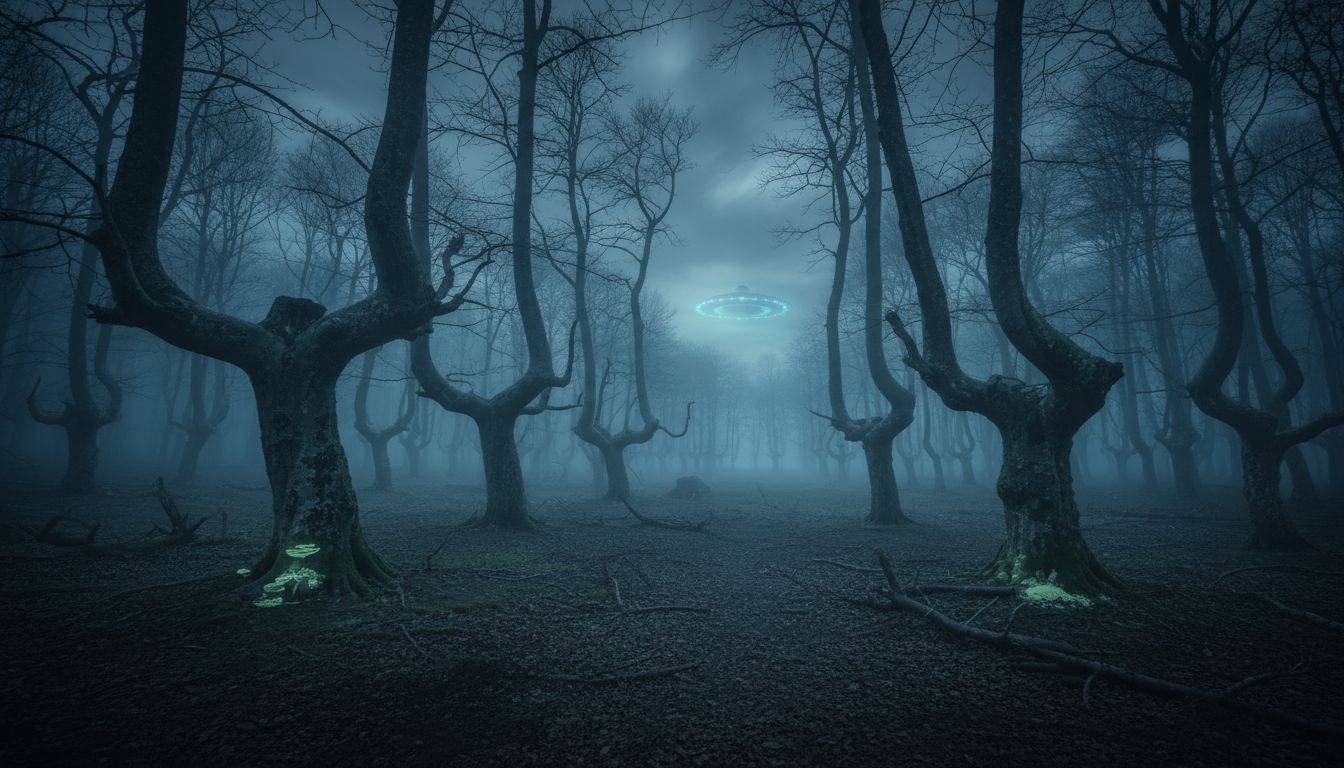
The Hoia Baciu forest, a 2‑square‑kilometre stand of beech and oak on the outskirts of Cluj‑Napoca, has long been billed by travel guides and online forums as “the world’s most haunted woodland”. Its reputation rests on a mixture of natural oddities – gnarled trunks that seem to bend toward a central clearing, sudden temperature drops and a faint, lingering mist – and a series of anecdotal reports that range from disorienting “time‑loss” experiences to bright, disc‑shaped lights that have been filmed by amateur enthusiasts. The forest’s modern mythos was cemented in 1978, when a group of Romanian students claimed to have witnessed a luminous, humming object hovering above the trees, an episode that was later featured in a Romanian television documentary and has since been cited in UFO‑research circles worldwide.
Local folklore predates the 20th‑century sightings. Oral histories collected by ethnographer Ioan Bălan in the 1990s describe the forest as the domain of “Mara”, a female spirit who lures wanderers deeper into the woods, and of “the black dog”, a spectral animal said to appear at night. The stories have been passed down through generations of villagers from the nearby commune of Baciu, who warn children that the forest “takes what it wants”. While such legends are typical of remote, densely wooded areas, the Hoia Baciu’s particular blend of visual and auditory anomalies has turned it into a focal point for “spooky tourism”, a niche that the Romanian Ministry of Tourism has begun to monitor as part of its broader effort to diversify the country’s cultural‑heritage offerings.
Guided tours now operate year‑round, often led by local naturalists who combine scientific explanation with the forest’s mythic narrative. Dr. Elena Popescu, a dendrologist at the University of Cluj‑Napoca, notes that the “twisted, almost skeletal appearance of many trees is largely the result of fungal infection and wind‑throw events that occurred after the 1970s storm that felled a large portion of the canopy”. She adds that the area’s unique microclimate – a convergence of humid air from the Apuseni Mountains and cooler air from the Transylvanian plateau – can produce “temperature inversions and light refraction that sometimes give rise to the luminous phenomena described by witnesses”. Nonetheless, Popescu acknowledges that the forest’s reputation continues to draw visitors who are less interested in botanical research than in the possibility of encountering the unexplained.
The economic impact is measurable. According to a 2024 report from the Cluj County Tourism Board, the Hoia Baciu forest attracted roughly 45,000 visitors in the previous year, a 12 % increase over 2023, with a notable surge in foreign tourists from the United Kingdom, Germany and the United States. Many of these travelers book “paranormal‑experience” packages that include night‑time walks, audio recordings of alleged EVP (electronic voice phenomena), and a stop at the nearby “UFO Museum”, a modest collection of photographs and artefacts curated by local enthusiast Andrei Ionescu. Ionescu, who has been documenting sightings since the early 2000s, says, “We don’t claim to have proof of extraterrestrials, but the forest offers a rare convergence of natural mystery and human imagination that people find compelling.”
Skeptics caution against conflating folklore with empirical evidence. The Romanian Academy’s Committee for the Study of Anomalous Phenomena released a brief statement in March 2025, emphasizing that “while the Hoia Baciu forest is a valuable site for ecological and cultural research, claims of paranormal activity remain unverified by controlled scientific methodology”. Yet the forest’s allure shows no sign of waning. As the region’s tourism officials plan to integrate the site into a broader “Transylvanian Legends” trail, the Hoia Baciu forest stands as a vivid example of how natural landscapes can become cultural touchstones, where the line between environmental curiosity and the human yearning for the extraordinary continues to blur.


