Overview
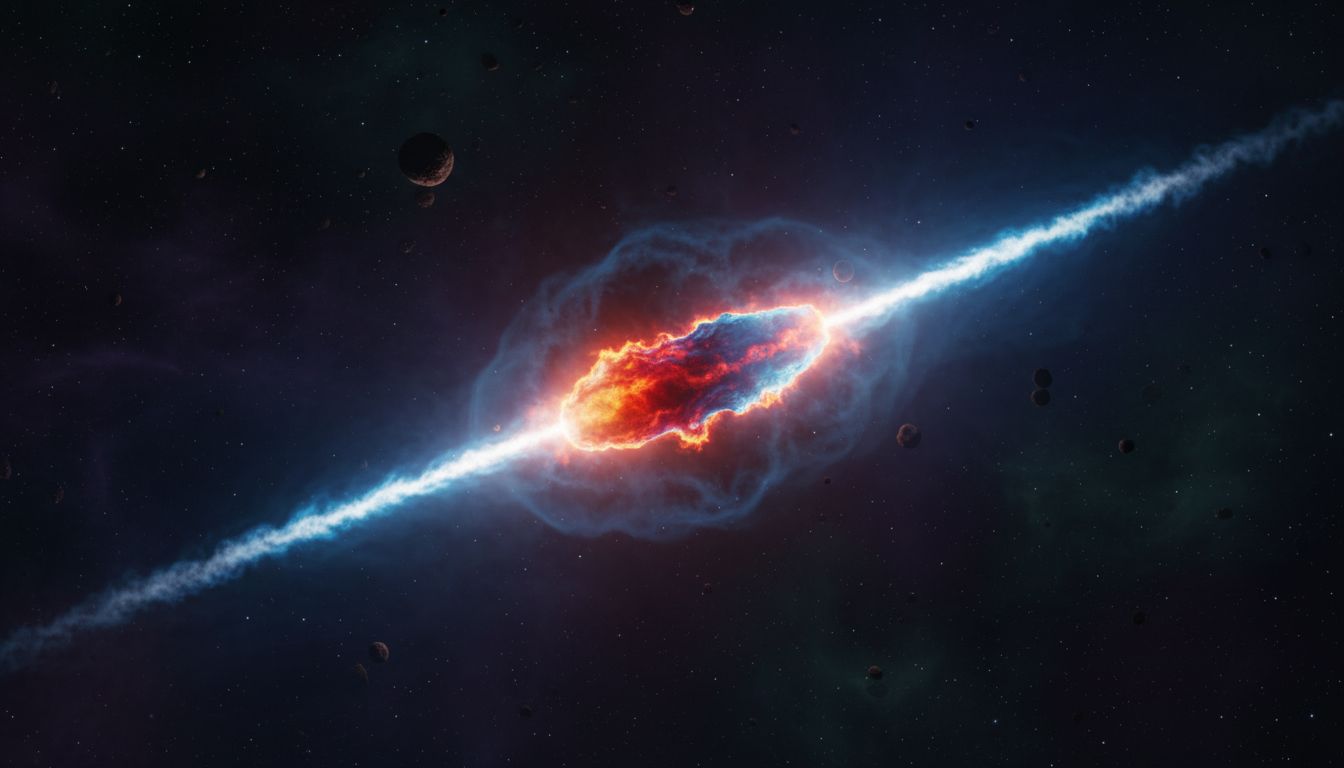
On 29 November 2025, amateur astronomer Teerasak Thaluang in Rayong, Thailand captured a high‑resolution image of the interstellar object 3I/ATLAS using a 0.26‑meter telescope. After applying a Larson–Sekanina rotational‑gradient filter, the image revealed two narrow, oppositely directed jets and a pronounced anti‑tail pointing sunward. The findings, reported by Samuel Lopez for the USA Herald, add to a growing series of observations that challenge conventional cometary physics and suggest the presence of a controlled, non‑gravitational propulsion mechanism.
Imaging Technique and Data Processing
The research team employed a thermal‑gradient (rotational‑gradient) filter to suppress the diffuse coma that typically obscures structural details in cometary images. By isolating the object's intrinsic geometry, the filter highlighted linear features that remain stable across multiple exposures taken over the past month. The processed frame, released with the article, shows the jets maintaining a fixed orientation relative to the nucleus even after accounting for the object's rotation and viewing angle. “The consistency of the jet vectors after gradient subtraction is unprecedented for any known natural comet,” Lopez wrote.
Key Anomalies
Collimated, bidirectional jets – Unlike the chaotic dust plumes produced by sublimation of volatile ices, the jets appear as thin, coherent streams extending in opposite directions. Their stability suggests a repeatable thrust source rather than random outgassing.
Sunward‑pointing anti‑tail – Conventional solar radiation pressure forces dust away from the Sun, forming an anti‑sunward tail. In the filtered image, material is projected directly toward the Sun, a phenomenon previously noted in observations from Hawaii, Utah, Italy, and Spain but never so clearly resolved.
Trajectory modulation – Preliminary orbit calculations indicate that the jets are contributing measurable non‑gravitational acceleration, subtly altering the object's path. This aligns with earlier reports of “pulsed activity” and “structured mass ejection” for 3I/ATLAS.
Scientific Context
Interstellar objects such as ‘Oumuamua (2017) and 2I/Borisov (2019) have prompted extensive debate over anomalous accelerations and potential artificial origins. Harvard astrophysicist Avi Loeb, who has previously advocated for rigorous scrutiny of such anomalies, emphasized that “any repeatable thrust pattern, especially one that can be mapped to a specific vector, demands a physical explanation beyond standard cometary models.” The current observations extend that line of inquiry by providing visual evidence of directed mass ejection, a hallmark of engineered propulsion in aerospace engineering.
Implications and Caution
While the imagery is compelling, researchers stress the need for continued multi‑wavelength monitoring before drawing definitive conclusions about intentional control. Spectroscopic analysis could identify the composition of the jets, distinguishing between volatile ices, metallic particles, or engineered propellants. Additionally, radar ranging and high‑resolution imaging from larger observatories will help confirm whether the observed structures are intrinsic to the nucleus or artifacts of observational geometry.
Next Steps
The USA Herald team plans to collaborate with the International Astronomical Union’s Working Group on Interstellar Objects to coordinate observations from facilities in Chile, the Canary Islands, and the upcoming James Webb Space Telescope. Funding proposals are under review to support a dedicated spectroscopic campaign aimed at characterizing the jet material. As Dr. Maria Sanchez, a cometary dynamics specialist at the European Southern Observatory, noted, “Only by combining imaging, spectroscopy, and dynamical modeling can we assess whether 3I/ATLAS is a naturally occurring body exhibiting an extreme outgassing event or something fundamentally different.”
The latest gradient‑filtered image of 3I/ATLAS thus adds a critical data point to the ongoing discourse on interstellar visitors, highlighting features that defy standard cometary explanations while underscoring the importance of rigorous, interdisciplinary investigation before attributing intentional control to an extraterrestrial phenomenon.


