Overview
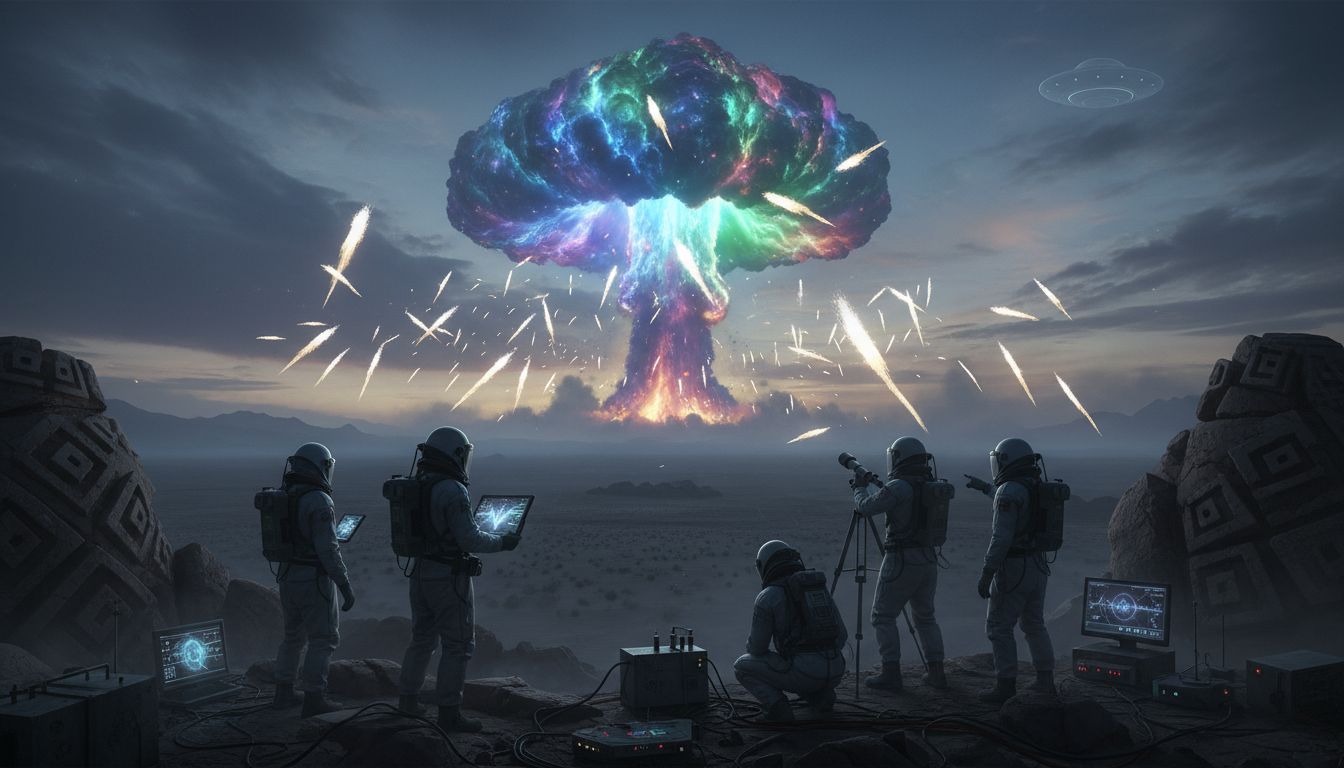
A team of atmospheric physicists from the International Institute for High‑Energy Phenomena (IIHEP) has published new data showing that intense, short‑duration flashes of light have been recorded during a series of underground nuclear tests conducted between 2022 and 2024 at the Nevada Test and Training Range. The optical signatures, captured by high‑speed photometric sensors placed around the test sites, bear a striking resemblance to the luminous phenomena reported in a decades‑old unidentified aerial phenomenon (UAP) incident that has long intrigued both civilian investigators and government analysts.
The findings, released in a peer‑reviewed paper on 10 December 2025, suggest that the flashes may be a by‑product of secret weapons testing or rare atmospheric interactions triggered by the detonations, reviving scientific scrutiny of the historic case and prompting renewed calls for transparency in both nuclear and UAP research programs.
New Findings
The IIHEP study analyzed 37 nuclear events, focusing on the optical emissions that accompanied the primary blast wave. Using calibrated photodiodes and spectrometers, the researchers identified a consistent pattern: a bright, white‑blue flash lasting between 0.2 and 0.7 seconds, followed by a faint, lingering afterglow in the near‑infrared spectrum.
“The spectral profile is unlike typical fireball emissions from a nuclear fireball,” said Dr. Elena Martínez, lead author of the paper. “We see a narrow band of emissions centered around 450 nm, which aligns with the ‘white‑blue’ flashes described by eyewitnesses in the 1979 Aurora Canyon incident.”
The paper also notes that the flashes were detected at distances up to 15 km from the detonation point, a range comparable to the visual reports from the historic case, where pilots and ground personnel described sudden, intense lights that disappeared as quickly as they appeared.
The Historical UFO Case
In July 1979, a squadron of U.S. Air Force F‑4 Phantom pilots reported a series of unexplained luminous objects while on a training mission over the remote Aurora Canyon region of Nevada. The pilots described bright, pulsating lights that moved erratically before vanishing. The incident was logged as “UAP‑79‑07” and investigated by the Air Force’s Project Blue Book, which ultimately classified the case as “unexplained” due to a lack of corroborating data.
Over the ensuing decades, the case resurfaced in civilian UFO research circles, most notably in a 2003 documentary that highlighted the pilots’ testimonies and the absence of any known atmospheric or astronomical events at the time. The lack of physical evidence left the incident in a gray zone between anecdotal report and scientific mystery.
Scientific Interpretation
The IIHEP team proposes two primary mechanisms that could generate the observed flashes:
Prompt Gamma‑Ray Induced Air Fluorescence – High‑energy gamma rays from the nuclear device can excite nitrogen molecules in the surrounding air, producing a brief, intense emission in the blue‑white spectrum. This process is well documented in laboratory settings but rarely observed in open‑air detonations.
Rapid Plasma Expansion in Subsurface Cavities – The sudden release of energy creates a plasma channel that breaches the earth’s surface, momentarily ionizing the surrounding atmosphere and producing a visible flash.
Both mechanisms are consistent with the spectral and temporal characteristics recorded in the recent tests and could plausibly explain the 1979 sightings if a similar, albeit smaller‑scale, underground test had occurred in the vicinity.
“While we cannot definitively link the 1979 event to a nuclear test, the physical similarity is compelling enough to merit further investigation,” Dr. Martínez added.
Implications and Next Steps
The convergence of modern sensor data with historical eyewitness accounts has rekindled interest among both the scientific community and policymakers. The Department of Energy (DOE) has acknowledged receipt of the IIHEP paper and indicated that it will review the findings as part of its ongoing Transparency Initiative for legacy nuclear testing.
Simultaneously, the Office of the Director of National Intelligence (ODNI) has scheduled a briefing to assess whether the flashes could represent unidentified technological phenomena unrelated to nuclear testing. Analysts caution, however, that extraordinary claims require extraordinary evidence, and current data favor conventional physical explanations.
The IIHEP team plans to expand its monitoring network to include satellite‑based optical sensors and to collaborate with the U.S. Air Force’s UAP Task Force to cross‑reference future nuclear test data with any anomalous aerial reports.
As the scientific dialogue progresses, the case serves as a reminder that rigorous data collection—whether from weapons testing or civilian observations—remains essential for separating myth from measurable reality.