Overview
In a recent episode of The Free Press podcast, two prominent Catholic thinkers—anthropologist Diana Pasulka and New York Times columnist Ross Douthat—argued that the surge of unexplained aerial phenomena (UAP) reported across the United States could be interpreted as divine signs rather than purely extraterrestrial or secret‑government activity. Their comments come amid heightened public interest following the Pentagon’s 2024 release of the “Preliminary Assessment,” which documented 144 credible sightings by military pilots and sensors. While the assessment stopped short of confirming alien technology, it reignited debate over how society should frame these events—scientifically, politically, and, as Pasulka and Douthat suggest, theologically.
A Catholic Lens on the Unknown
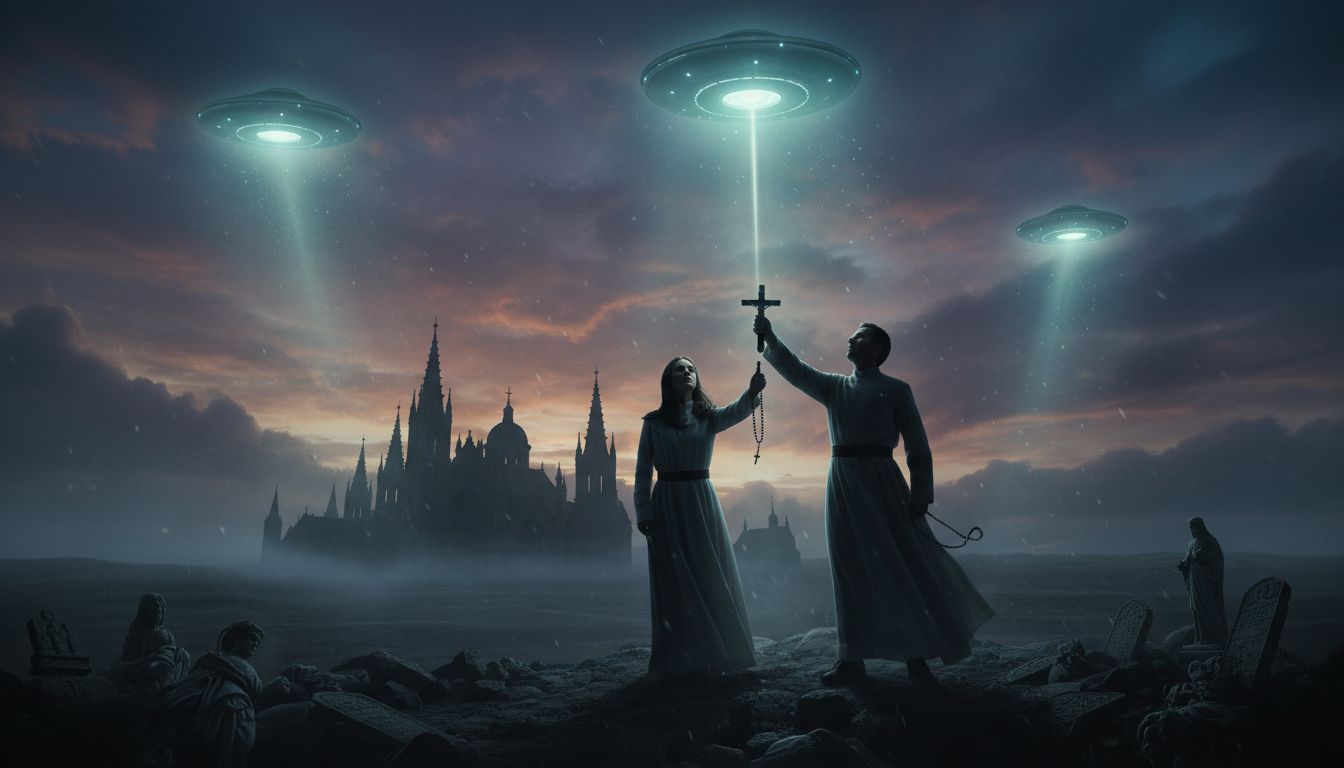
Pasulka, whose scholarship on religion and technology has focused on the “sacred‑secular” interface, contended that the Catholic tradition has long accommodated mystery as a pathway to God. “The Church teaches that God can reveal Himself through extraordinary means,” she told host Will Rahn. “When a phenomenon defies our current scientific models, it invites a prayerful response rather than an immediate dismissal.” Douthat echoed this sentiment, noting that the Catechism speaks of “God’s hiddenness” and that “signs” are a biblical motif, from the burning bush to the transfiguration. Both emphasized that viewing UAP through a spiritual prism does not preclude scientific inquiry; instead, it adds a layer of moral and existential reflection.
Contrasting Views Within the Faith Community
The episode also referenced the divergent stance of Senator J.D. Vance, a recent Catholic convert who has publicly labeled UFOs “demons” in a 2026 interview with The Guardian. Vance warned that “every great world religion…recognizes there are weird things out there…both good and evil.” Pasulka cautioned against such binary labeling, arguing that “demonizing the unknown can close the door to genuine wonder and dialogue.” Douthat added that the Church’s history of discernment—distinguishing between authentic spiritual experiences and deception—provides a framework for evaluating UAP claims without resorting to fear‑based narratives.
Scientific and Governmental Context
The theological discussion occurs alongside a growing body of empirical data. Since the establishment of the All‑Domain Anomaly Resolution Office (AARO) in 2023, the Department of Defense has cataloged hundreds of sightings, many captured on infrared and radar. Independent researchers, such as Harvard astrophysicist Dr. Avi Loeb, have advocated for “open‑minded but rigorous” study, emphasizing that extraordinary claims demand extraordinary evidence. Pasulka acknowledged the importance of this approach, stating, “Faith and science are not mutually exclusive; both seek truth, albeit through different methodologies.” The podcast hosts highlighted that the U.S. Senate’s 2025 UFO hearings featured testimonies from pilots, engineers, and even a former Vatican diplomat, underscoring the interdisciplinary nature of the conversation.
Implications for Public Discourse
By framing UAP as potential signs of God, Pasulka and Doutht underscore a broader cultural shift: a willingness to integrate religious meaning into contemporary scientific puzzles. Their perspective invites policymakers, scientists, and clergy to collaborate on guidelines that respect both empirical rigor and spiritual sensibility. As Douthat concluded, “If the ultimate question is ‘Who are we?’ then any credible anomalous event—whether alien, demonic, or divine—must be examined with humility.” Whether future investigations will substantiate these theological interpretations remains uncertain, but the dialogue signals a renewed openness to exploring the mysteries that lie at the intersection of faith, mystery, and the skies.