Overview
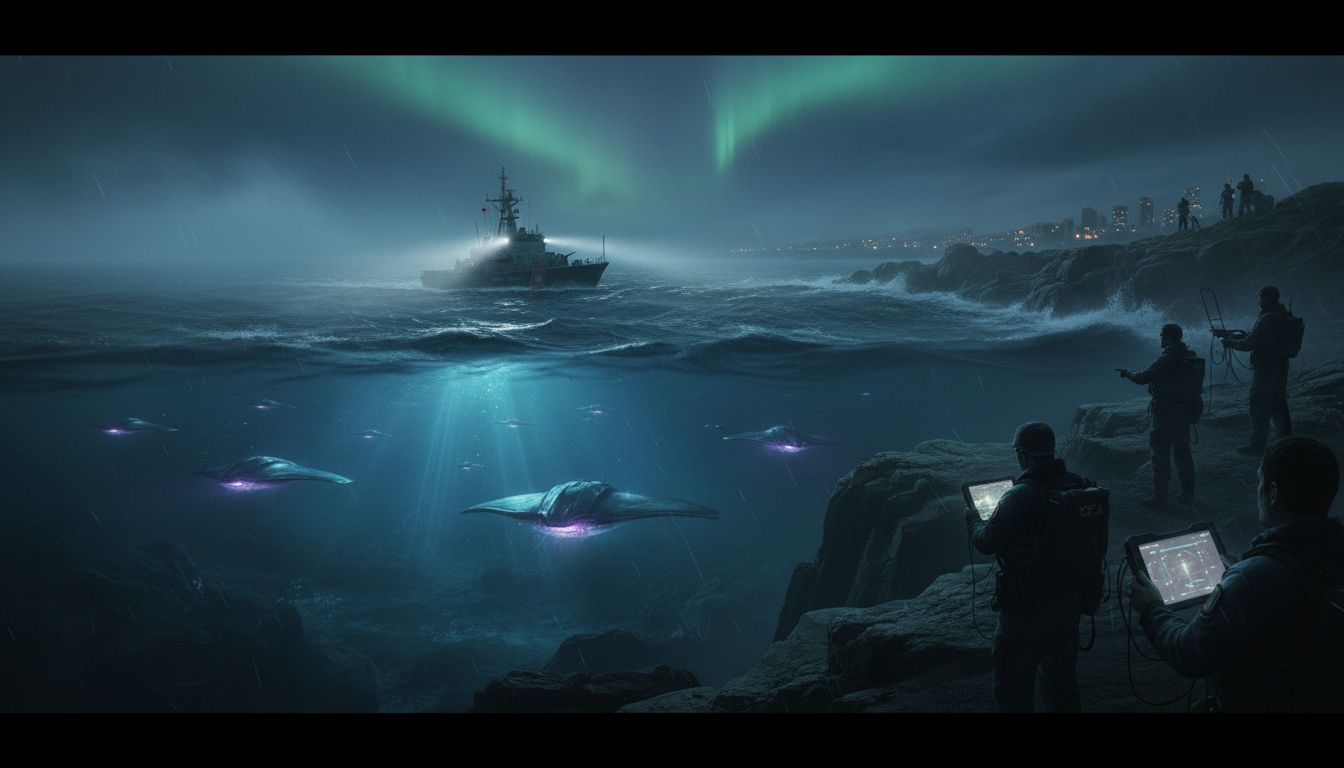
A crowdsourced “UFO tracker” app has logged thousands of unidentified underwater objects along the Atlantic and Pacific coasts of the United States, according to a report released on May 14, 2026. Users of the free‑downloadable platform recorded anomalous contacts ranging from a few meters to over 30 metres in length, at depths between 200 and 1,500 feet. The aggregated data, spanning the past six months, suggests a pattern of repeated sightings in waters off New York, New Jersey, California, and Washington state. While the app’s developers caution that the observations are unverified, the sheer volume of reports has sparked renewed discussion about possible non‑conventional technology operating beneath the ocean’s surface.
How the Data Was Collected
The tracker app, marketed as a citizen‑science tool for “underwater anomalous phenomena,” uses a combination of sonar pings, acoustic recordings, and user‑submitted video clips. Participants activate the app while on fishing vessels, research boats, or personal watercraft; the software then timestamps and geotags each detection. In total, the database now contains over 4,200 entries, with roughly 60 % classified as “unidentified” after automated filtering removed known marine life, debris, and routine vessel traffic.
One frequent description notes objects moving silently in a straight line at speeds up to 25 knots, then abruptly changing direction without visible propulsion. A sample video, released by the app’s founder, shows a dark, torpedo‑shaped silhouette gliding just above the seabed, illuminated only by the boat’s navigation lights. The app’s creator, software engineer Maya Patel, said, “We’re not claiming these are alien craft, but the consistency of the reports warrants a systematic scientific review.”
Official Response
Federal and state agencies have so far not confirmed the sightings. A spokesperson for the National Oceanic and Atmospheric Administration (NOAA) indicated that the organization is reviewing the data but emphasized that “extraordinary claims require extraordinary evidence.” Similarly, the U.S. Navy’s Office of Naval Intelligence declined to comment on the specific reports but reiterated its ongoing monitoring of unidentified submerged phenomena (USP) under the Unidentified Aerial Phenomena (UAP) Task Force, now expanded to include underwater domains.
Coast Guard District‑One Command issued a brief statement: “We are aware of the public interest in these reports and are coordinating with relevant scientific bodies to assess any potential safety concerns for maritime operations.” No formal investigation has been launched, and officials stress that the data must be corroborated with independent sensor readings before any conclusions can be drawn.
Expert Perspectives
Marine biologists caution against jumping to extraterrestrial explanations. Dr. Elena García, a professor of marine ecology at the University of Maryland, noted, “Many deep‑sea organisms produce acoustic signatures that can be misinterpreted as mechanical. Bioluminescent swarms, for example, can appear as moving silhouettes on low‑light video.”
Former Navy sonar analyst Lt. Cmdr. James Whitaker (ret.) offered a different angle, suggesting that some contacts could stem from unidentified autonomous underwater vehicles (UAVs) being tested by private firms. “The speed and maneuverability reported are within the realm of advanced AUVs, which are increasingly operating in civilian waters for research and commercial purposes,” he said.
Conversely, a handful of ufologists view the data as a potential breakthrough in underwater UAP research, pointing to the 2020 “Lake Michigan anomaly” where unexplained sonar echoes prompted a limited Navy study. “If these are indeed non‑human technologies, the underwater environment provides a natural shield from conventional detection methods,” remarked UAP researcher Dr. Maya Rios of the Center for Aerial Phenomena Studies.
Next Steps and Context
The report arrives amid a broader governmental push to catalog anomalous phenomena after the 2023 Pentagon release of the Preliminary Assessment on UAPs. While that document focused on aerial sightings, it explicitly called for multidisciplinary investigations, including oceanic domains. Scientists and policymakers alike agree that rigorous, peer‑reviewed analysis is essential.
The UFO tracker team has invited NOAA, the Navy, and independent research institutions to access the raw dataset for validation. In the meantime, the app continues to collect data, urging users to follow standardized recording protocols to improve the reliability of future submissions. As the investigation unfolds, the maritime community watches closely, balancing curiosity with the practical need to ensure navigational safety in U.S. waters.


