Overview
A former senior fighter pilot has ended a 45‑year silence to describe a close encounter with an unidentified aerial phenomenon (UAP) while on a routine patrol near a U.S. nuclear weapons installation. According to the pilot, a 50‑foot triangular craft hovered at low altitude, emitted bright, pulsating lights, and executed maneuvers that exceeded the performance envelope of any known aircraft. The disclosure, made in a televised interview and corroborated by a written statement, adds a new, high‑profile testimony to a growing body of military UAP reports that have surfaced since the Pentagon’s 2023 unclassified assessment.
The Pilot’s Account
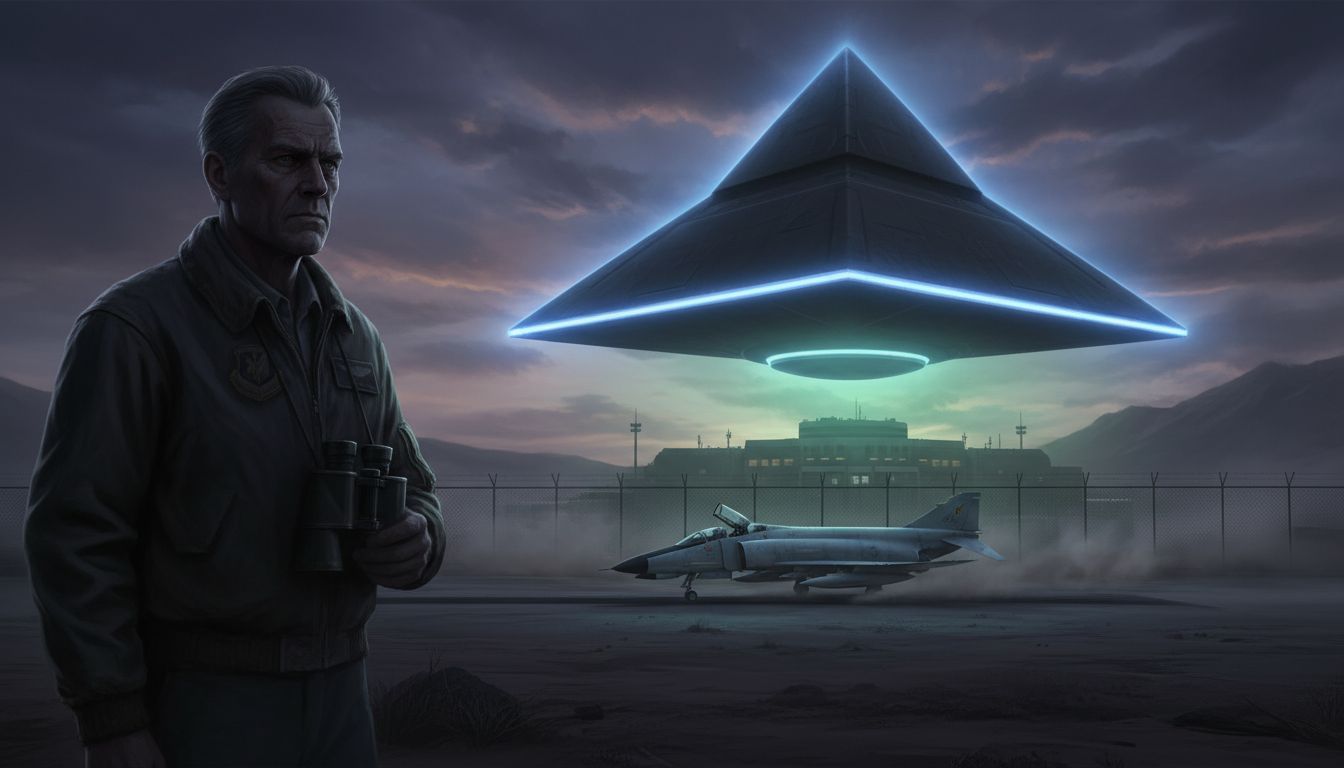
The pilot, who asked to remain unnamed for security reasons, said the incident occurred in early 1980, during a night training sortie over the perimeter of the Pantex Plant, a key component of the United States’ nuclear arsenal. He described the object as a “large, dark‑metal triangular shape, roughly the size of a small house, with three bright white lights at each corner and a central pulsating beacon.”
According to his testimony, the craft hovered silently for approximately 30 seconds, then accelerated laterally at an estimated Mach 2.5 without any visible propulsion or aerodynamic disturbance. “It turned on a dime, vanished from our radar, and re‑appeared a few miles away,” he recalled. The pilot reported that his aircraft’s onboard sensors failed to lock onto the object, and that no other aircraft or ground‑based radar recorded the encounter at the time. He said he filed an internal report in 1980, which was classified and never released to the public.
Context of Military UAP Reports
The pilot’s revelation arrives amid heightened congressional and public interest in UAPs. In June 2023, the Office of the Director of National Intelligence released a preliminary assessment noting 144 UAP incidents involving military personnel since 2004, many of which displayed “flight characteristics that defy our current understanding of aeronautics.” More recently, a U.S. Senate Armed Services Committee hearing in March 2025 featured testimonies from former Navy pilots who described similar triangular objects near sensitive installations.
Historically, the “triangular UFO” motif dates back to the 1980s “Phoenix Lights” and the 1997 “Belgian Wave,” both of which involved large, silent, low‑altitude craft with bright illumination. The pilot’s description aligns with these earlier reports, suggesting a possible pattern of sightings near strategic sites.
Official Response and Skepticism
The Department of Defense, through a spokesperson for the All‑Domain Anomaly Resolution Office (AARO), acknowledged receipt of the pilot’s statement but declined to comment on specific details, citing “operational security.” AARO officials reiterated that investigations are ongoing and that conclusive identification of many UAPs remains elusive.
Defense analysts caution against drawing definitive conclusions. Dr. Megan Collins, a senior researcher at the National Institute for Aerospace Studies, noted that “the lack of contemporaneous radar data or corroborating sensor logs makes it difficult to verify the physical characteristics of the craft.” She added that instrumentation failures during high‑stress flight operations are not uncommon and can sometimes be misinterpreted as anomalous phenomena.
Implications and Next Steps
If substantiated, the pilot’s account could have significant security implications, given the proximity to a nuclear weapons complex. The incident underscores longstanding concerns within the defense community about potential foreign or non‑human technologies operating near critical infrastructure.
Congressional leaders have called for greater transparency and enhanced data collection at restricted sites. The U.S. Senate’s Subcommittee on Emerging Threats is slated to hold a follow‑up hearing in early 2026, focusing on “UAP activity around strategic assets.” Meanwhile, the pilot’s disclosure may encourage other retired service members to come forward, potentially enriching the evidentiary pool that AARO and other agencies rely on for analysis.
As the investigation proceeds, the balance between national security and public accountability will shape how, and how quickly, the mystery of the “50‑foot triangular craft” is resolved.