Overview
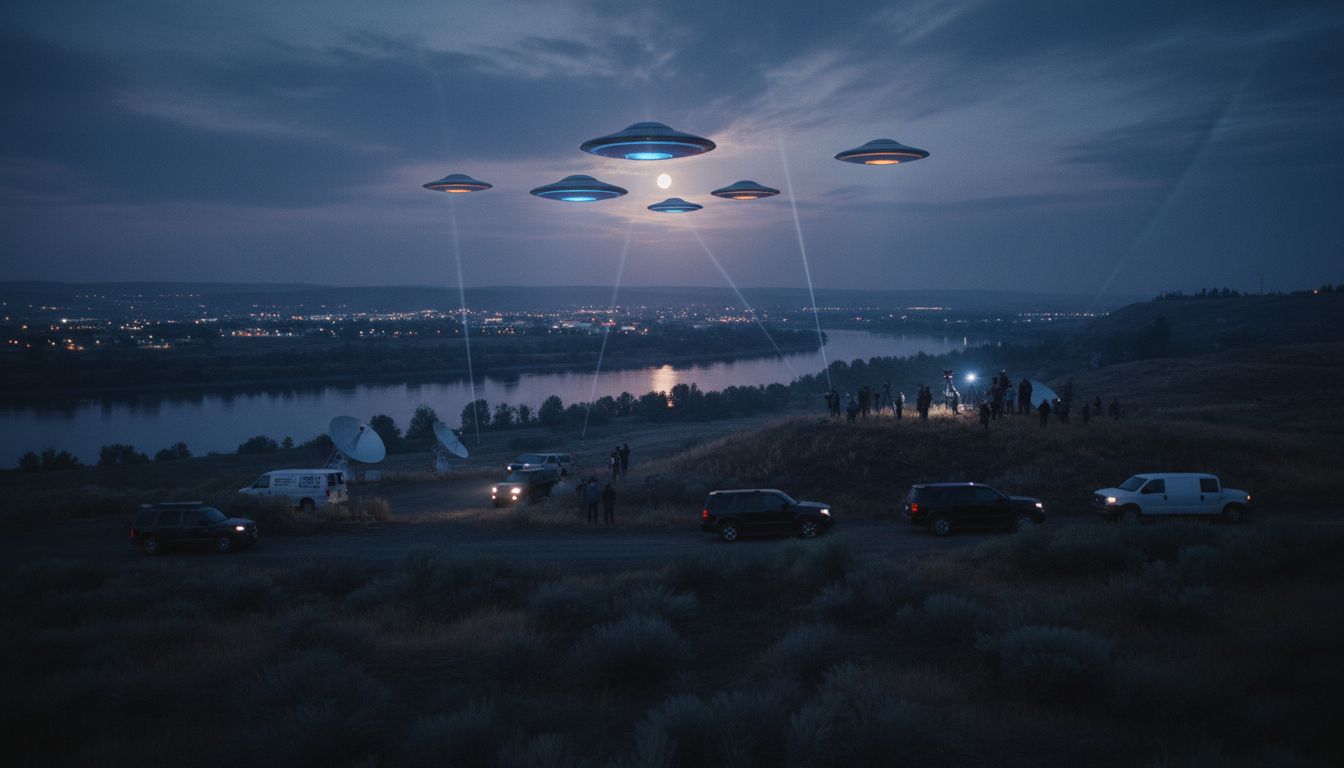
The Tri‑Cities region of southeastern Washington—comprising Kennewick, Pasco, Richland and surrounding communities—has found itself at the center of a growing national conversation about unidentified aerial phenomena (UAP). According to the latest data released by the National UFO Reporting Center (NUFORC), Washington now ranks second nationwide in reported sightings, trailing only California. The surge in reports has prompted local media outlets, including NEWStalk 870, to spotlight the area as a potential “UFO hotspot,” and has drawn the attention of both amateur investigators and professional researchers.
Reporting Trends
NUFORC’s year‑to‑date figures show that Washington residents filed 1,274 sighting reports in 2023, a 38 % increase over the previous year and well above the national average of roughly 0.8 reports per 1,000 residents. The state’s jump to the #2 spot follows a broader uptick in UAP reporting across the Pacific Northwest, a region already known for its clear skies and extensive aviation activity. The agency attributes the rise partly to the expansion of its online reporting platform and heightened public awareness after the release of the Pentagon’s UAP task‑force findings earlier this year.
Local Sightings
Tri‑Cities residents have described a variety of unexplained lights and objects over the past several months. On March 5, a farmer near Kennewick reported a “cluster of pulsating orange and white lights moving in a synchronized pattern at low altitude,” while a group of commuters on Interstate 182 observed “a silent, disc‑shaped object hovering for approximately three minutes before accelerating eastward at high speed.” Kennewick Police Department spokesperson Officer Laura Martinez confirmed that officers responded to multiple calls but were unable to verify any conventional aircraft or weather‑related explanations. “We coordinate with the FAA and local air traffic control on every report,” Martinez said, “but so far none of these incidents have matched known flight plans or meteorological events.”
Expert Analysis
UAP researcher Dr. Elena Ramirez, who leads the Pacific Northwest UAP Study Group, cautions against jumping to extraterrestrial conclusions. “The data show a genuine increase in credible reports, but many can be attributed to misidentified drones, atmospheric phenomena, or classified military testing,” Ramirez explained. She added that Washington’s proximity to several Air Force and Navy testing ranges, including the nearby Naval Air Station Whidbey Island, could account for some of the anomalous observations. Nonetheless, Ramirez emphasizes the importance of systematic documentation: “When multiple, independent witnesses provide consistent details—time, altitude, maneuverability—that information becomes valuable for scientific inquiry.”
Looking Ahead
In response to the mounting interest, the Tri‑Cities City Council has scheduled a public hearing on April 22 to discuss community concerns and to coordinate with state and federal agencies on data collection. Meanwhile, the Washington State Department of Transportation has pledged to share radar data with NUFORC and local investigators, aiming to improve the verification process for future sightings. Residents are encouraged to submit reports through NUFORC’s online portal or the newly launched state‑run “UAP Washington” app, which includes a geotagging feature to help researchers map activity patterns more accurately.
As the region continues to attract both curiosity and scrutiny, officials stress that rigorous, transparent investigation remains the best path forward. Whether the Tri‑Cities will ultimately be labeled a “hotspot” or simply a well‑documented case study in modern UAP reporting, the ongoing collaboration between citizens, law‑enforcement, and scientific experts underscores a renewed commitment to understanding the skies above Washington.