Overview
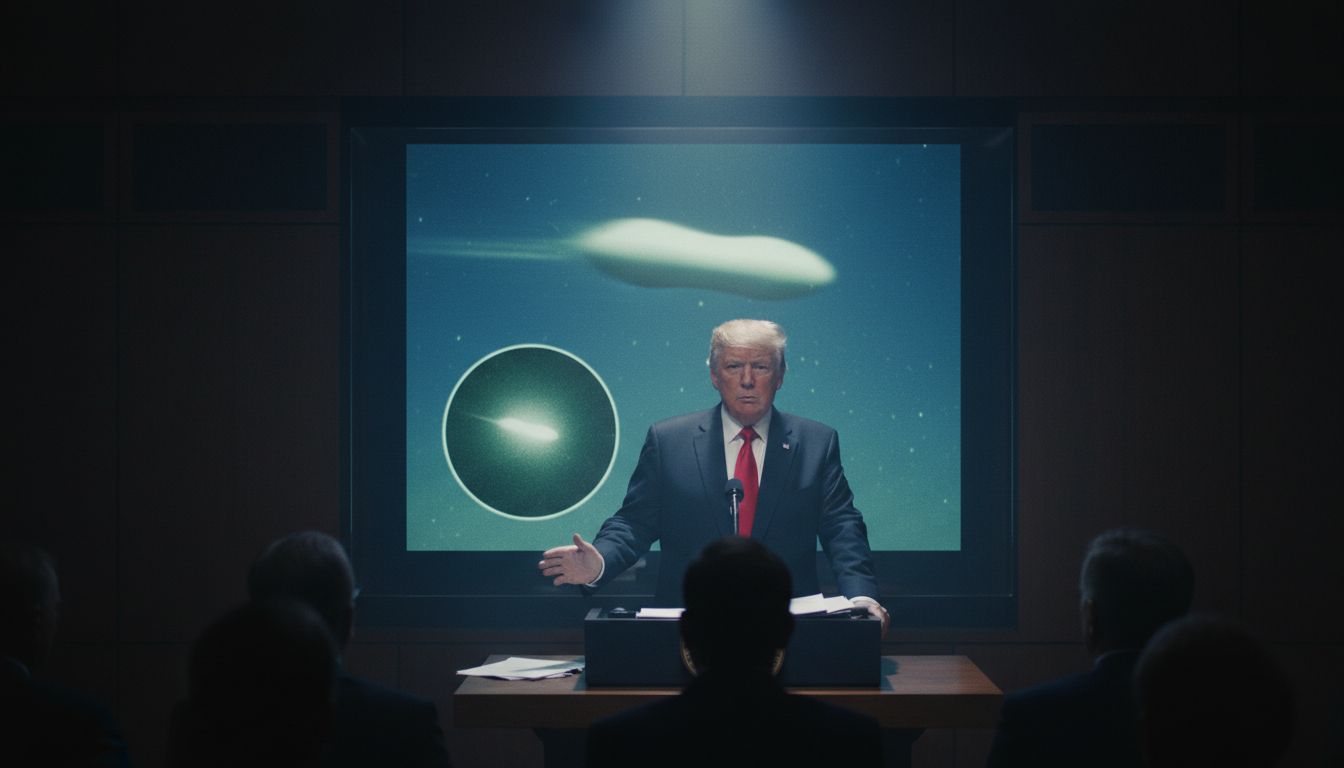
Former President Donald Trump sparked a fresh wave of public interest in unidentified aerial phenomena (UAP) after suggesting he could authorize the release of a large cache of classified UFO documents. Speaking at a fundraiser in Florida on April 14, Trump referenced the widely discussed “Tic‑Tac” sighting by Navy pilots and a recently declassified Pentagon video that shows an unidentified object maneuvering at high speed. His comments arrived just weeks after the Department of Defense’s All‑Domain Anomaly Resolution Office (ADARO) disclosed additional footage from 2022, reigniting calls for greater government transparency on the subject.
Trump’s Remarks
During the event, Trump told supporters, “We have more files than anyone’s ever seen about these things. If I decide to put them out there, the American people will finally know what’s really happening.” He did not specify a timeline or the scope of the material, but the implication was clear: a potential “UFO file dump” could be on the table if he returns to office or influences the current administration. A spokesperson for the former president declined to comment further, noting that any release would have to respect national‑security protocols.
Recent Pentagon Revelations
The Pentagon’s latest disclosures include a high‑resolution version of the “GoFast” video, captured by a US Navy EP‑3E aircraft in 2022, and a new short clip showing a spherical object performing abrupt, non‑aerodynamic maneuvers over the Atlantic. These releases follow the 2023 congressional report from the Senate Armed Services Committee, which acknowledged that UAPs pose “potential flight‑safety and national‑security risks.” The report documented 144 sightings by military personnel between 2004 and 2022, with a majority remaining unexplained after analysis.
Reactions and Calls for Transparency
The reaction from lawmakers and experts has been measured but pointed. Senator Lisa Murkowski (R‑AK), a longtime advocate for UAP disclosure, said, “If the former president can help accelerate the declassification process, it would be a welcome step toward the transparency the American public deserves.” Conversely, Defense Department officials cautioned that premature release of classified material could compromise intelligence sources and methods. Dr. David Spergel, an astrophysicist at the Institute for Advanced Study, emphasized the scientific value of the data, noting that “rigorous, peer‑reviewed analysis is essential before drawing any conclusions about extraterrestrial origins.”
Outlook
While Trump’s tease has energized both UFO enthusiasts and skeptics, the practical hurdles remain significant. The National Archives and Records Administration (NARA) maintains that any declassification must undergo a multi‑agency review, a process that can take months or even years. Moreover, the current administration has signaled a willingness to continue the ADARO’s work, with a scheduled briefing to the House Intelligence Committee later this month. Whether Trump’s influence will translate into an actual “file dump” or simply add pressure to ongoing efforts is still uncertain, but the episode underscores a growing bipartisan consensus that the mystery of UAPs cannot be ignored indefinitely.


