Overview
In a recent interview for NewsNation’s “The Truth of the Matter,” Harvard‑Smithsonian astrophysicist Avi Loeb examined three topics that have resurfaced in the public discourse on unidentified aerial phenomena (UAP): the newly released Trump‑administration UAP files, a series of reported underwater UFO sightings, and a provocative hypothesis that extraterrestrial life may have become extinct on Earth. Loeb, whose 2021 book Extraterrestrial argued that interstellar object ‘Oumuamua could be an artificial probe, stressed that each of these subjects warrants rigorous scientific scrutiny, rather than dismissal as fringe speculation.
Trump Administration UAP Files
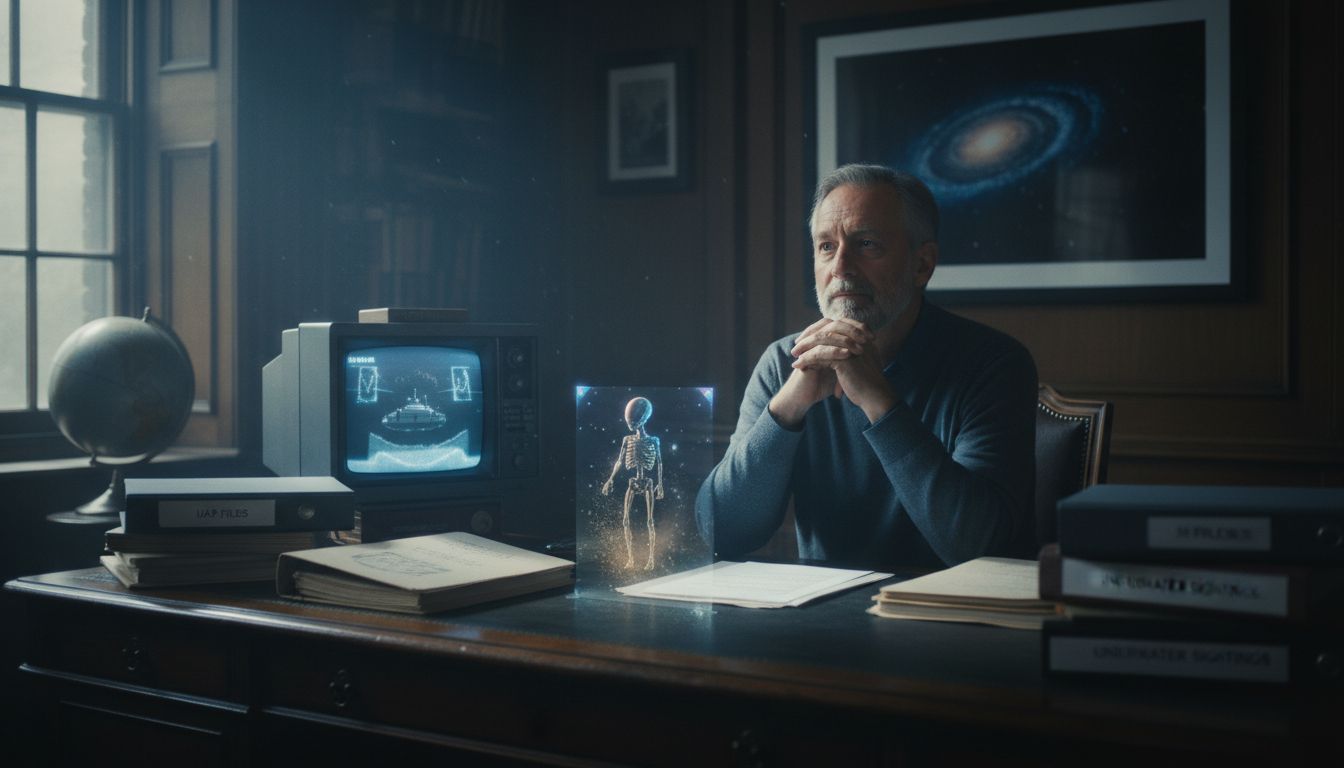
The National Archives released a batch of declassified documents from the Trump era, covering more than 200 UAP incidents reported between 2017 and 2021. The files include radar logs, pilot testimonies, and video clips captured by Navy F/A‑18s. Loeb highlighted that “the sheer volume of data, combined with the credibility of the sources—active‑duty pilots, seasoned radar operators, and senior defense officials—creates a record that cannot be ignored.” He noted that many of the entries describe objects exhibiting accelerations far beyond known aircraft capabilities, as well as flight paths that defy conventional aerodynamics. While the government has yet to issue a definitive explanation, Loeb argued that the files provide a starting point for systematic, peer‑reviewed analysis.
Underwater UFO Sightings
Parallel to the aerial reports, Loeb referenced a growing collection of underwater observations compiled by marine research institutes and independent citizen‑science groups. These sightings involve luminous, high‑speed objects detected by sonar arrays and low‑light cameras in the Pacific and Atlantic oceans. “In several cases, the objects performed sharp turns and rapid ascents that are inconsistent with known marine technology,” Loeb said. He cautioned that the ocean’s opacity makes verification difficult, but emphasized that “the convergence of acoustic signatures and visual data suggests a phenomenon that merits multidisciplinary investigation involving oceanographers, physicists, and engineers.”
The Extinct‑Aliens Hypothesis
Perhaps the most speculative element of the interview was Loeb’s suggestion that Earth may have once hosted an extraterrestrial civilization that subsequently vanished. Drawing on geological records of rapid, global events—such as the Permian‑Triassic extinction—Loeb proposed that an advanced, non‑human biosphere could have been eradicated by a catastrophic event, leaving only indirect traces. He cited anomalous isotopic ratios found in certain sediment layers as “potential signatures of technology that differ from natural processes.” While acknowledging the hypothesis is “far from proven,” Loeb argued that dismissing it outright hinders the exploratory mindset essential to scientific progress.
Call for Scientific Rigor
Across all three topics, Loeb’s central message was clear: anomalous phenomena should be approached with the same methodological standards applied to any frontier science. He urged funding agencies to allocate resources for open‑access data repositories and for the formation of interdisciplinary panels that can evaluate UAP evidence without political bias. “We have the tools—high‑resolution sensors, advanced data analytics, and a global network of observers—to move beyond anecdote,” Loeb asserted. He also warned that “politicizing the issue or relegating it to the realm of conspiracy risks missing a potential paradigm shift in our understanding of life in the universe.”
Looking Ahead
The release of the Trump‑era files, combined with emerging underwater reports and bold new hypotheses, signals a growing momentum in the study of unidentified phenomena. While definitive answers remain elusive, the conversation is shifting from fringe speculation to mainstream scientific inquiry. As Loeb concluded, “If we are to answer whether we are alone, we must first be willing to examine the evidence wherever it appears—sky, sea, or stone.” The next few years may therefore prove pivotal, not only for UFO research but for the broader quest to comprehend humanity’s place in the cosmos.