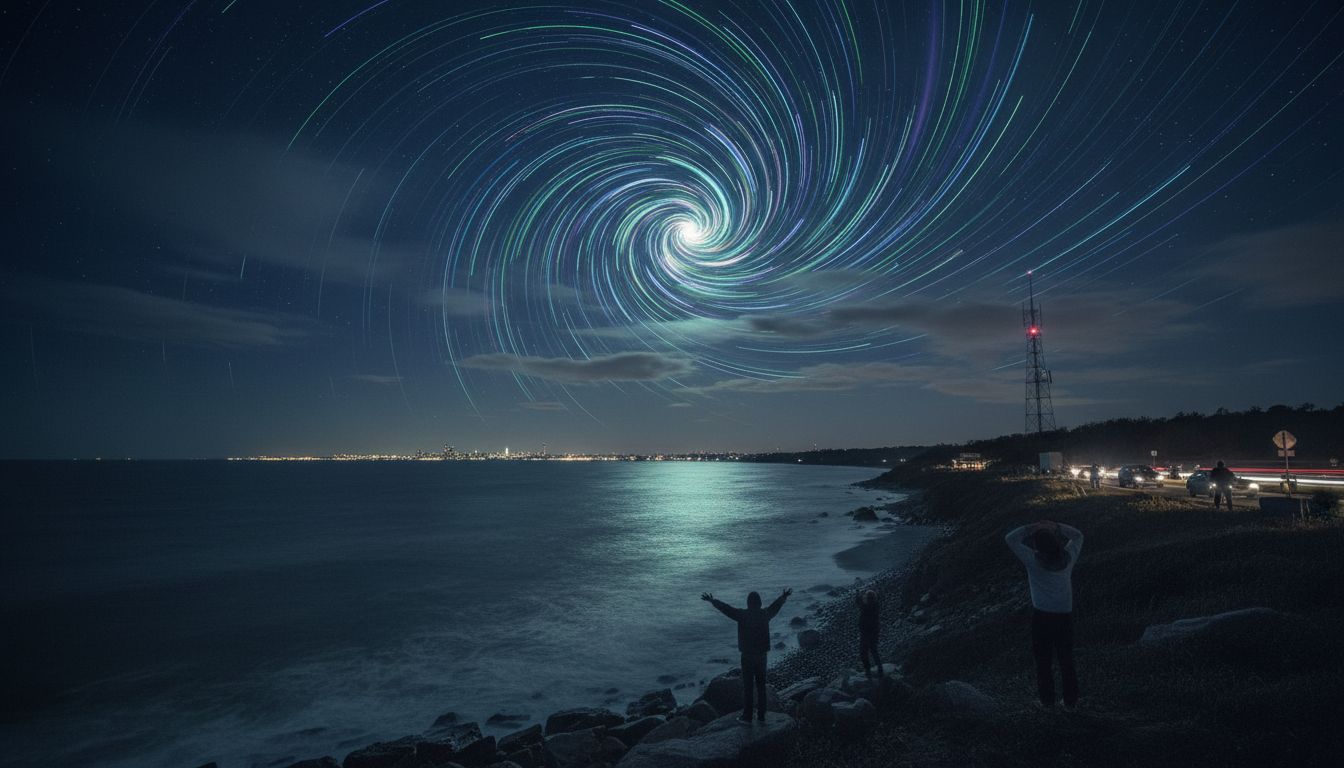
A bright, swirling display lit the night sky over the Mid‑Atlantic on Tuesday, prompting dozens of calls to New Jersey’s 101.5 FM news desk and social‑media posts that stretched from Boston to Virginia. Listeners described a “moving ribbon of light” that appeared around 10 p.m. Eastern Time and lingered for several minutes before fading. While the phenomenon was visible across a broad swath of the East Coast, state and federal officials have yet to issue a formal explanation, leaving residents to wonder whether the spectacle was natural, man‑made, or something else entirely.
The most plausible explanation offered by aerospace analysts ties the display to the recent Ariane 6 launch from the Guiana Space Centre in French Guiana. The Ariane 6, Europe’s newest heavy‑lift vehicle, lifted off on Tuesday afternoon carrying a communications payload for a commercial operator. According to a statement from the European Space Agency (ESA), the launch’s second stage is expected to perform a controlled re‑entry over the Atlantic Ocean, a maneuver designed to minimize debris risk. When large rocket components re‑enter the atmosphere, the intense friction can generate luminous trails that, under the right conditions, are visible thousands of miles away. “A re‑entry event of this magnitude can produce a spectacular fireball that appears as a slow‑moving, rotating ribbon of light,” explained Dr. Elena Martínez, a senior researcher at the University of Maryland’s Space Science Center.
Local authorities have confirmed that no official alerts were issued for the night. The Federal Aviation Administration (FAA) and the National Oceanic and Atmospheric Administration (NOAA) both noted that the re‑entry was “planned and within safety parameters,” but they declined to provide a detailed timeline, citing ongoing coordination with ESA. “We monitor all re‑entry events that could affect the public,” said FAA spokesperson Mark Whitaker. “When a vehicle’s trajectory is over open water, the risk to people on the ground is negligible, and we typically do not issue public warnings unless debris is projected to land.” The agency’s lack of an immediate public notice likely contributed to the surprise among observers.
Social media amplified the mystery, with hashtags such as #EastCoastLights and #Ariane6 trending on Twitter within minutes of the sighting. Residents in New Jersey, New York, and Pennsylvania posted videos showing a faint, spiraling glow that seemed to pulse as it crossed the horizon. “I thought it was a UFO at first,” said Amanda Liu, a commuter in Newark who recorded the event on her phone. “It moved too slowly to be a plane and too bright to be a meteor.” Such reactions are common when large re‑entry events occur; similar sightings were reported after the 2023 launch of SpaceX’s Starlink satellites, which also produced visible trails over the continental United States.
Experts caution against jumping to conclusions about extraterrestrial activity, emphasizing that atmospheric re‑entries are a well‑understood source of night‑time illumination. “The physics are straightforward: a vehicle re‑enters at hypersonic speeds, the outer skin heats up, and the resulting plasma emits light,” said Dr. Martínez. “What makes this event noteworthy is the public’s heightened awareness of space activities and the increasing frequency of launches that produce such visible effects.” As commercial and governmental launch cadence accelerates, observers across the globe may see more of these light shows, prompting a need for clearer public communication from launch providers and regulatory bodies.
For now, the swirling lights remain a striking reminder of humanity’s growing presence in near‑Earth space. While officials have not released a definitive statement linking the Tuesday night display to the Ariane 6 re‑entry, the convergence of launch schedules, expert analysis, and eyewitness accounts points strongly in that direction. As the aerospace industry continues to expand, the night sky may become a regular canvas for the by‑products of our ventures beyond Earth, turning what once seemed extraordinary into a familiar, if still awe‑inspiring, part of modern life.