Overview
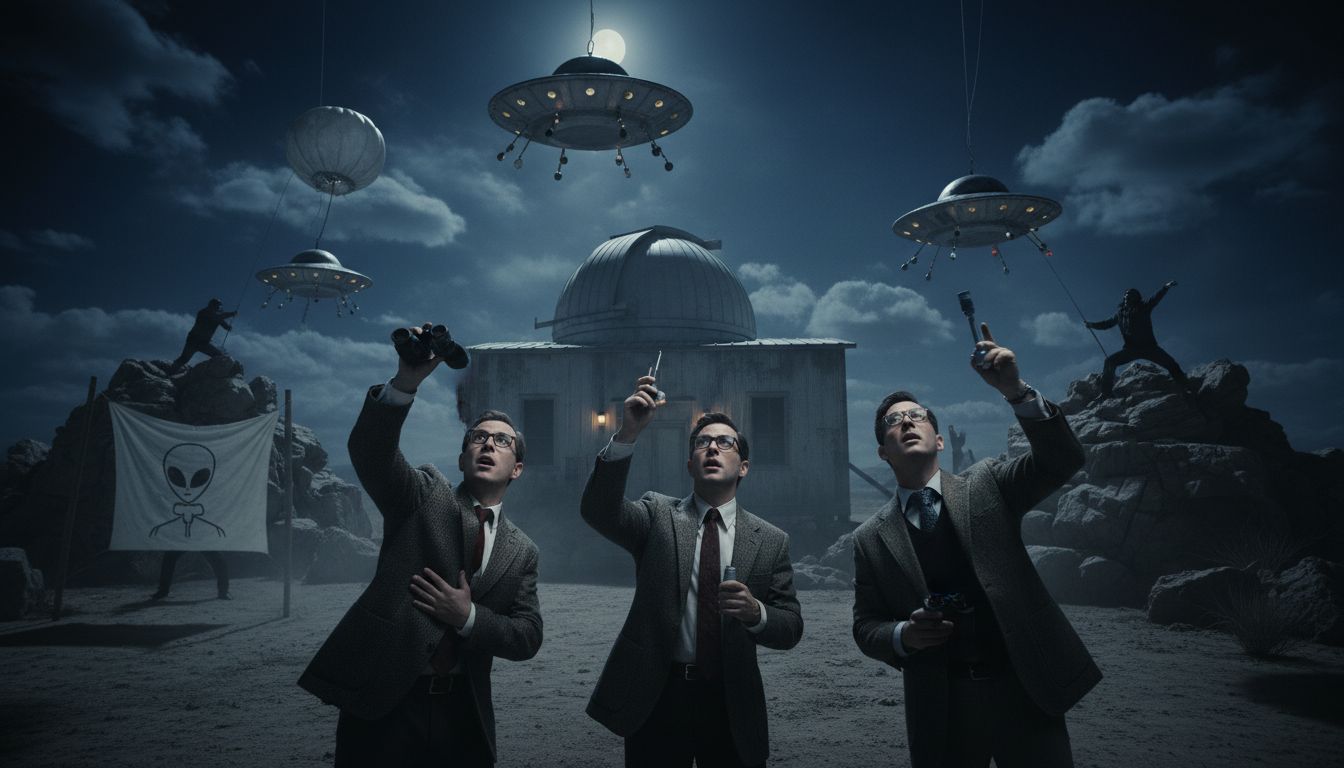
New Scientist’s weekly cartoon series Twisteddoodles published on 27 May 2026 offers a tongue‑in‑cheek illustration of how a fabricated UFO sighting could be used to “lure unsuspecting academics.” The single‑panel drawing shows a shadowy figure handing a glossy flyer titled “UFO Observation – Immediate Academic Study Required” to a bewildered professor, while a caption warns that “sensational claims can exploit scholarly curiosity.” Though presented humorously, the cartoon taps into a growing conversation about the need for scientific skepticism when extraordinary reports surface.
The Cartoon’s Premise
Created by the anonymous artist collective behind Twisteddoodles, the illustration satirises a classic bait‑and‑switch tactic: a bogus extraterrestrial event is publicised, media outlets scramble for comment, and researchers—eager to be first on a potentially paradigm‑shifting topic—rush to publish papers before the facts are verified. The cartoon’s visual punchline is the professor’s expression, half‑amused and half‑alarmist, underscoring how even seasoned scholars can be drawn into “UFO‑flavored” research without rigorous vetting. As the artist notes on the New Scientist page, “We wanted to highlight how easy it is for a well‑crafted hoax to become a headline and a grant proposal in a matter of days.”
Academic Curiosity and UFO Research
Interest in unidentified aerial phenomena (UAP) has surged since the U.S. Department of Defense released an unclassified report in 2021 and several governments announced formal investigations. Universities worldwide have responded with dedicated research centers, such as the University of Colorado’s UAP Studies Initiative, and a modest increase in peer‑reviewed papers on anomalous aerial observations. While many scholars argue that a systematic, data‑driven approach could yield insights into atmospheric physics or sensor technology, critics warn that the field is vulnerable to “confirmation bias” and “media‑driven hype.”
Dr. Elena Martínez, a physicist at the University of Barcelona who has published on atmospheric optics, told New Scientist, “UFO reports can be a legitimate source of data if we treat them as any other observational anomaly—subject to rigorous methodology and independent verification.” She added that the Twisteddoodles cartoon serves as a reminder that “the allure of a sensational story should never replace the discipline of peer review.”
The Role of Scientific Skepticism
The cartoon’s central message—skepticism is essential—resonates with long‑standing scientific principles. Historian of science Dr. James O’Leary, author of The Culture of Credulity, explains that “when an extraordinary claim appears, the burden of proof lies squarely on the claimant, not on the skeptic.” He cites the 1997 Phoenix Lights incident, where initial media frenzy prompted several universities to launch investigations that ultimately concluded the sightings were a combination of military flares and misidentified aircraft. “If researchers had rushed to publish without critical analysis, the episode could have polluted the literature for years,” O’Leary says.
The cartoon also subtly critiques the modern “publish‑or‑perish” environment, where academics may feel pressure to chase trending topics for funding and citation counts. By portraying the professor as both intrigued and wary, Twisteddoodles encourages scholars to ask: Is the data robust enough, or are we chasing a headline?
Broader Implications
Beyond academia, the illustration touches on public trust in science. In an era where misinformation spreads rapidly on social media, the line between genuine curiosity and sensationalism can blur. The New Scientist editorial team, which featured the cartoon, emphasizes that humor can be an effective tool for public education, prompting readers to question extraordinary claims before accepting them at face value.
As the UFO phenomenon continues to attract attention from governments, journalists, and the scientific community, the Twisteddoodles cartoon reminds us that critical thinking remains the best defense against deception—whether the deception originates from a prankster, a commercial interest, or an earnest but misguided researcher. By maintaining rigorous standards, scholars can ensure that any genuine anomalous observation, however rare, receives the thoughtful scrutiny it deserves.


