Overview
For more than three‑quarters of a century, reports of strange objects in the sky have moved from fringe speculation to a matter of national security. The term now used by Congress and the Pentagon—Unidentified Anomalous Phenomena (UAP)—reflects a shift from ridicule to formal investigation. Two veterans, Maj. Donald E. Keyhoe and Luis Elizondo, each in his own era, helped steer that transformation, turning a cultural joke into a policy agenda that now shapes federal reporting requirements and congressional oversight.
Key Figures
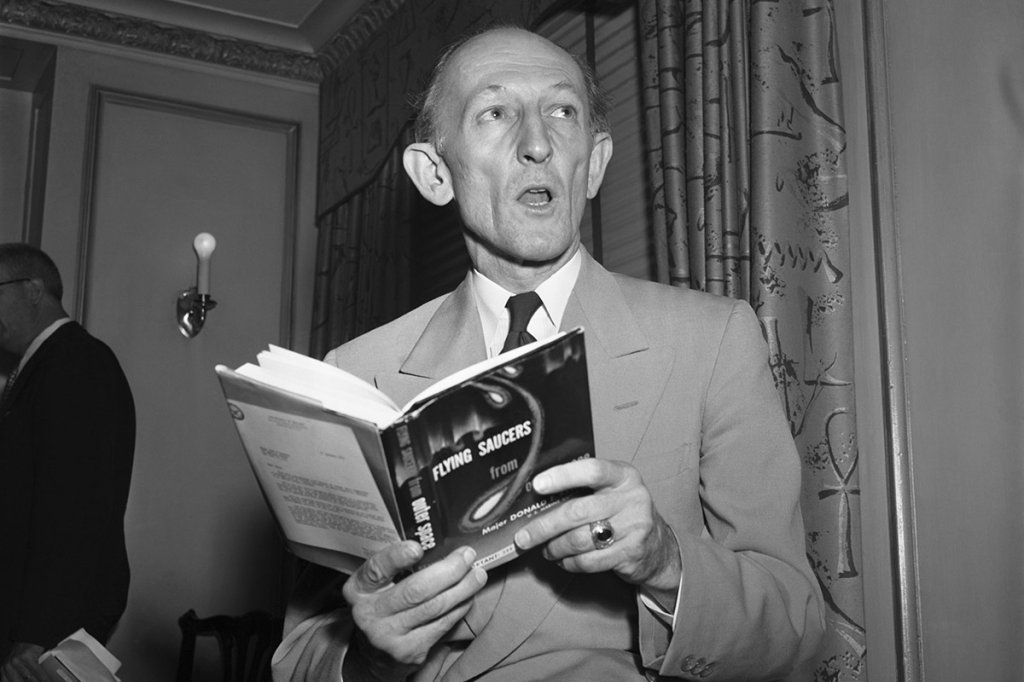
Born in 1897, Donald Edward Keyhoe graduated from the U.S. Naval Academy and served as a Marine Corps aviator during World II. After an injury forced his early retirement, he leveraged his aviation expertise as a journalist for the U.S. Naval Institute Proceedings and other mainstream outlets. Unlike many contemporaries who treated UFO sightings as sensationalist fodder, Keyhoe approached them with the rigor of an aerospace professional, arguing that dismissing credible reports could jeopardize national defense. His 1950 book, The Flying Saucer Conspiracy, and subsequent lobbying led the U.S. Air Force to launch Project Blue Book, the first systematic government study of UFOs.
Luis Elizondo, a former Army Counter‑Intelligence Special Agent, entered the UFO arena in the early 2010s. After a career that included service in Iraq and Afghanistan, he was recruited to lead the Pentagon’s Advanced Aerospace Threat Identification Program (AATIP), a classified effort funded from 2007 to 2012. When the program’s budget was cut, Elizondo continued to collect and analyze sightings, eventually bringing the material to public attention in 2020 through a series of interviews and congressional testimony. His insistence on “data‑driven transparency” pressured the Department of Defense to declassify several videos and to establish the All‑Domain Anomaly Resolution Office (AARO) in 2023.
From Hoax to Policy
The early UFO craze of the late 1940s was steeped in pop‑culture imagery—flying saucers, little green men, and speculative conspiracies. Keyhoe’s 1949 article in Popular Science was one of the first to argue that the phenomenon merited serious scientific scrutiny, citing pilot testimonies and radar contacts that could not be easily explained. His advocacy forced the Air Force to confront the possibility that unknown aerial technology—whether foreign or domestic—might be operating in U.S. airspace. Although Project Blue Book ultimately concluded that most sightings were misidentified conventional objects, the program set a precedent for systematic data collection that later veterans would build upon.
Decades later, Elizondo’s work shifted the conversation from curiosity to security. By presenting classified footage of “high‑speed, maneuverable objects” that defied known aeronautical performance, he forced lawmakers to ask whether the United States was adequately monitoring its own skies. The resulting UAP Task Force report to Congress in June 2021, and the subsequent National Defense Authorization Act provisions requiring annual UAP reporting, trace directly to the pressure generated by Elizondo’s public disclosures.
Impact on Federal Action
Both veterans’ efforts have culminated in concrete legislative and bureaucratic changes. In 2022, Congress passed the UAP Transparency Act, mandating the creation of an inter‑agency database and regular briefings to the intelligence committees. The Department of Defense’s 2023 establishment of AARO institutionalized the review of UAP incidents across air, space, and cyber domains, a scope far broader than the original Air Force‑only investigations of the 1950s.
Keyhoe’s legacy endures in the civil‑military partnership model that now underpins UAP reporting. Commercial pilots, NASA scientists, and private aerospace firms are encouraged to submit sightings through the UAP Reporting Portal, a system that mirrors the civilian‑military liaison Keyhoe advocated for in the 1950s. Meanwhile, Elizondo’s push for unclassified dissemination has led to the release of three official videos—“Gimbal,” “GoFast,” and “FLIR”—which have been analyzed by independent experts and cited in academic journals on aerospace anomalies.
Looking Ahead
The trajectory set by Keyhoe and Elizondo suggests that UAP scrutiny will continue to evolve from anecdotal accounts to a rigorous scientific discipline. The Pentagon’s upcoming fiscal year budget includes funding for advanced sensor networks and AI‑driven analytics aimed at reducing the “unknown” category in UAP databases. Congressional hearings slated for late 2026 will likely probe the effectiveness of AARO and the extent to which data sharing with allied nations is occurring.
While the phenomenon remains unexplained, the policy framework now in place reflects a decisive move away from the dismissive attitudes of the mid‑20th century. As former pilots and intelligence officers turn their observations into actionable intelligence, the United States is poised to address the national security implications of any aerial technology—known or unknown—with a level of transparency that would have been unimaginable to the early UFO enthusiasts of the 1940s.


