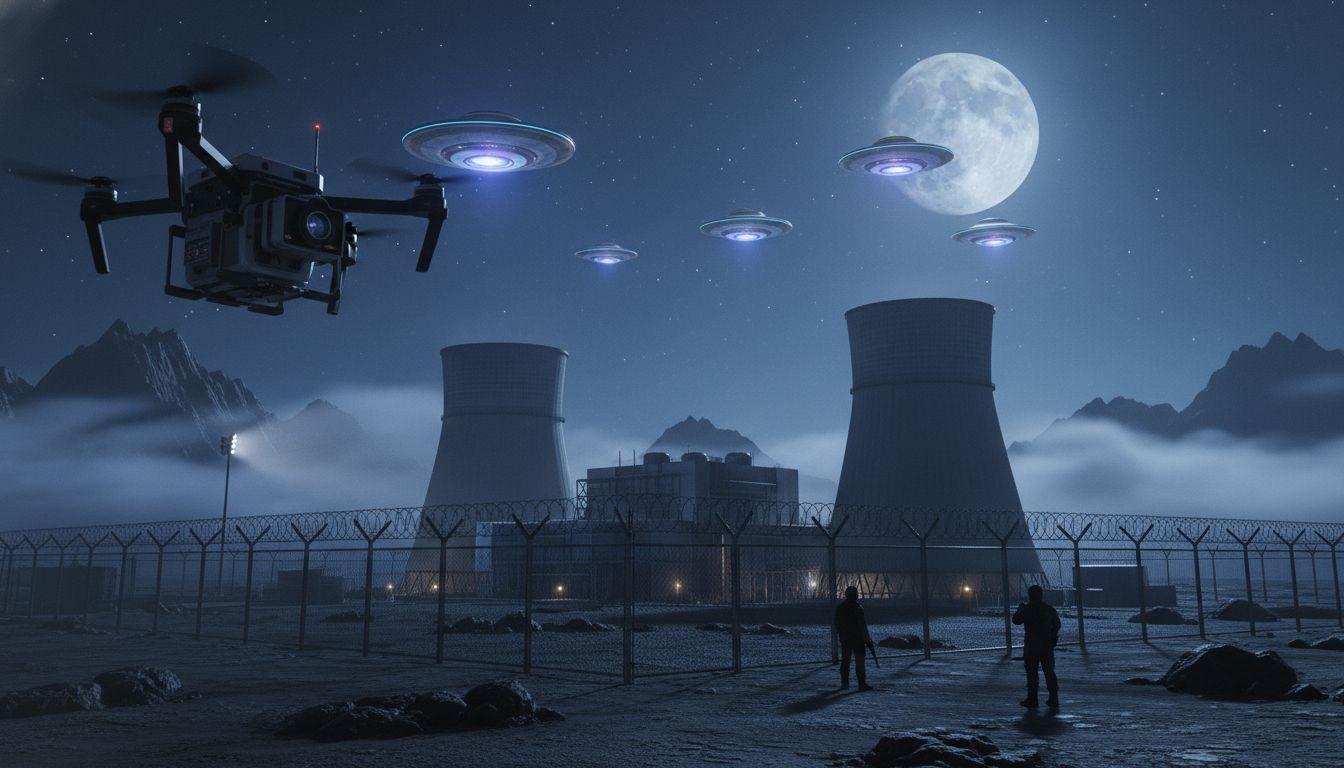
Recent peer‑reviewed research has added a measure of scientific rigor to a phenomenon that has long hovered on the fringe of mainstream discourse: the repeated observation of unidentified aerial phenomena (UAP) in the vicinity of nuclear facilities. The study, which appeared in a respected interdisciplinary journal earlier this month, systematically catalogues more than two dozen documented incidents spanning the United States, Europe, and Asia. Its authors argue that the concentration of sightings near power plants, enrichment sites, and weapons depots is statistically significant and merits focused investigation by both civilian and governmental bodies.
The research team, led by Dr. Elena Martínez of the Institute for Aeronautical Studies, compiled data from declassified government reports, eyewitness testimonies from plant personnel, and radar logs obtained through Freedom of Information Act requests. “When you map these events, a clear clustering emerges around high‑security, high‑energy installations,” Martínez explained in an interview. “It is not a random distribution; the pattern persists across decades and across different geopolitical contexts.” The paper notes that many of the encounters involve objects that exhibit flight characteristics—such as instantaneous acceleration, hypersonic speeds, and the ability to hover without visible propulsion—that are inconsistent with known aircraft or atmospheric phenomena.
The findings echo a body of anecdotal evidence that has been circulating among ufologists and former military personnel for years. Notable cases include the 1980s “Roswell‑style” lights observed over the Palo Verde Nuclear Generating Station in Arizona, the 2004 radar lock‑on at the European Organization for Nuclear Research (CERN) that triggered a temporary shutdown of a particle accelerator, and the 2010 visual encounter reported by a guard at the South Korean nuclear power plant, which was later corroborated by multiple infrared cameras. While none of these incidents have been definitively linked to extraterrestrial technology, their recurrence near sites that store or generate vast amounts of energy has prompted speculation about possible motivations—ranging from scientific curiosity to surveillance of humanity’s most potent power sources.
Ancient Origins, the popular science outlet that highlighted the study, emphasized the shift from speculative reportage to academically vetted analysis. “The peer‑review process serves as a filter, ensuring that the data meet rigorous standards of verification and reproducibility,” the site’s editorial team wrote. “This does not prove the existence of alien craft, but it does compel the scientific community to take the pattern seriously and allocate resources for systematic monitoring.” The article also referenced a recent briefing by the U.S. Department of Defense, in which the Pentagon acknowledged ongoing efforts to assess UAP threats to critical infrastructure, citing the need for “enhanced sensor coverage and inter‑agency data sharing.”
Policy experts caution that the implications of the study extend beyond curiosity. Dr. Samuel Reed, a security analyst at the Center for Strategic Energy Studies, warned that “if an unknown technology can approach a nuclear facility undetected, it raises legitimate concerns about potential sabotage, espionage, or unintended interference with reactor operations.” Reed advocates for a coordinated response that includes upgraded airspace monitoring, transparent reporting mechanisms for plant staff, and a dedicated research task force that bridges the gap between aerospace engineering and national security. Meanwhile, legislators in several states have introduced bills requiring utilities to report any anomalous aerial activity to the Federal Energy Regulatory Commission within 24 hours.
The peer‑reviewed validation of UAP sightings near nuclear sites marks a turning point in a debate that has long been characterized by anecdote and conjecture. By grounding the discussion in systematic data collection and statistical analysis, the study invites both the scientific establishment and policymakers to move beyond dismissive attitudes and consider concrete steps to safeguard critical infrastructure. As Dr. Martínez concludes, “Our goal is not to sensationalize but to illuminate a genuine knowledge gap. Understanding what is happening in our skies, especially over facilities that power the modern world, is essential for both scientific progress and public safety.”