Overview
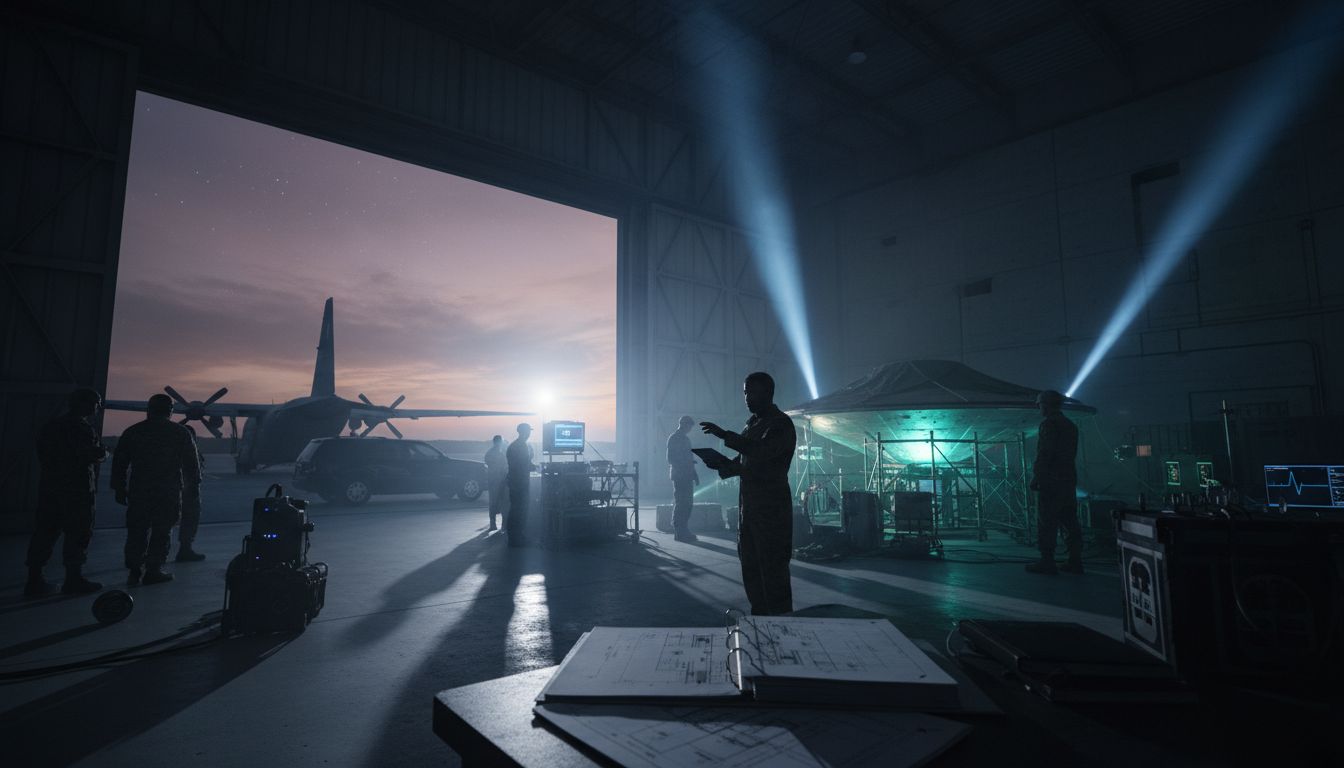
Liberation Times reports that an “exotic vehicle of unknown origin” has been stored for decades at Naval Air Station Patuxent River (commonly called Pax River) in Maryland. The claim, based on unnamed government and industry sources, ties the alleged craft to a series of stalled material‑transfer efforts that involved the CIA, Lockheed Martin, and Bigelow Aerospace. While the sources declined to describe the vehicle or disclose how it arrived at the base, they indicated that contingency plans exist to relocate the object should its location become publicly known.
Background on Pax River and UAP Documentation
Patuxent River is the headquarters of the Naval Air Systems Command (NAVAIR), the Navy’s senior acquisition organization for aviation research, development, testing, and sustainment. In 2020, NAVAIR’s FOIA reading room became the official repository for the now‑famous “Gimbal” and “GoFast” UAP videos, which had circulated for years before the Navy formally released them. The presence of these videos underscores the base’s role as a hub for evaluating unidentified aerial phenomena (UAP) and for coordinating any potential analysis of recovered material.
Alleged Transfer and CIA Involvement
Former director of the Pentagon’s Advanced Aerospace Threat Identification Program (AATIP), Luis Elizondo, testified before Congress that Patuxent River was among several sites prepared for a material transfer involving Lockheed Martin and Bigelow Aerospace. Elizondo said a hangar at the base had been specifically designed to move the material by air and by river. According to his testimony, the transfer—intended to spur technological breakthroughs—was blocked by the CIA’s Directorate of Science and Technology, which he described as the “original custodian” of the recovered objects, some of which date back to the 1950s. Elizondo added, “When the CIA intervened, the whole plan collapsed, and the material remained at the base under tight security.”
Congressional Voices and Ongoing Investigations
Recent statements from David Grusch, a former intelligence officer who publicly disclosed classified UAP information in 2023, and former CIA Director James Clapper echo concerns about transparency. Grusch has repeatedly warned that “there are objects in our custody that have never been publicly acknowledged,” while Clapper, speaking at a 2024 Senate hearing, noted that “the intelligence community has long recognized the need for a coordinated, scientifically rigorous approach to these phenomena.” Their comments lend credence to the notion that the Patuxent River storage claim is part of a broader, still‑unresolved effort to understand and possibly reverse‑engineer non‑human technology.
Legislative Action in Vermont
In parallel with federal discussions, a Vermont state legislator has introduced a bill to create a dedicated UFO investigative panel. The proposal calls for the panel to receive technical assistance from the Scientific Coalition for UAP Studies (SCU), a nonprofit that aggregates expertise from aerospace, physics, and engineering fields. If enacted, the panel would have authority to request records from the Department of Defense and to coordinate with existing federal bodies, mirroring the bipartisan push in Congress for a permanent UAP office.
While the Patuxent River claim remains unverified, the convergence of testimony from former officials, historical FOIA releases, and renewed legislative interest suggests that the U.S. government is gradually moving toward greater openness about unidentified aerial phenomena. Whether the alleged craft will ever be disclosed—or remain hidden behind “contingency plans”—is likely to hinge on future congressional oversight and the willingness of intelligence agencies to share classified findings with both lawmakers and the scientific community.


