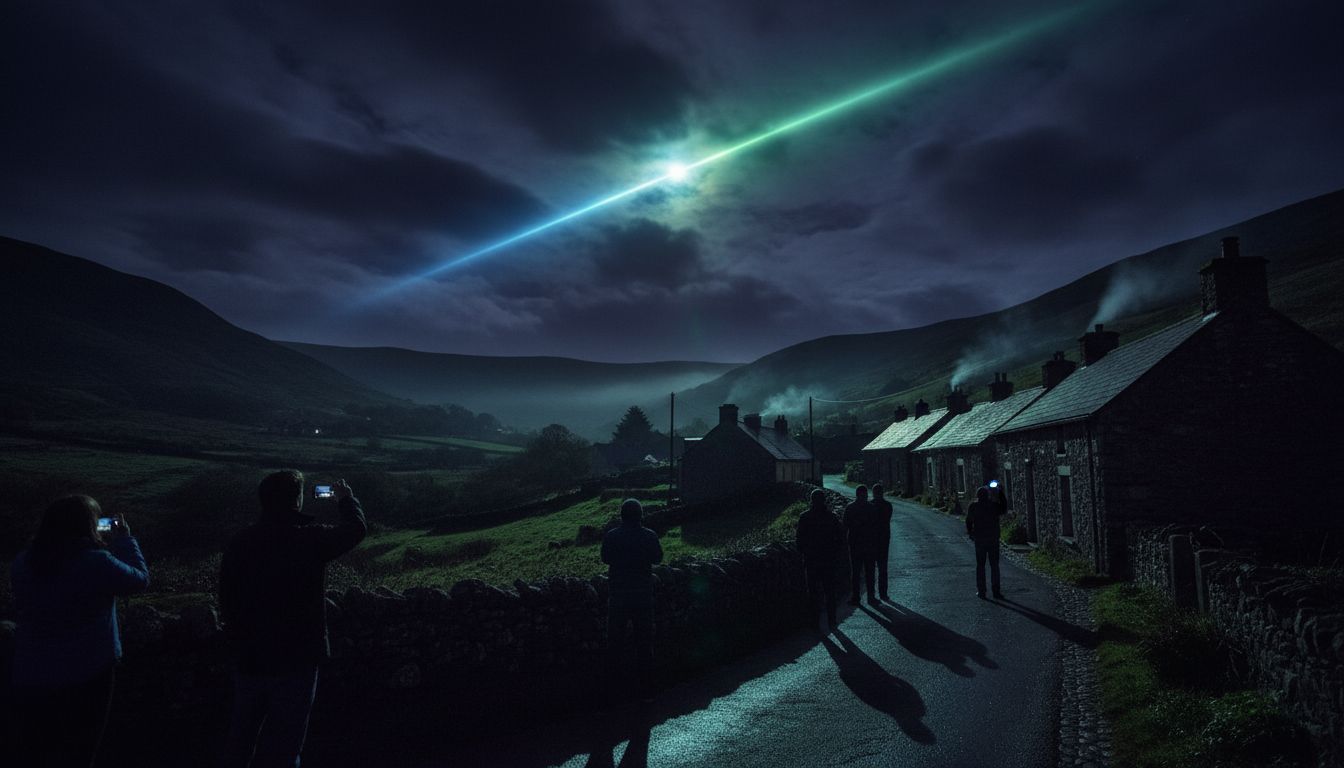
Reports of a bright, fast‑moving object streaking across the night sky poured in from towns and villages across the Republic of Ireland on the evening of 28 October. Witnesses described a “large, silent light” that seemed to dart “very quickly” before disappearing, prompting a surge of posts on social‑media platforms that were quickly tagged with #UFOIreland. The Irish Star compiled more than a dozen firsthand accounts, ranging from a farmer in County Mayo who said the light “lit up the whole field for a few seconds” to a commuter in Dublin who captured a brief video that shows a luminous disc moving erratically before vanishing against a backdrop of clouds.
The phenomenon has not been officially identified, and neither the Irish Aviation Authority (IAA) nor the Gardaí have issued a definitive explanation. An IAA spokesperson confirmed that no known aircraft or scheduled flights were operating in the reported area at the time, and that the agency is reviewing radar data to determine whether any unidentified aerial contacts were recorded. “We take all reports of unusual aerial activity seriously,” the spokesperson said, “but at this stage we have no conclusive evidence linking the sightings to any known object.” The Department of Defence also declined to comment, citing standard security protocols.
Meteorologists offered a more grounded hypothesis. Dr. Siobhán Kelley, a senior atmospheric scientist with Met Éireann, suggested that the sightings could be consistent with a bolide—a bright meteor that burns up in the upper atmosphere—combined with a low‑level cloud formation that can amplify the visual effect. “A bolide can produce a sudden, intense flash that lasts a few seconds, and if it passes through a thin cloud layer the light can appear to linger and move in a way that seems almost deliberate,” Dr. Kelley explained. She added that the timing of the event coincided with a minor meteor shower peak, although she cautioned that the lack of a sonic boom or lingering debris makes it difficult to confirm without further data.
Public reaction has been a mix of curiosity and caution. On X, a user identified only as “Liam K.” wrote, “I’ve lived in Kilkenny all my life and have never seen anything like that – could it be a secret drone test?” Others pointed to the growing interest in unidentified aerial phenomena (UAP) following the U.S. government’s recent declassification of several reports, noting that “the world is watching the skies more closely than ever.” Nonetheless, local officials emphasized the importance of waiting for a thorough investigation before drawing conclusions. “Speculation is natural, but we must rely on verified information,” the IAA spokesperson reiterated.
Ireland has a modest history of documented UFO sightings, most notably the 1998 “Mullingar lights” and the 2009 “Cork County fireball,” both of which were later attributed to natural atmospheric events after detailed analysis. The current wave of reports underscores a renewed public appetite for understanding unexplained aerial occurrences, especially as advances in sensor technology make it easier for ordinary citizens to capture and share visual evidence. Whether the October 28 event proves to be a meteor, an experimental aircraft, or something else entirely, authorities say the investigation remains ongoing, and any definitive findings will be released through official channels.