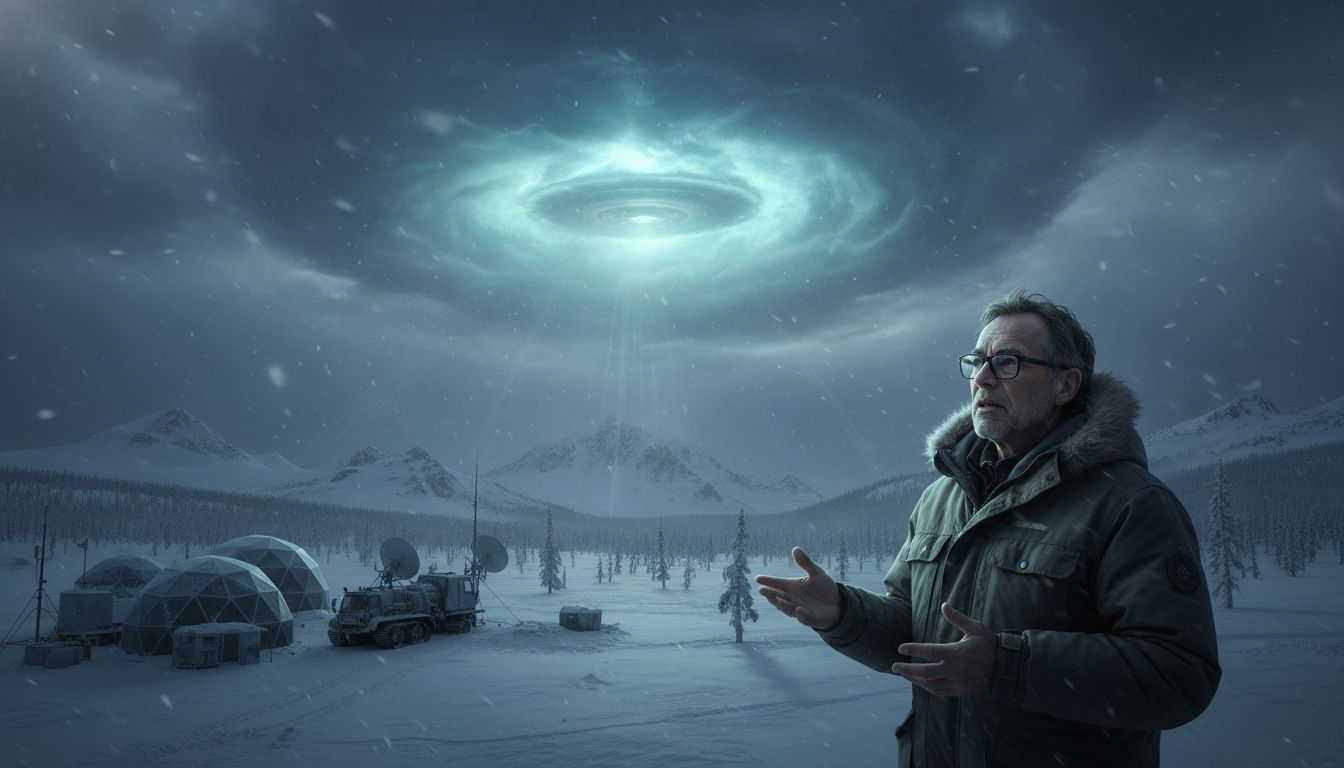
The sighting of an unidentified aerial phenomenon (UAP) over the Russian Federation on 24 April has reignited a debate that has lingered since the Cold War: how the scientific community should respond to reports that fall outside conventional explanations. The incident, captured by multiple civilian video recordings and corroborated by a regional air‑traffic control radar, showed a bright, disc‑shaped object executing rapid, non‑linear maneuvers at an altitude of roughly 12 kilometres before disappearing from view. While Russian authorities have not yet released an official statement, the footage quickly circulated on social media, prompting a prompt response from Dr. Elena Mikhailova, a senior researcher at the Institute for Atmospheric Physics in Moscow.
In an interview with a national news outlet, Dr. Mikhailova emphasized that “extraordinary claims require extraordinary evidence,” and warned against the temptation to jump to speculative conclusions. She called for a systematic collection of raw data—including high‑resolution video, radar logs, and any available electromagnetic signatures—so that independent analysts can apply rigorous statistical methods. “The first step is transparency,” she said. “If the data are made available in an open repository, peer‑reviewed studies can assess whether the observed behavior aligns with known atmospheric or technological phenomena, or whether it truly lies beyond our current models.” Dr. Mikhailova’s remarks echo a growing consensus among physicists and aerospace engineers that UAP investigations must be grounded in the same methodological standards that govern mainstream research.
The call for openness arrives at a moment when governments worldwide are beginning to formalize their approach to UAPs. In the United States, the Department of Defense’s Unidentified Aerial Phenomena Task Force released a preliminary assessment in June 2023, acknowledging that most sightings could be explained but that a small fraction remained “unexplained” after analysis. Similarly, the European Space Agency has recently convened a working group to develop guidelines for data sharing among member states. Russia, however, has traditionally treated such reports as matters of national security, often restricting access to military radar data. Analysts note that the recent public dissemination of the Russian footage may signal a shift toward a more collaborative posture, especially as the incident attracted attention from civilian astronomers who reported no concurrent meteor activity.
Beyond the immediate scientific implications, the episode has rekindled discussions about the broader geopolitical context of UAP sightings. Some experts suggest that heightened military activity in the Arctic and the increasing deployment of hypersonic test vehicles could produce anomalous radar returns that resemble “UFO” behavior. Others point to the possibility of foreign surveillance platforms operating at the edge of known airspace. Dr. Mikhailova cautioned against conflating unexplained observations with espionage, noting that “a rigorous, data‑driven inquiry can help separate benign atmospheric anomalies from genuine security concerns.” She advocated for a joint task force that includes both defense analysts and civilian scientists to evaluate future incidents.
The scientific community’s response underscores a broader trend toward demystifying UAPs through open‑source intelligence and interdisciplinary collaboration. Universities in Moscow, St. Petersburg, and Novosibirsk have already expressed interest in contributing expertise in optics, signal processing, and fluid dynamics to any forthcoming study. Internationally, the incident may encourage the formation of a standardized protocol for reporting and analyzing UAPs, similar to the protocols used for near‑Earth object tracking. As Dr. Mikhailova concluded, “Whether the object was a classified drone, a rare atmospheric event, or something entirely new, the only way forward is through transparent, peer‑reviewed science. Anything less leaves us vulnerable to misinformation and missed opportunities for discovery.”


