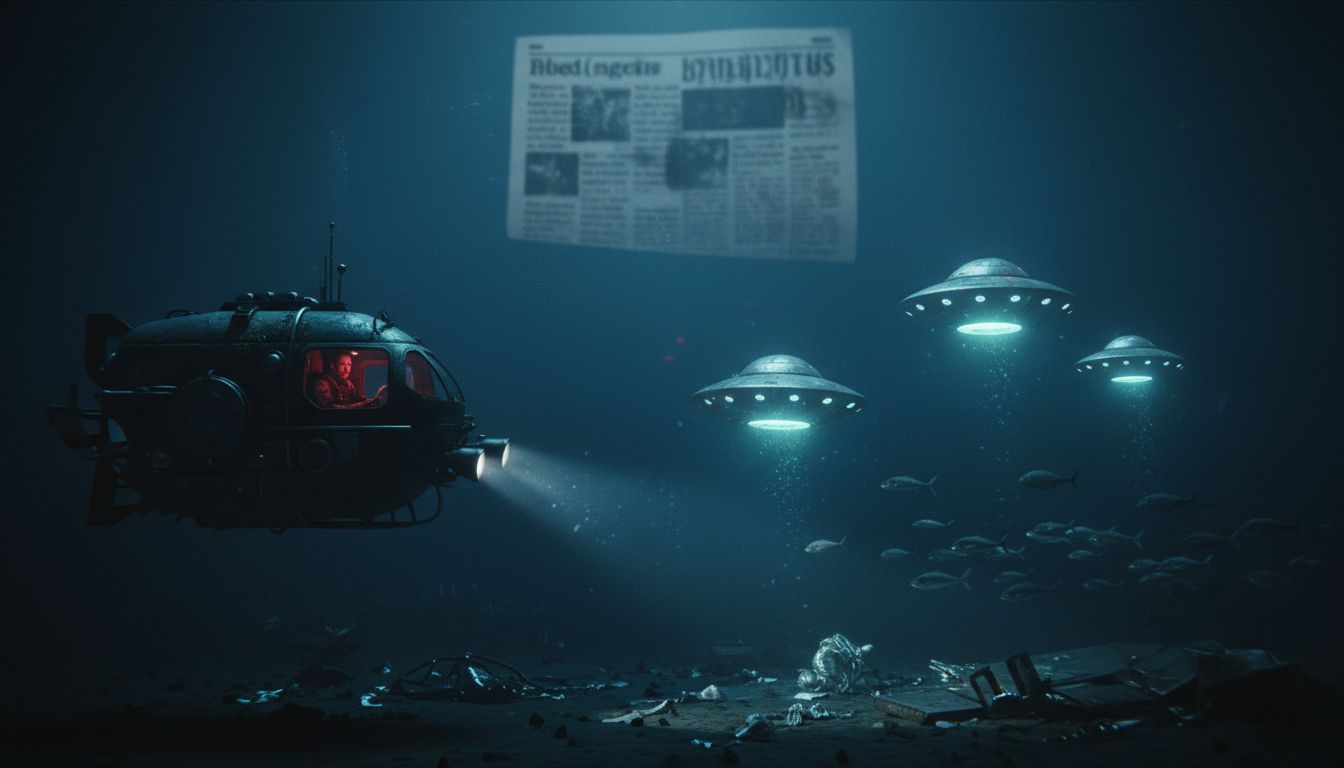
A surge in reports of unidentified objects descending into the ocean has drawn renewed attention from both the scientific community and national‑security agencies. According to a recent tally compiled by a civilian reporting platform, more than 9,000 sightings have been logged along the United States coastline since the start of the year, a figure that far exceeds the annual average for underwater anomalous phenomena. Most of the reports describe luminous or metallic shapes that appear to plunge beneath the surface, sometimes accompanied by unusual acoustic signatures captured by commercial sonar equipment.
The United States Navy, which has overseen the Pentagon’s Unidentified Aerial Phenomena (UAP) Task Force since 2020, confirmed that it is monitoring the uptick in underwater reports but cautioned that “the data set is still preliminary.” A spokesperson for the Office of Naval Intelligence said that analysts are cross‑referencing the civilian submissions with military sensor logs and that “any indication of a coordinated, foreign‑origin activity would be taken seriously and investigated in accordance with existing protocols.” The Navy’s interest reflects a broader shift in defense circles, where underwater domains are increasingly viewed as potential vectors for novel threats, whether technological or biological.
Scientists, however, urge restraint in interpreting the raw numbers. Dr. Emily Hart, a marine acoustics researcher at the Scripps Institution of Oceanography, noted that “the ocean is a complex acoustic environment, and false positives can arise from bioluminescent organisms, debris, and even atmospheric phenomena refracted through the water column.” She added that “while the sheer volume of reports is noteworthy, rigorous validation—ideally with independent sensor data—is essential before drawing any conclusions about extraterrestrial involvement.” Hart’s assessment aligns with the stance of the Scientific Coalition for UAP Studies (SCU), which has called for systematic, peer‑reviewed investigations to differentiate genuine unknowns from misidentified conventional objects.
The possibility of an extraterrestrial origin, though speculative, has sparked debate among security analysts. James Whitaker, a senior fellow at the Center for Strategic and International Studies, warned that “if even a fraction of these sightings were verified as non‑human in nature, it would have profound implications for national security, scientific research, and public policy.” Whitaker emphasized that the United States government has already begun to develop frameworks for dealing with anomalous aerial phenomena, and that similar mechanisms may be required for underwater encounters, especially given the strategic importance of maritime domains.
Public reaction mirrors the mixture of curiosity and apprehension that has accompanied UAP disclosures over the past decade. Social‑media groups dedicated to cataloguing “underwater UFOs” have grown rapidly, with members sharing dash‑cam footage, sonar screenshots, and personal testimonies. While some participants claim the sightings could herald an “invasion,” experts stress that sensational narratives often outpace the evidence. “The human mind is wired to seek patterns, especially under uncertain conditions,” said Dr. Jacques Vallée, a noted UAP researcher, “but responsible inquiry demands that we separate the compelling story from the verifiable fact.”
As authorities continue to sift through the reports, the focus remains on establishing a reliable evidentiary base. The Department of Defense has indicated that it will allocate additional resources to integrate civilian data streams with military sensors, a move that could enhance situational awareness across both air and sea. Until such corroboration is achieved, the underwater sightings remain an intriguing, yet unverified, phenomenon—one that underscores the need for transparent, interdisciplinary collaboration in exploring the unknown.


