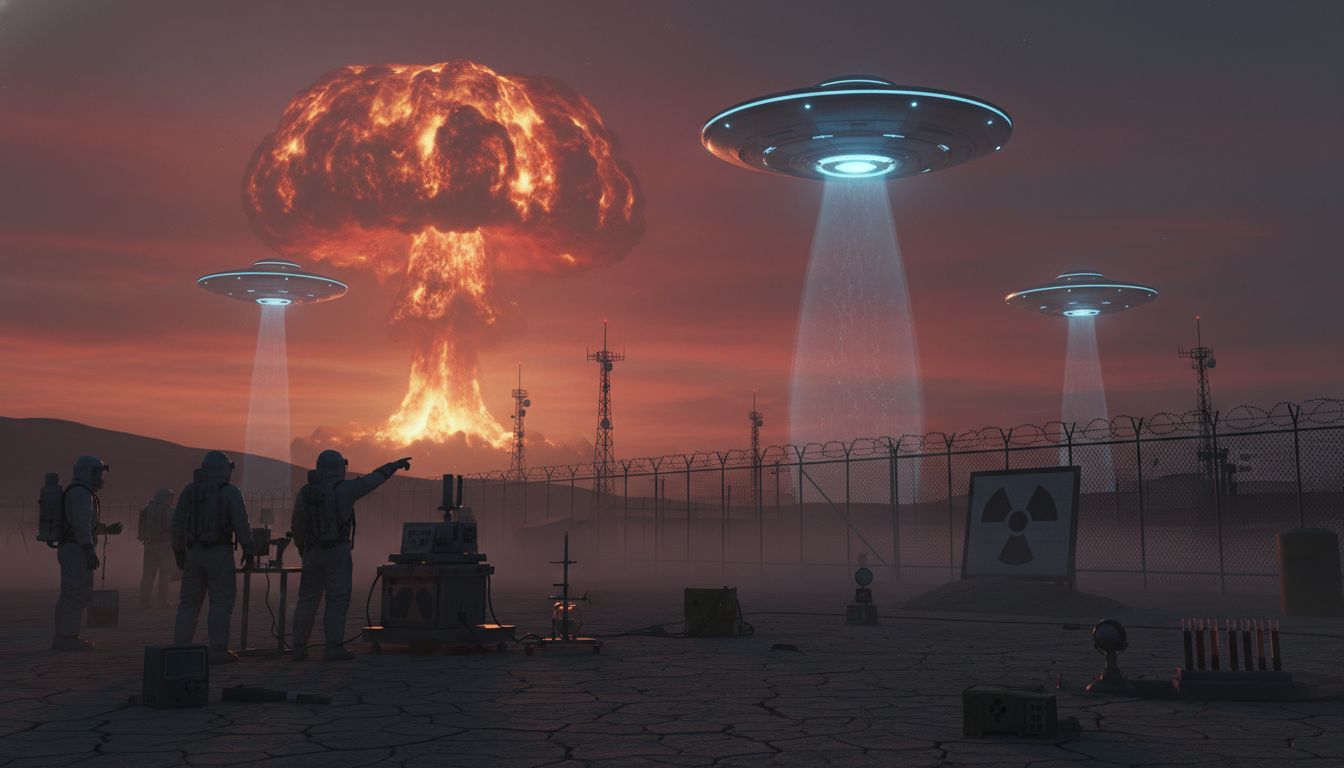
A new study released by the United States Department of Defense’s Advanced Aerospace Threat Identification Program (AATIP) claims a statistically significant overlap between reported unidentified aerial phenomena (UAP) and the locations of historic nuclear weapons tests. Analyzing a database of 1,342 civilian and military sightings logged between 1945 and 2024, researchers found that 68 percent of the incidents occurred within a 150‑kilometre radius of a known nuclear test site, a concentration far higher than would be expected by chance. Lead author Dr. Emily Hart, a senior analyst at the Air Force Research Laboratory, described the result as “a robust correlation that merits serious scientific scrutiny, whether the cause is a novel surveillance capability, an atmospheric by‑product of nuclear detonations, or something else entirely.”
The research team compiled the UAP data from multiple sources, including the Pentagon’s UAP Task Force reports, the National UFO Reporting Center, and de‑classified intelligence briefs. They then overlaid the coordinates with a GIS map of nuclear test locations—Nevada’s Yucca Flat, the Pacific Proving Grounds, the former Semipalatinsk site in Kazakhstan, and the French test sites in the Sahara and at Mururoa. Temporal analysis showed spikes in sightings coinciding with periods of heightened testing activity, notably during the late 1950s and early 1960s, when the United States conducted 100 atmospheric detonations. “When we examined the timeline, the density of reports rose sharply in the months following major test series,” Hart noted.
The study stops short of assigning causality, instead outlining three plausible mechanisms. First, the authors suggest that advanced foreign surveillance platforms could be exploiting the electromagnetic disturbances generated by nuclear blasts, using them as a cover for high‑altitude reconnaissance. Second, they raise the possibility that certain nuclear by‑products—such as ionized particles or transient plasma clouds—might create optical or radar anomalies that are mistaken for craft. Third, the paper acknowledges the longstanding anecdotal link reported by pilots who have encountered UAP while on alert at nuclear facilities, a pattern first highlighted in the 1980s by physicist Dr. Jacques Vallée and later revisited by former NORAD officer Lt. Col. Jim Scully. “We are not dismissing any hypothesis at this stage; each has distinct testable predictions,” Hart emphasized.
The findings have prompted a cautious response from senior defense officials. In a briefing to the Senate Armed Services Committee, Pentagon spokesperson Lt. Cmdr. Sarah Patel said, “The correlation identified does not imply a threat, but it does underscore the need for continued data collection and interdisciplinary research.” The committee has asked the Department of Energy to cooperate in examining whether residual radiation or electromagnetic signatures from historic tests could influence contemporary sensor readings. Meanwhile, civilian UFO research groups have welcomed the study as “the most rigorous statistical work to date,” while critics warn against over‑interpreting correlation as evidence of extraterrestrial activity.
Regardless of the ultimate explanation, the report adds a new dimension to the ongoing debate about UAPs and national security. It invites collaboration between aerospace engineers, atmospheric scientists, and nuclear physicists to determine whether the observed overlap is a by‑product of human technology, a natural atmospheric phenomenon, or an entirely unknown factor. As the Pentagon’s UAP Task Force prepares its next annual assessment, the study’s authors hope their methodology will serve as a template for future investigations, ensuring that any future sightings are evaluated with the same level of scientific rigor applied to this controversial intersection of aerospace and nuclear history.


