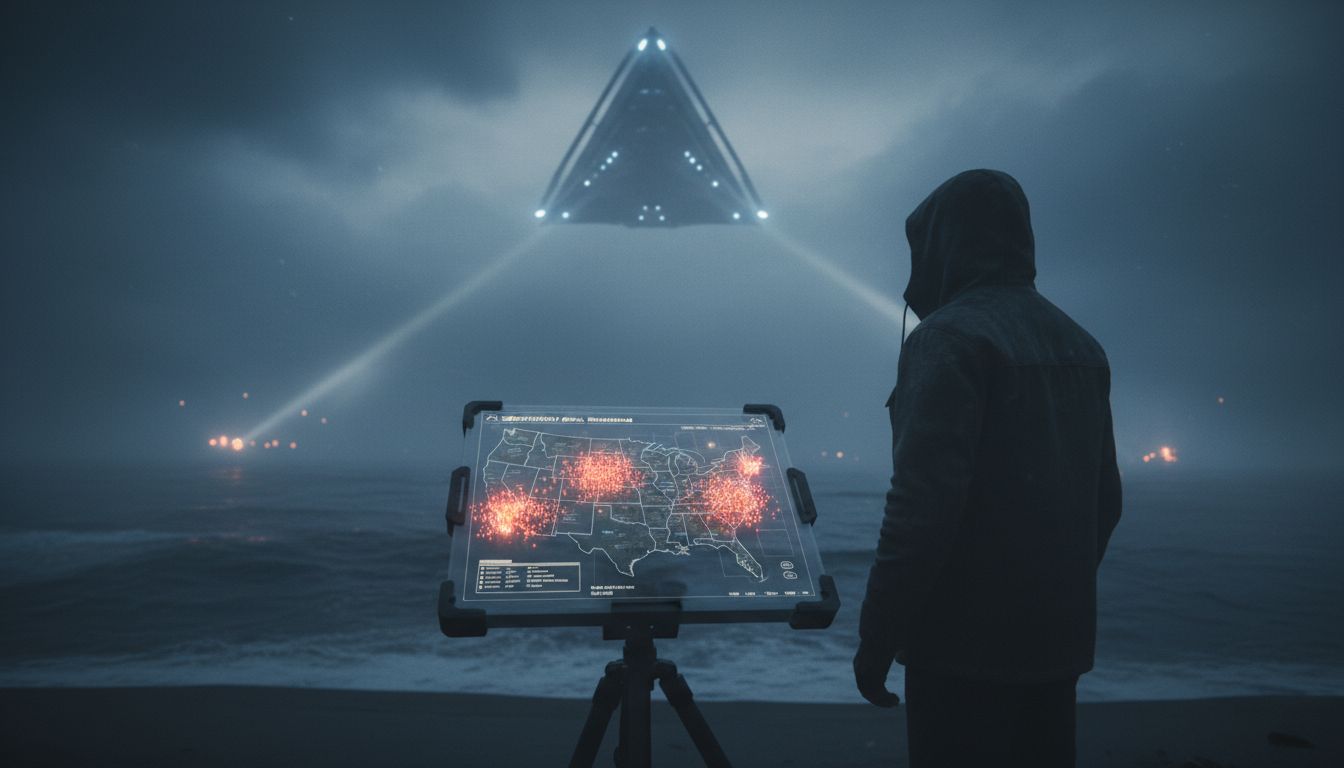
A new online tracker released last week has plotted dozens of dense “clusters” of unidentified objects that appear to linger just offshore along the United States’ Atlantic, Gulf and Pacific coasts. The map, compiled from publicly available radar, Automatic Identification System (AIS) and sonar data, shows repeated detections of contacts that do not correspond to known commercial vessels, aircraft or marine life. The visualizations have quickly gone viral on social media, prompting a fresh round of questions about the extent of unexplained aerial and sub‑surface activity in U.S. airspace and waters.
The tracker was created by a collective of civilian researchers who describe themselves as “open‑source UAP analysts.” According to the group’s website, the data set spans the past twelve months and includes more than 7,800 individual sightings, of which roughly 1,200 form the highlighted clusters. “What we’re seeing are repeat returns that stay in roughly the same geographic envelope for days, sometimes weeks,” said lead analyst Maya Patel, who prefers to remain anonymous for safety reasons. “They are not associated with any registered transponder, and their flight paths—when we can infer them—often involve low‑altitude, low‑speed maneuvers that don’t match known aircraft or drone profiles.”
Federal officials have not yet commented on the specific tracker, but the Pentagon’s Unidentified Aerial Phenomena (UAP) Task Force, reconstituted as the All‑Domain Anomaly Resolution Office (ADARO) in 2023, has repeatedly emphasized the need for more data. In a briefing to Congress in March, ADARO director Dr. Sean Kirkpatrick noted that “the majority of UAP reports we receive are still explainable, but a non‑trivial minority remain unresolved, especially those that appear in maritime environments where sensor coverage is less uniform.” He added that the department is working with the Navy’s Undersea Warfare Center to improve detection capabilities, but cautioned that “isolated clusters in public‑domain data should not be taken as definitive evidence of a coordinated presence.”
Skeptics argue that the clusters could be the result of mundane phenomena misread by automated systems. Dr. Elena Martinez, a marine acoustics professor at the University of Washington, explained that “sonar and radar can produce ghost returns from sea‑state clutter, schools of fish, or even floating debris that reflects signals in unpredictable ways.” She noted that the tracker’s reliance on algorithmic filtering, without human verification of each contact, raises the risk of false positives. “When you aggregate large data sets, you inevitably find patterns that look compelling but may be statistical artifacts,” Martinez said.
The renewed public interest echoes earlier spikes in UAP reporting that followed the 2020 release of the Navy’s “Gimbal” and “GoFast” videos and the 2021 Office of the Director of National Intelligence (ODNI) assessment. That assessment estimated that roughly 15‑25 % of the 400‑plus UAP incidents reviewed remained unexplained, many involving “unusual flight characteristics” and “potentially advanced technology.” While the current tracker focuses on objects near the waterline—an area historically under‑covered by the UAP reporting infrastructure—its findings could prompt a broader push for integrated, cross‑domain monitoring that includes maritime, aerial and space‑based sensors.
For now, the clusters remain “unidentified” in the strictest sense: they have not been matched to known platforms, but they also have not been independently verified by government agencies. As Patel put it, “Our goal is to shine a light on gaps in the data, not to jump to conclusions.” Whether the patterns reflect novel technology, natural phenomena, or simply the quirks of automated detection, the episode underscores a growing demand for transparency and a more robust, scientifically grounded approach to the UAP mystery.