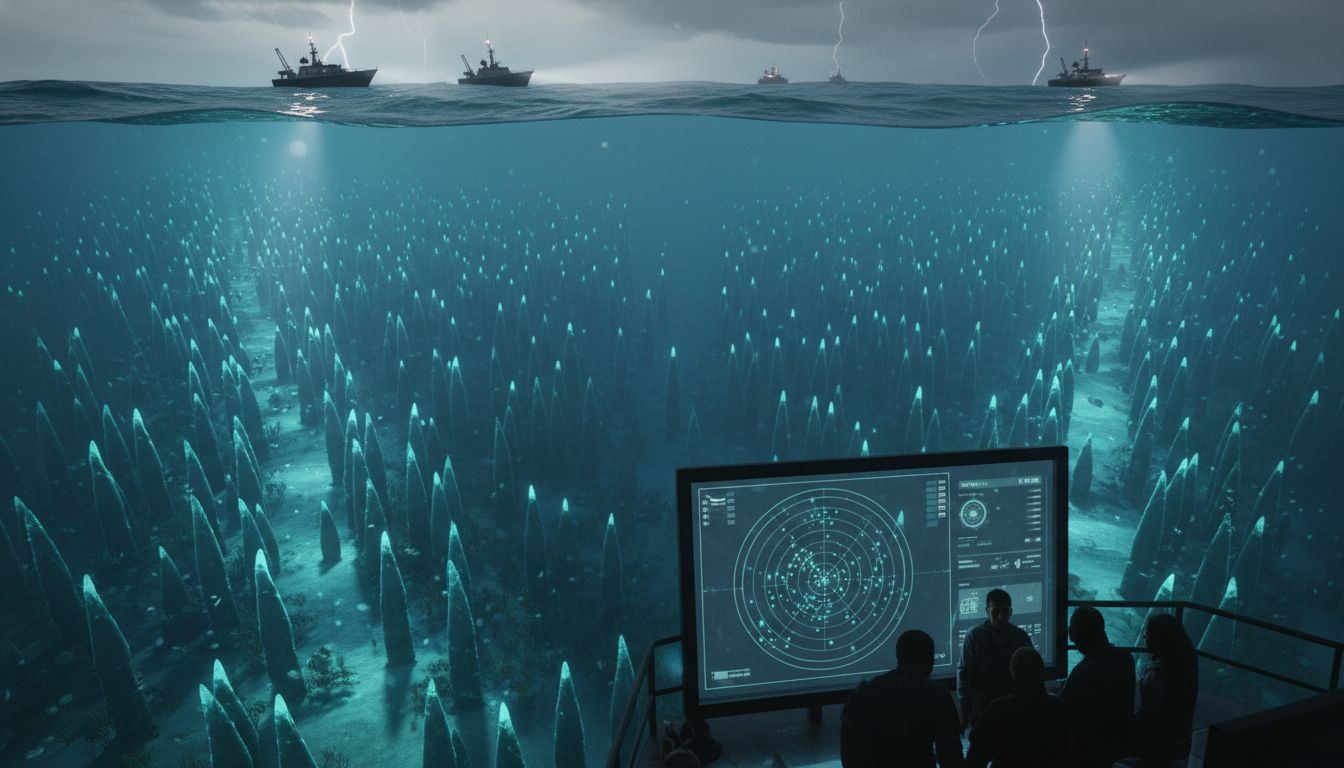
A civilian monitoring group known as Enigma UFO Tracker has released a data set that it says shows a dramatic increase in unidentified submerged objects (USOs) detected along both the Atlantic and Pacific coastlines of the United States. According to the organization’s latest report, more than 4,200 separate anomalies were logged between January 1 and September 30 of this year, a figure that dwarfs the roughly 1,200 USO sightings recorded over the same period in 2023. The detections were captured using a network of low‑frequency sonar buoys, hydrophone arrays and autonomous underwater vehicles that volunteer operators have deployed in coastal waters for scientific and hobbyist purposes.
Enigma’s founder, Dr. Maya Patel, a former oceanographic researcher at the University of Washington, said the surge “cannot be easily dismissed as a statistical artifact.” She noted that many of the recorded events share common characteristics: rapid, non‑propulsive movement; abrupt changes in depth; and acoustic signatures that do not match known marine life, commercial vessels, or typical underwater drones. “In over 70 percent of the cases we observed a distinct, high‑frequency ping followed by a silent glide that lasted anywhere from a few seconds to several minutes,” Patel explained in an interview. “The objects often appear to hover just below the surface before disappearing at speeds that exceed conventional propulsion limits for civilian equipment.”
The findings arrive at a time when the U.S. Navy’s Unidentified Aerial Phenomena (UAP) task force has been publicly acknowledging a rise in unexplained aerial sightings, but it has not yet released an official assessment of underwater anomalies. A spokesperson for the Office of Naval Intelligence, Lt. Cmdr. James Whitaker, declined to comment on the specific Enigma data, but reiterated the department’s ongoing interest in “any anomalous activity that could impact maritime safety or national security.” In a recent congressional briefing, the Pentagon’s Under Secretary of Defense for Research and Engineering, Dr. Ellen M. Kullman, cautioned that “the ocean remains the least explored domain on Earth, and our detection capabilities are still maturing.” She added that while most USO reports are likely attributable to known phenomena—such as schools of fish, seismic activity, or experimental submersibles—“the possibility of novel platforms cannot be ruled out without rigorous analysis.”
Independent experts are urging a measured response. Dr. Robert L. Jensen, a marine acoustics specialist at the Scripps Institution of Oceanography, highlighted the challenges of differentiating between biological and mechanical sources in noisy coastal environments. “Many marine mammals produce clicks and whistles that can mimic the acoustic profiles of engineered objects, especially when they surface or dive rapidly,” Jensen said. He suggested that cross‑referencing Enigma’s timestamps with existing databases of marine mammal migrations and naval exercise schedules could help filter out false positives. Meanwhile, former Navy SEAL and underwater operations consultant, Cmdr. Lisa Ortega (ret.), warned that “if any of these objects are operating near commercial shipping lanes, they could pose a collision risk, regardless of their origin.”
The Enigma team has made the raw sonar recordings and metadata publicly available through an open‑access portal, inviting researchers, government agencies and independent analysts to examine the evidence. Patel emphasized that transparency is central to the project’s mission: “We are not trying to prove an extraterrestrial hypothesis; we simply want to catalog what the ocean is telling us and hand that information over to anyone with the expertise to interpret it.” As the scientific community begins to sift through the thousands of entries, the broader conversation about USOs may shift from speculative headlines to a more grounded assessment of the ocean’s hidden dynamics. Whether the uptick reflects a genuine increase in novel underwater activity or improved detection methods, the data underscores the need for continued investment in maritime surveillance and interdisciplinary research.