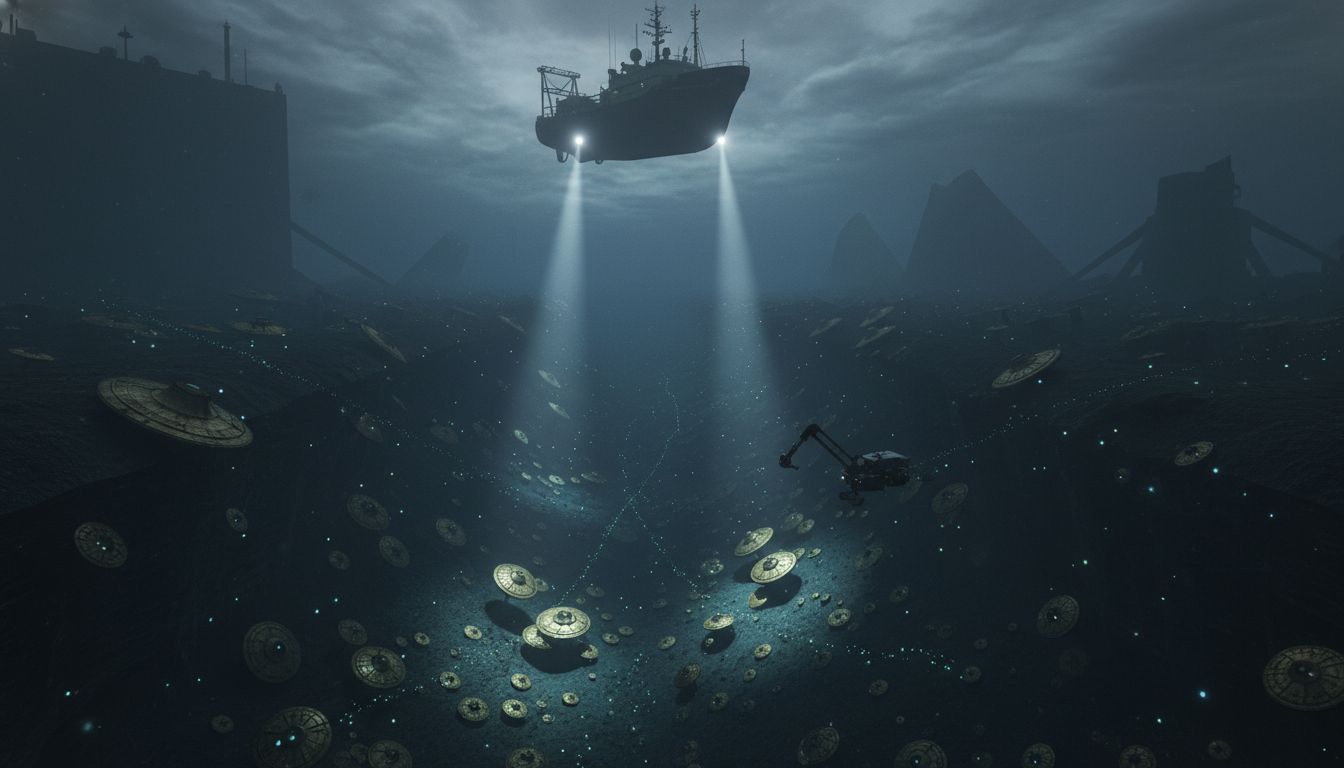
A civilian “UAP‑tracker” that aggregates sonar and satellite data has flagged what its operators describe as “thousands of unidentified underwater objects” along the Atlantic, Pacific and Gulf coasts of the United States. The list, posted on the tracker’s public dashboard on Oct. 24, shows clusters of contacts ranging from a few hundred meters to several kilometres offshore, with estimated depths between 200 m and 2,000 m. While the raw data are publicly available, the tracker does not identify the nature of the contacts, prompting speculation that the sightings could represent a hidden class of underwater phenomena distinct from the more widely reported aerial UAP.
The tracker’s creator, former naval sonar analyst Michael “Mick” Reynolds, says the system pulls real‑time acoustic signatures from commercial and military vessels that have opted into a data‑sharing program. “We’re not seeing a single blip,” Reynolds told reporters, “but a pattern of persistent, non‑standard echoes that don’t match known marine life, wreckage or conventional vessels.” He cautioned that the term “UFO” (unidentified flying object) is being used loosely; the objects are, in fact, submerged and detected through sonar, not visual observation.
Experts in oceanography and defense have urged restraint in interpreting the findings. Dr. Lisa H. Caldwell, a marine acoustics researcher at the Scripps Institution of Oceanography, noted that “sonar can pick up a wide variety of acoustic anomalies—schooling fish, bubbles, even temperature gradients—that can masquerade as solid objects on a screen.” Similarly, former Navy SEAL and current AARO (All‑Domain Anomaly Resolution Office) consultant Rear Admiral (ret.) James “Jim” McAllister warned that “the ocean is a noisy environment. Without corroborating evidence—visual, magnetic, or otherwise—these contacts remain just that: unidentified.” Both experts emphasized the need for multidisciplinary analysis before drawing conclusions about extraterrestrial or advanced technological origins.
The U.S. government’s recent focus on UAP, spurred by the 2022 Pentagon report and the establishment of the AARO, has primarily centered on aerial phenomena. However, the agency’s mandate explicitly includes “all domains,” and a 2024 congressional briefing referenced “underwater anomalies” as a growing area of interest. AARO spokesperson Karen Liu said the office is “reviewing all credible data streams, including acoustic and sub‑surface detections, to assess any potential national security implications.” The agency has not yet confirmed whether the tracker’s data have entered its assessment pipeline.
In the absence of definitive identification, the scientific community is calling for a coordinated effort that combines sonar, underwater drones, and optical imaging to verify the contacts. The National Oceanic and Atmospheric Administration (NOAA) announced a pilot program in early November to deploy autonomous underwater vehicles (AUVs) in regions highlighted by the tracker, aiming to capture high‑resolution imagery and environmental measurements. “If there is something novel down there, we need to approach it with the same rigor we apply to any oceanographic discovery,” said NOAA’s chief scientist, Dr. Miguel Alvarez.
For now, the thousands of underwater blips remain a curiosity—a reminder that the ocean’s depths are still largely unmapped and that, whether terrestrial or otherwise, many of its mysteries await systematic study. As Reynolds put it, “The data are a starting point, not a conclusion. It’s up to the scientific and defense communities to determine what, if anything, is truly anomalous.”


