Overview
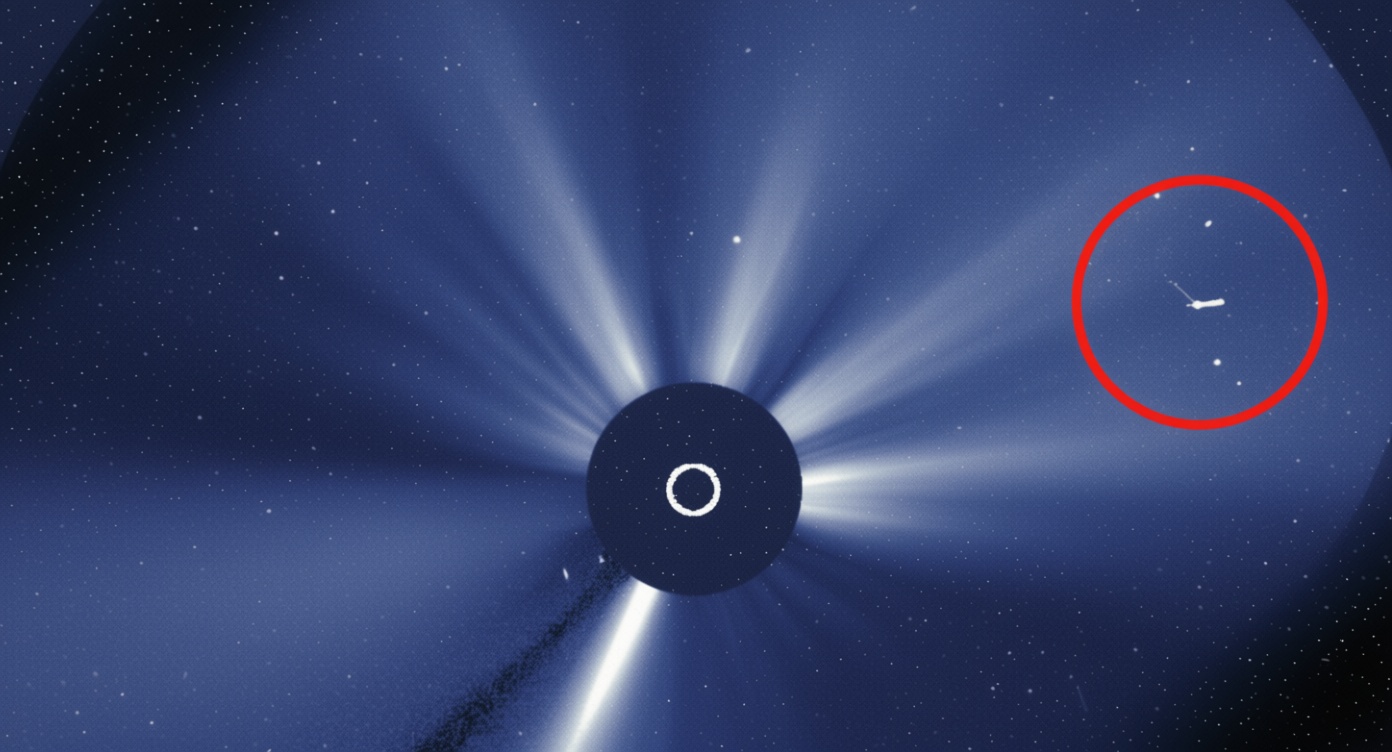
A ufologist is claiming that an image or video captures a giant “UFO mothership” crossing in front of the Sun at near-light speed. The allegation was reported by the Daily Mail on October 14, 2026, but the material described in the report does not establish that the object is extraterrestrial, unusually large or moving at anything close to the speed of light.
The post appears to rely primarily on the visual impression created by an object passing across a solar image. No independently verified data, detailed observation logs or corroborating reports were provided to demonstrate what the object was or how quickly it traveled. There was also no confirmation cited from NASA, a solar observatory or another scientific institution.
What the Claim Shows—and Does Not Show
Images of the Sun are frequently affected by sensor artifacts, image-processing effects, dust, foreground objects and transient disturbances. A dark or bright shape in a single frame can also result from a camera exposure, compression, a satellite crossing the field of view or an object much closer to the observing instrument than the Sun. Without the original, uncompressed file and information about the camera, lens, exposure settings and observation time, it is difficult to assess the image reliably.
A sequence of frames would be required to estimate an object’s apparent motion. Even then, apparent speed across a two-dimensional image would not automatically reveal the object’s true velocity. Its distance from the camera, direction of travel and the scale of the field of view would all be necessary for a meaningful calculation. A visual estimate alone cannot support a claim of near-light-speed travel.
The Physics of a Near-Light-Speed Object
The speed of light in a vacuum is approximately 299,792 kilometers per second. Under established physics, any object with mass would require increasingly vast amounts of energy to approach that limit. A large spacecraft traveling at such a speed would also raise major questions about propulsion, heat, radiation and the effects of interacting with particles and magnetic fields.
If an object genuinely crossed the Sun’s apparent disk at near-light speed, precise timing and multiple observations would be essential. Researchers would need to distinguish the object’s actual motion from the effects of perspective and determine whether it was in the foreground, near Earth or at a greater distance. A single image generally cannot provide that information.
Scientific Verification Remains Absent
The claim has not been accompanied by independent confirmation or a publicly documented analysis from professional astronomers. No evidence supplied in the source material demonstrates that the feature is a physical craft, much less an extraterrestrial “mothership.” Extraordinary interpretations require more than an unusual-looking image; they require reproducible evidence that can withstand examination by researchers using the original data.
Until the source file, observation metadata and a transparent frame-by-frame analysis are made available, the image should be treated as an unverified UFO claim. The reported interpretation may attract attention because of its dramatic scale and speed, but neither has been established by the evidence described.