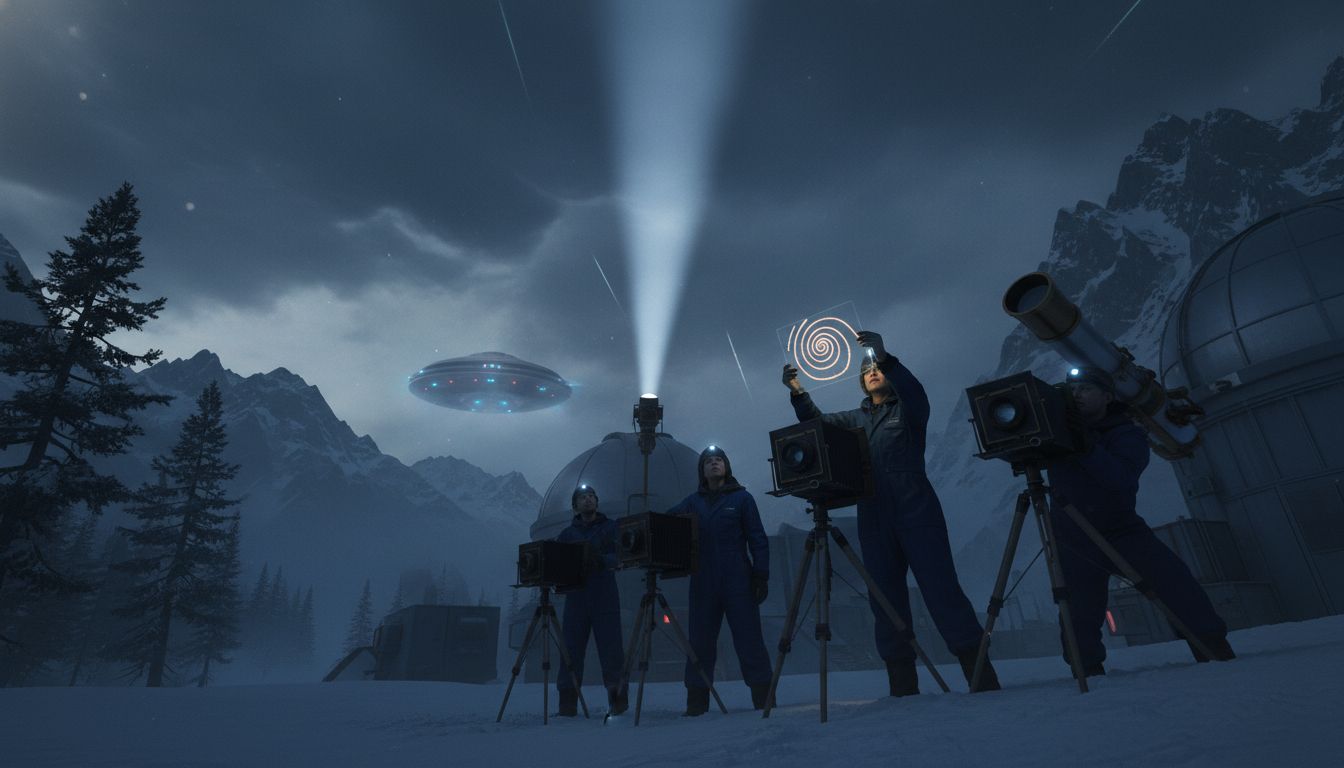
The recent appearance of two peer‑reviewed papers linking mysterious flashes captured on mid‑century photographic plates to possible artificial objects has reignited public fascination with unidentified aerial phenomena, but the scientific community is treating the findings as a test case for how extraordinary claims are vetted. The studies, led by Swedish astronomer Beatriz Villarroel, were published in Scientific Reports (Oct. 20) and the Publications of the Astronomical Society of the Pacific (Oct. 17). Both papers examine data from the Palomar Sky Survey, a monumental effort carried out between 1949 and 1958 with the 1.2‑meter Schmidt telescope at the Palomar Observatory. More than 2,000 glass plates—each the size of a vinyl record cover and coated with a light‑sensitive emulsion—were later digitized, providing a searchable archive of the night sky before the launch of Sputnik 1 in 1957.
Using the VASCO (Vanishing & Appearing Sources during a Century of Observations) framework, Villarroel’s team applied modern image‑processing algorithms to the digitized scans, hunting for transient events—brief brightenings or disappearances that could indicate astrophysical outbursts, meteoric impacts, or instrumental artifacts. The effort yielded a catalog of over 107,000 transients, a figure that underscores both the richness of the historical dataset and the challenges of sifting signal from noise. Among the cataloged events, a subset displayed a striking geometric pattern: multiple flashes aligned in a straight line across a single plate. Villarroel argues that such linear arrangements are statistically improbable under known natural processes, prompting the speculation that they could be reflections from man‑made objects orbiting Earth, even though the plates predate any known satellite.
The hypothesis has drawn both intrigue and skepticism. Astrophysicist Adam Frank of the University of Rochester, who has written extensively on the search for extraterrestrial life, praised the openness of the investigation, saying, “I think there are many in the UFO community who really want to know what’s going on… This is a great way to show people how science works.” Yet many experts caution that more mundane explanations remain viable. Solar flares and high‑energy particles from nuclear tests in the 1950s can produce brief bursts of radiation that register on photographic emulsions. Meteors entering the upper atmosphere, especially those breaking into fragments, can create linear streaks that mimic the observed patterns. Additionally, imperfections in the telescope’s optics or in the plate‑handling process could generate artifacts that masquerade as transients.
The papers have been lauded for their methodological rigor, particularly the decision to restrict the analysis to pre‑Sputnik data, thereby eliminating contemporary space‑based sources of interference. Peer reviewers highlighted the careful statistical treatment of alignment probabilities and the transparent sharing of the processed dataset. Nonetheless, the authors themselves acknowledge the limits of working with digitized scans rather than the original glass plates. “To move beyond speculation, we need to re‑examine the physical plates with modern microscopy and spectroscopy,” Villarroel wrote in the Scientific Reports article. She and her collaborators have called on other observatories and archival institutions to make their historic plates available for independent verification.
The broader significance of the work lies less in confirming an extraterrestrial presence and more in demonstrating how legacy astronomical data can be repurposed to address contemporary questions. As the U.S. government and NASA continue to formalize UAP research programs, the Palomar findings serve as a reminder that extraordinary claims demand extraordinary evidence—and that the evidentiary chain often begins with painstaking archival work. Whether the linear flashes prove to be artifacts, atmospheric phenomena, or something more enigmatic, the ongoing dialogue underscores the scientific method’s capacity to engage public curiosity while maintaining rigorous standards of proof.


