Overview
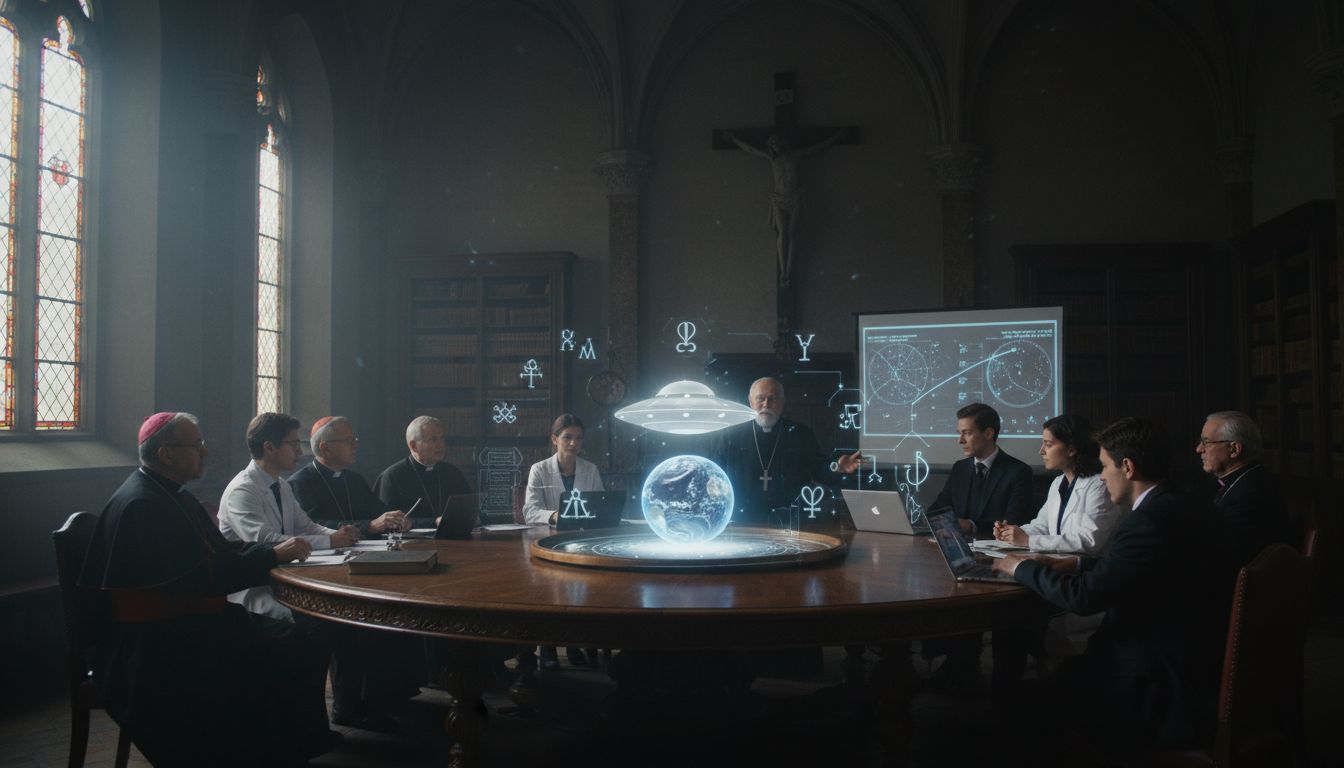
On April 29, 2026, the St. Anne parish in Vatican City hosted a public lecture titled “UAPs from Schopenhauer to Other Forms of Intelligence.” The event, part of the parish’s long‑running “Cultural Wednesdays” series, brought together clergy, academics, and UFO researchers to examine how reports of unidentified aerial phenomena (UAP) intersect with Catholic doctrine. Organized amid heightened political interest—U.S. President Donald Trump and several members of Congress have recently hinted that secret government files on UFOs may soon be released—the discussion aimed to foster a measured dialogue between faith and emerging scientific inquiries.
Participants and Setting
The primary speaker was Vladimiro Bibolotti, president of Italy’s National Ufology Center, who presented a slide show that included images of President Trump, Secretary of State Marco Rubio, congressional testimony from UFO whistleblowers, and headlines about alleged classified investigations. About twenty attendees filled the parish hall, a modest audience that reflected both curiosity and skepticism. Among the questionsers was Giuseppe Loiacono, a retired philosophy teacher, who pressed for rigorous scientific standards, while Marco Cremoncini, an amateur astronomer, offered a more conciliatory perspective. The parish’s clergy facilitated the session, emphasizing the Catholic tradition of engaging contemporary cultural issues.
Key Points from the Talk
Bibolotti traced the phenomenon of UFO sightings from classical antiquity—citing references in Greek philosophy—to the modern “disclosure” movement in the United States. He highlighted documented military encounters, congressional hearings, and recent media coverage, asserting that “every day I publish at least 20 news items about debates in the U.S. Congress” where tangible evidence is examined. While acknowledging that “I don’t have the truth in my pocket,” he argued that the material presented is grounded in publicly available scientific and governmental documents rather than personal speculation.
The discussion also referenced Vatican scholars, including astronomers from the Pontifical Academy of Sciences, who have previously stated that the existence of extraterrestrial life would not contradict Catholic teaching. Bibolotti noted that the Church’s openness to scientific discovery—rooted in the principle that “faith seeks truth wherever it may be found”—provides a framework for considering UAP reports without compromising doctrine.
Theological and Scientific Perspectives
Loiacono’s intervention underscored a central tension: the need for verification and reproducibility in any scientific claim. He warned that “scientific conjectures have to be tested and verified,” cautioning against elevating unverified sightings to the status of dogma. In response, parish representatives reminded the audience that the Catholic Church distinguishes between faith and empirical inquiry, encouraging believers to remain open to new knowledge while maintaining doctrinal integrity.
The Vatican’s own astronomers have long advocated a cautious yet hopeful stance on extraterrestrial life, suggesting that if intelligent beings were discovered, they would be regarded as part of God’s creation, deserving of the same moral consideration afforded to humanity. This theological openness aligns with the broader scientific principle that absence of evidence is not evidence of absence, a sentiment echoed by several participants.
Implications and Outlook
The St. Anne event illustrates a growing willingness within Catholic institutions to engage with controversial scientific topics in a measured, scholarly manner. By providing a platform for both proponents and skeptics, the parish demonstrated an interdisciplinary approach that mirrors the Vatican’s historic dialogue with science—from Galileo’s era to contemporary bioethics. As U.S. legislative bodies continue to debate the declassification of UAP files, the Vatican’s engagement signals that religious communities are prepared to assess any new data through the lenses of theology, ethics, and empirical rigor.
Whether future disclosures will substantiate the claims discussed remains uncertain, but the Vatican’s participation underscores a broader cultural shift: faith and science are increasingly seen as complementary avenues for exploring humanity’s place in the cosmos. The conversation at St. Anne parish may well serve as a model for other religious institutions seeking to navigate the evolving landscape of extraterrestrial inquiry.