Overview
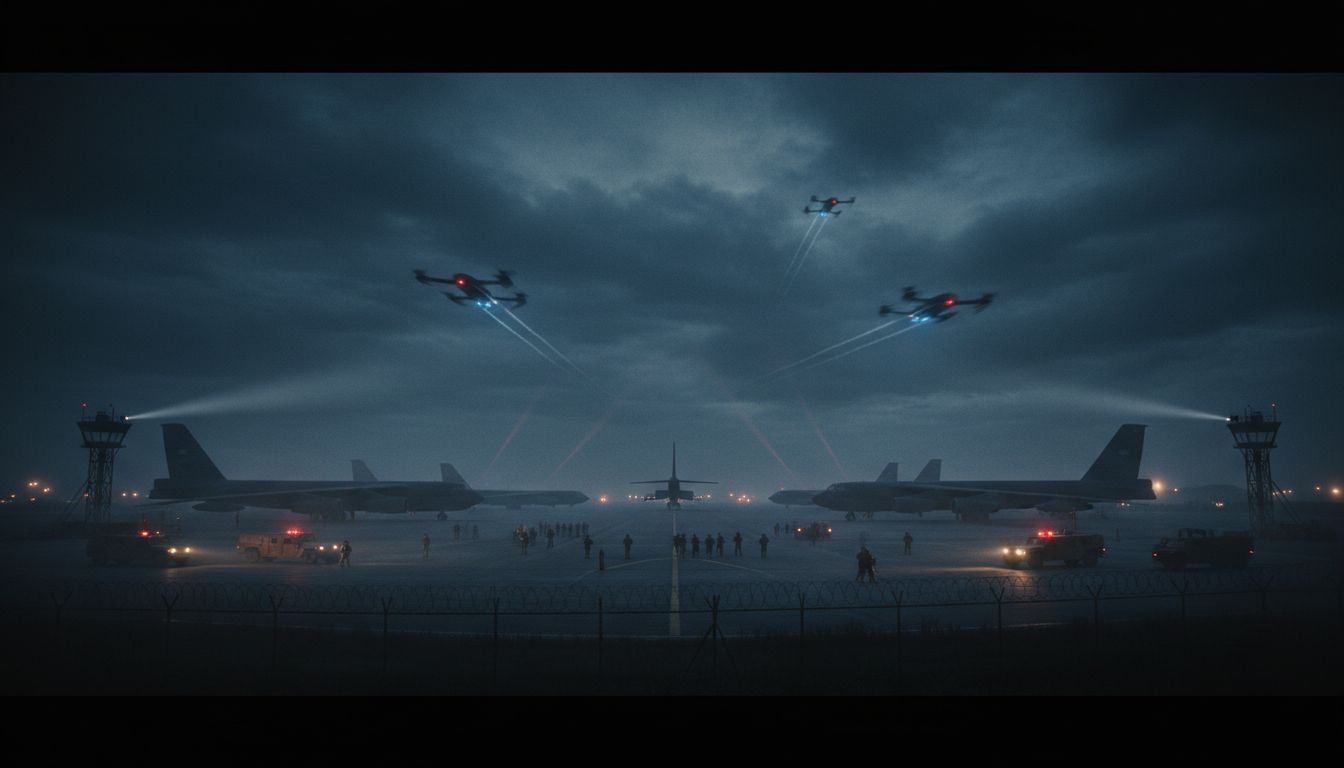
The U.S. Department of Defense confirmed that multiple unauthorized drones were detected over a Louisiana Air Force base that houses the Air Force’s nuclear‑capable B‑52 bomber fleet on the evening of March 19, 2026. The intrusion was identified by the base’s air‑defense radar and prompted an immediate security response, according to a statement released by the Pentagon’s public affairs office. The drones were not recognized as friendly or authorized aircraft, raising concerns about potential airspace violations near one of the nation’s most sensitive strategic assets.
Incident Details
Base personnel reported a series of small, low‑altitude unmanned aerial systems (UAS) entering the restricted airspace surrounding the installation at approximately 19:45 local time. Radar operators logged “unidentified contacts” that exhibited erratic flight patterns and did not respond to standard identification‑friend‑or‑foe (IFF) interrogations. “Our sensors picked up several craft that were not on any known flight plan and did not emit any transponder signals,” said Lt. Col. Mark Henderson, the base’s air‑defense commander. The drones remained in the vicinity for roughly twelve minutes before being intercepted by a Quick Reaction Alert (QRA) aircraft, which escorted them out of the restricted zone.
Immediate Response
Following protocol, the base activated its Integrated Air Defense System and notified the Continental U.S. (CONUS) NORAD sector. Pentagon spokesperson Sabrina Patel briefed reporters, stating, “All necessary measures were taken to safeguard our personnel and aircraft. The incident is under active investigation by the Air Force’s Office of Special Investigations and the Federal Aviation Administration.” No damage to aircraft, infrastructure, or personnel was reported, and the B‑52 fleet continued its routine operations after the threat was neutralized.
Broader Context
The occurrence adds to a growing list of airspace incursions near critical military installations. In recent years, the Department of Defense has documented an uptick in unauthorized UAS activity, prompting the establishment of the Unidentified Aerial Phenomena (UAP) Task Force to assess both civilian and potentially foreign threats. While the Pentagon has not classified these drones as UAPs, officials acknowledge that “unidentified aerial activity near nuclear‑capable platforms warrants heightened scrutiny,” according to a 2025 congressional briefing on national security risks posed by emerging drone technologies.
Next Steps and Outlook
The investigation will focus on determining the origin, ownership, and intent behind the drones. Authorities have appealed to the public for any information that could aid the inquiry, emphasizing cooperation with local law‑enforcement agencies and the Federal Aviation Administration’s registration database. Meanwhile, the Air Force is reviewing its perimeter‑security protocols, including the possible deployment of additional counter‑UAS systems and enhanced radar coverage. As the inquiry proceeds, the incident serves as a reminder of the evolving challenges posed by unauthorized aerial platforms in safeguarding America’s strategic deterrent forces.