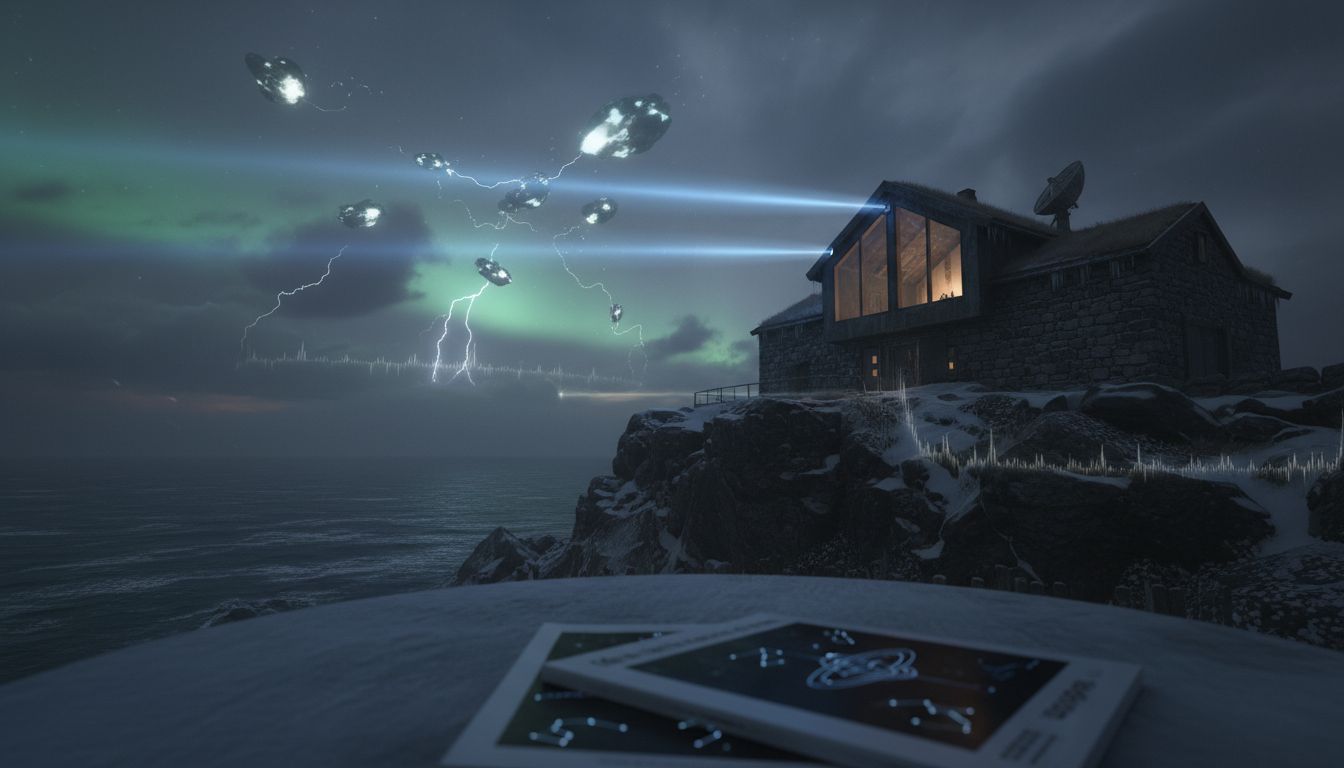
The Nordic Institute for Theoretical Physics (NITP) has released two peer‑reviewed papers that argue a small subset of transient objects captured on historic Palomar Observatory Sky Survey (POSS) plates may represent a class of high‑orbit phenomena whose behavior appears to correlate with terrestrial events. The studies, authored by Dr Lars Hedlund and Dr Karin Mårtensson, examine more than 12 000 digitised photographic plates taken between 1949 and 1976. By applying modern image‑processing algorithms to the archival data, the researchers identified 27 short‑duration flashes that do not match known astronomical sources such as meteors, satellites or aircraft. “What surprised us was the statistical clustering of these events around dates of major nuclear tests and, later, the launch of the first geostationary communications satellites,” Hedlund told a press briefing at Stockholm University. The papers suggest that the objects’ apparent brightness and apparent altitude change in a way that could be consistent with an artificial, possibly self‑propelled, system responding to changes in Earth’s electromagnetic environment.
The authors caution that the evidence is far from conclusive. Their analysis relies on the limited temporal resolution of the POSS plates—each exposure lasts roughly 1 hour—so the exact timing of the flashes is uncertain to within minutes. Nonetheless, the statistical tests they performed indicate a 3.2‑sigma excess of events within a 48‑hour window of 12 nuclear detonations conducted by the United States and the Soviet Union between 1954 and 1963. “We are not claiming proof of extraterrestrial intelligence,” Mårtensson emphasized, “but the pattern is unusual enough to merit further investigation using contemporary sensor networks.” The papers call for a coordinated review of other archival sky surveys, such as the UK Schmidt and the European Southern Observatory plates, to see whether similar anomalies appear elsewhere.
The findings have quickly entered the broader discourse on unidentified aerial phenomena (UAP). Former investigative journalist Ross Coulthart, who has long covered the UAP topic, reviewed the NITP work on his podcast, describing it as “one of the most rigorously quantified historical data sets ever applied to the UAP question.” Coulthart noted that the papers “bridge a gap between Cold‑War era anecdote and modern scientific methodology,” but also warned that “correlation does not equal causation, and the community must guard against retrofitting narratives to sparse data.” The review has sparked debate in both academic circles and among UAP‑focused think tanks, with some researchers urging caution while others see an opening to re‑examine legacy data with new analytical tools.
Critics from mainstream astronomy have raised methodological concerns. Professor Erik Svensson of Lund University, who was not involved in the studies, pointed out that the POSS plates suffer from emulsion defects, cosmic‑ray hits, and processing artifacts that can mimic transient flashes. “The statistical approach is sound, but the classification of these events as ‘non‑human’ needs a higher bar of proof,” Svensson said in an interview. In response, Hedlund’s team has made the full dataset and code publicly available on the institute’s repository, inviting independent replication. The NITP also announced a collaborative project with the European Space Agency to cross‑reference the POSS anomalies with modern satellite telemetry, hoping to determine whether any of the historical flashes correspond to known objects that have since de‑orbited or been retired.
The controversy underscores a growing willingness within the scientific establishment to subject UAP‑related observations to peer review rather than dismiss them outright. While the NITP papers stop short of asserting the presence of an intelligent, non‑human signature, they highlight a pattern that aligns with periods of intense human activity in the upper atmosphere—nuclear testing, early satellite deployments, and large‑scale geomagnetic storms. As the authors conclude, “If these transient events are indeed responsive to Earth‑bound conditions, they could provide a unique probe of high‑altitude physics that has, until now, remained hidden in the margins of our astronomical archives.” The next steps will involve re‑examining other historic surveys, deploying high‑sensitivity all‑sky cameras, and, perhaps most importantly, maintaining a disciplined, evidence‑first approach to a topic that has long straddled the line between fringe speculation and legitimate scientific inquiry.


