Overview
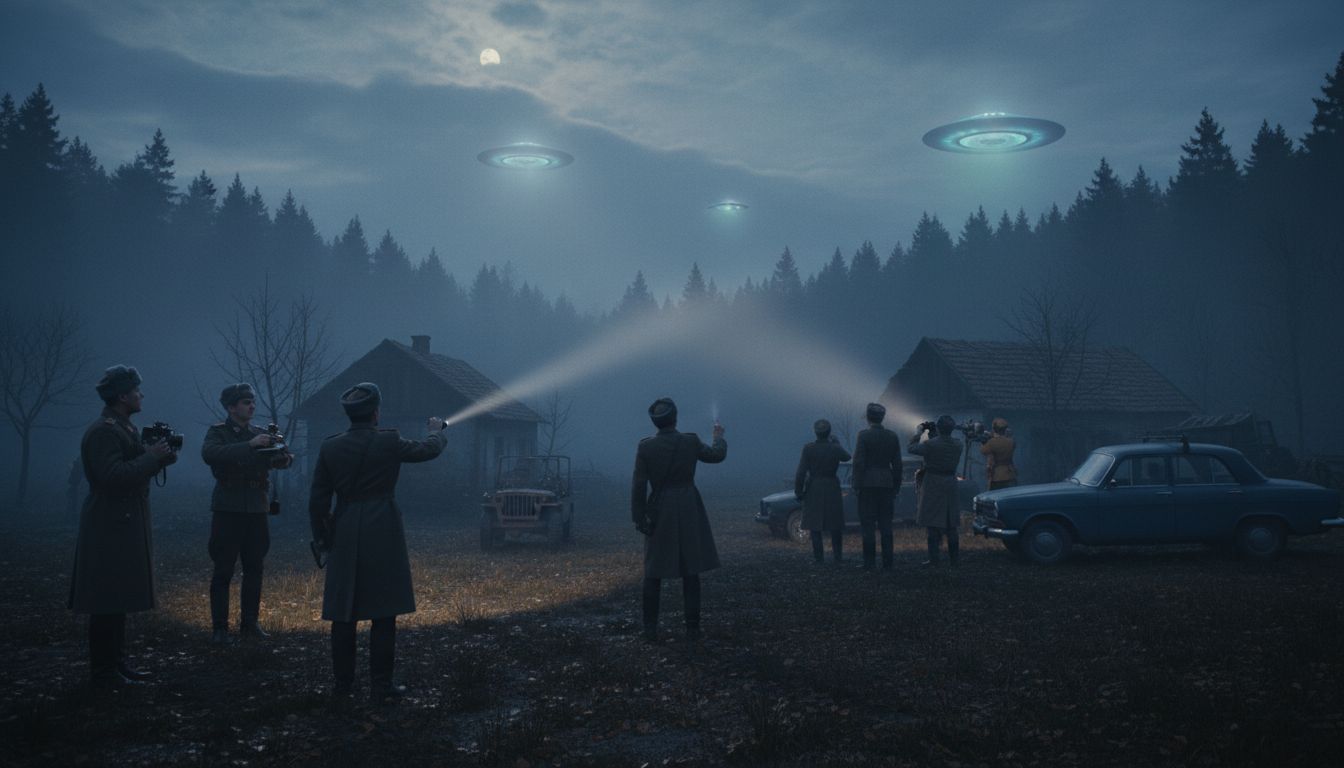
In the last weeks of 1978, residents of several Bulgarian provinces reported unexplained luminous objects moving across the night sky. The national news agency БТА (Bulgarian News Agency) published a series of brief reports between 30 December and 2 January, documenting sightings from Sofia, Plovdiv, Varna and the mountainous regions of the Rhodope and Pirin ranges. Witnesses described the phenomena as “bright, disc‑shaped lights” that accelerated, hovered, and performed abrupt changes in direction that did not correspond to any known aircraft or natural atmospheric activity.
Eyewitness Accounts
The accounts collected by local police stations and relayed to БТА share several common details. In Sofia, a group of university students observed a pulsating orange orb that rose vertically from 2 km altitude, lingered for roughly 30 seconds, and then vanished in a “sharp, silent flash.” In Plovdiv, a farmer reported a triangular formation of three white lights moving at a speed he estimated to be “faster than a jet,” executing a series of tight turns before disappearing behind the Rhodope foothills. A retired pilot from Varna, speaking on condition of anonymity, noted that the objects “did not emit any sound, and their flight paths were inconsistent with any known military or civilian aircraft operating in the region at that time.”
These testimonies were recorded in official police logs, which БТА cited in its brief. The agency also noted that no radar contacts were registered by the Bulgarian Air Defence during the reported windows, a point that has drawn particular interest from researchers studying historical UAP incidents.
Official Response
Following the surge of reports, the Ministry of Interior instructed regional law‑enforcement units to compile statements and forward them to the State Committee for National Security (the predecessor of today’s Ministry of Defense). In a statement released on 31 December 1978, a spokesperson for the committee said:
“We have opened a preliminary inquiry into the aerial phenomena reported in several districts. At this stage, no evidence points to a violation of Bulgarian airspace by known aircraft. We will continue to coordinate with the Civil Aviation Authority and, where appropriate, with our Soviet counterparts.”
The Civil Aviation Authority confirmed that no scheduled flights or military exercises were planned in the affected airspace during the dates in question. However, officials declined to comment on any classified operations that might have been underway, citing national security considerations.
Historical Context
Bulgaria’s UFO record dates back to the early 1950s, when the country’s strategic position behind the Iron Curtain made it a frequent waypoint for both Soviet and NATO aircraft. The late 1970s saw heightened activity in the Balkans, with several documented incidents in neighboring Romania and Yugoslavia. Scholars such as Dr. Elena Petkova of Sofia University note that the 1978 sightings align with a broader pattern of Cold‑War‑era reports where bright, maneuverable objects appeared during periods of heightened military tension.
Moreover, the timing of the Bulgarian reports coincides with the “Moscow–Bucharest satellite flare” observed across Eastern Europe in November 1978, a known natural phenomenon caused by sunlight reflecting off the Soviet satellite Kosmos 954. While some analysts initially linked the Bulgarian lights to this flare, the described erratic motions and low‑altitude behavior differentiate the events, suggesting a separate cause.
Conclusion
The late‑1978 Bulgarian UAP reports remain an intriguing footnote in the nation’s aerospace history. Although no definitive explanation has emerged from official investigations, the convergence of multiple independent witnesses, the absence of radar corroboration, and the lack of scheduled air traffic lend credibility to the accounts. As Bulgaria continues to modernize its air‑space monitoring infrastructure, researchers hope that archived police logs and newly digitized radar data may eventually shed light on these unidentified aerial phenomena. Until then, the 1978 sightings stand as a reminder that even in a tightly controlled Cold‑War environment, the sky can still hold mysteries that defy easy classification.


