Overview
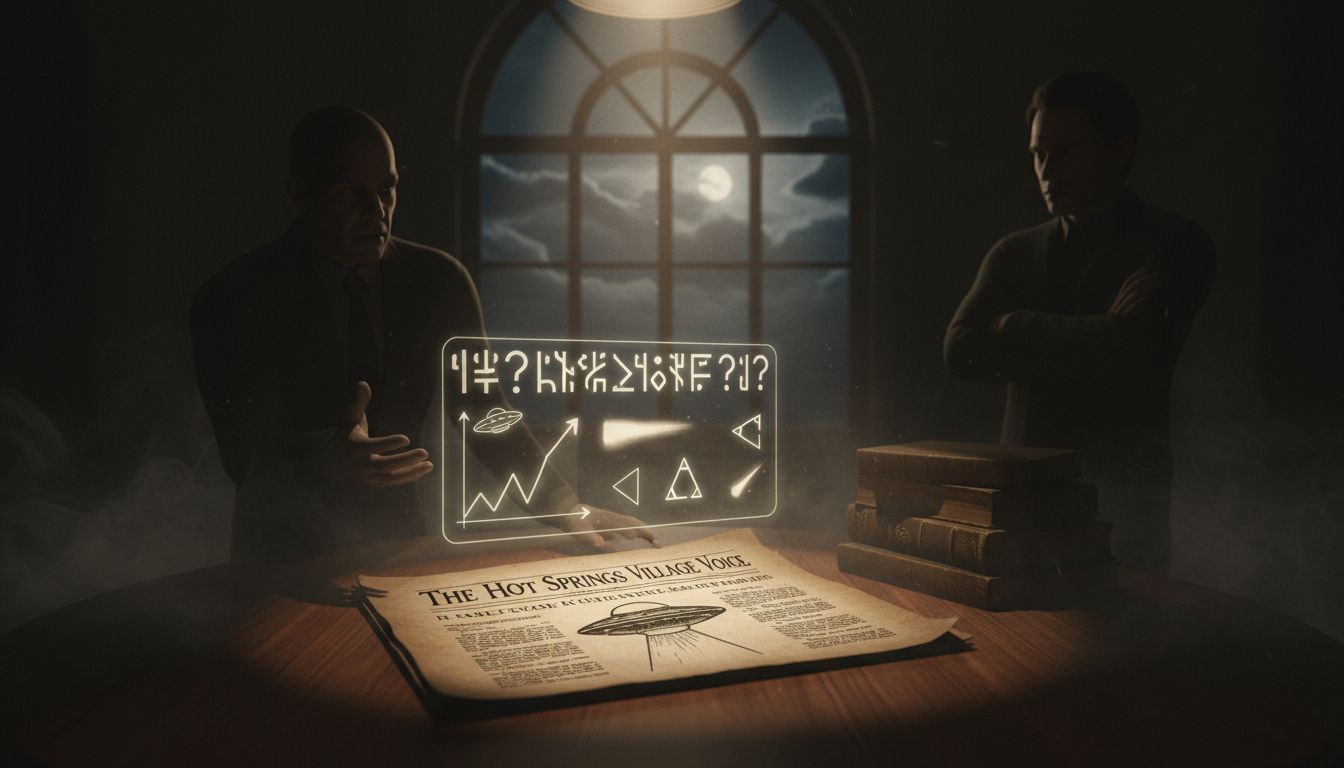
The debate over unidentified flying objects—now more commonly labeled UAP (Unidentified Anomalous Phenomena)—has resurfaced with renewed vigor in the United States. A recent piece in the Hot Springs Village Voice outlines how public opinion, scientific curiosity, and political pressure intersect on a topic that has long hovered between fringe speculation and serious inquiry. While some observers treat UFO sightings as isolated curiosities, others point to a pattern of unexplained incidents that involve high‑profile scientists and military personnel, prompting calls for transparent government investigation.
Recent Sightings and Historical Context
The article references a personal encounter reported by the author in the early 1970s, as well as a broader wave of sightings between 1964 and 1966 that motivated a generation of hobbyists to join groups such as the Aerial Phenomena Research Organization (APRO) and the National Investigations Committee on Aerial Phenomena (NICAP). More recent reports have surfaced in mainstream media, highlighting “unexplainable movements” captured on video by reputable researchers. These contemporary accounts have been amplified by the disappearance or death of several scientists—some formerly employed at the Jet Propulsion Laboratory, Los Alamos National Laboratory, and an Air Force Research Laboratory—whose cases remain unresolved, according to former FBI assistant director Chris Swecker.
Government Response
In May 2026, former President Donald Trump directed federal agencies to intensify the investigation of UAP and to release any related files on alien life. The directive led to renewed testimony from former Pentagon official Luis Elizondo, who managed the Advanced Aviation Threat Identification Program (AATIP) until his resignation in 2017. Elizondo, now working with the so‑called “Luna Committee,” emphasized a measured approach:
“We don’t want to rush the investigation. The FBI needs time to conduct a thorough review.”
Current FBI Director Kash Patel has pledged a prompt report in response to the presidential request, while former FBI official Chris Swecker maintains that the list of missing scientists is limited—approximately twelve individuals—with “four or five” cases already explainable, leaving a core group that “cannot be explained.” The administration’s push for declassification aligns with broader efforts to scrutinize historical records, including those related to the assassinations of JFK, RFK, and civil‑rights leader Martin Luther King Jr.
Expert Perspectives
To provide a balanced view, the Village Voice correspondent consulted Larry Hancock, a veteran UFO researcher and Air Force communications specialist. Hancock’s career spans decades of civilian investigative work and academic study. He recounts a 1970s incident at Sheppard Air Force Base where an object entered restricted airspace, performed multiple low‑altitude passes over the runway, and vanished without any identifiable communication signals. “It couldn’t be identified; it had no communication and was in restricted airspace at three or four in the morning,” Hancock said.
Hancock, author of the forthcoming book UFO Intentions: Decoding the Patterns (release slated for September 29), stresses methodological rigor: “My approach avoids speculation. We need verifiable data before drawing conclusions about intent or origin.” His assessment mirrors a growing sentiment among serious researchers that, while many sightings can be explained by conventional aircraft, atmospheric phenomena, or sensor artifacts, a subset remains resistant to current scientific models.
Cultural Impact and Outlook
Public reaction to the UFO controversy remains mixed—ranging from curiosity and belief to outright skepticism and fear. Media coverage of the issue has spurred renewed interest in the phenomenon, influencing everything from popular entertainment to academic conferences. Yet the underlying tension lies in the balance between national security concerns and the public’s right to know. As the FBI prepares its report and the Luna Committee pushes for further declassification, the next few months could determine whether the discourse shifts from speculative intrigue to evidence‑based policy.
Regardless of the outcome, the Hot Springs Village Voice article underscores that the UFO conversation is no longer confined to fringe forums; it now occupies a legitimate space in the national dialogue, demanding transparency, rigorous analysis, and, above all, an objective assessment of the facts.


