Overview
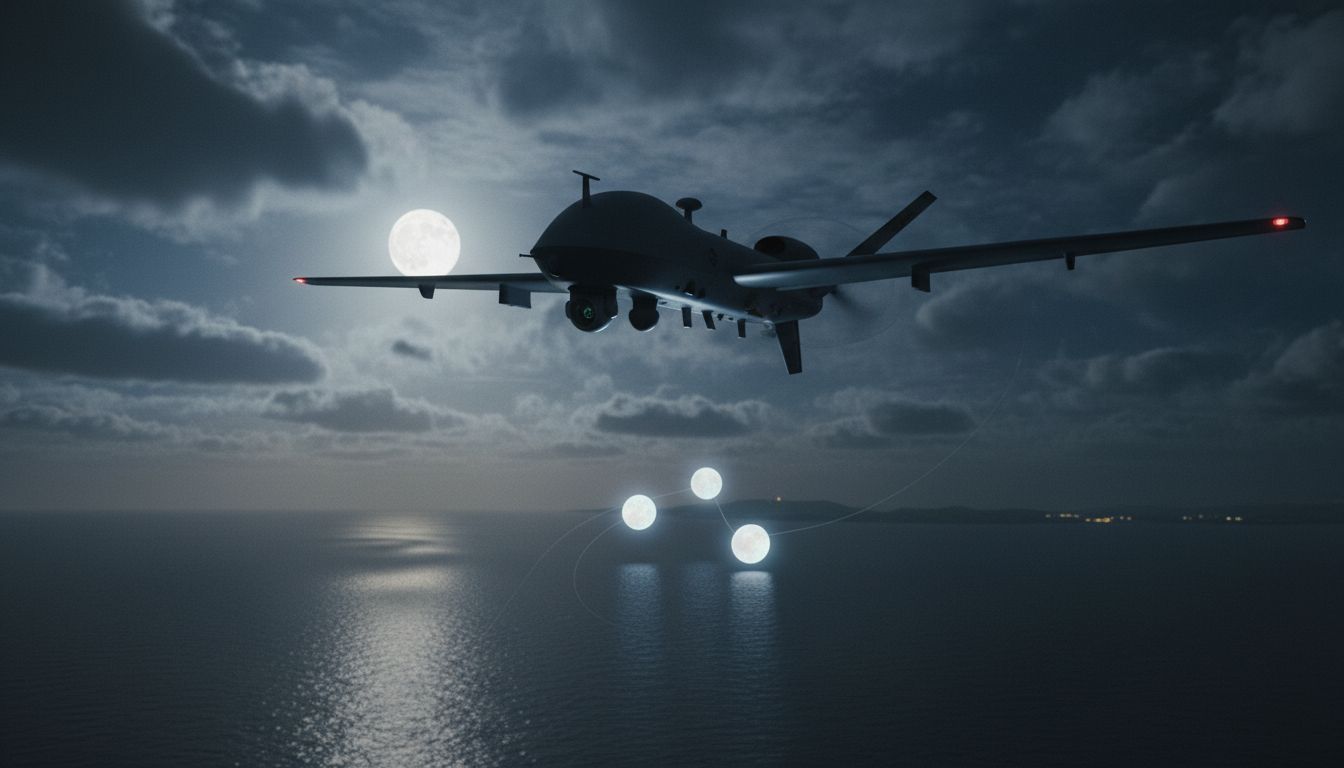
On August 23, 2012, a United States Air Force MQ‑9 Reaper drone captured infrared footage of three luminous, orb‑like objects moving over the Persian Gulf near the Saudi‑Iran maritime boundary. The recording, obtained by investigative journalist Jeremy Corbell and his colleague George Knapp, was released on their WEAPONIZED podcast and quickly attracted attention because it originates from a military‑grade sensor system rather than a civilian smartphone. The Department of Defense (formerly the Department of War) subsequently classified the video as UAP—Unidentified Anomalous Phenomena—and, according to Corbell, placed it in a restricted “non‑human” archive that is not accessible to the public.
Flight Characteristics
The infrared sequence shows three distinct points of light maintaining a precise triangular formation for most of the minute‑long clip. The objects remain equidistant, suggesting coordinated motion rather than random drift. No conventional aircraft signatures—such as wings, fins, exhaust plumes, or radar cross‑section—are visible. Mid‑recording, one orb briefly drops out of formation, lingers before accelerating forward to rejoin the triangle, a maneuver described by Knapp as “clearly not a single craft with three lights but three separate objects moving together.” The lack of aerodynamic features and the apparent “playful” maneuver have led analysts to label the behavior as unexplained and non‑conventional.
Pentagon Handling and the “Non‑Human” Archive
Corbell reported that after the footage entered the Department of Defense’s review process, officials created a separate archival folder designated for evidence deemed “non‑human.” He cited internal documents indicating the video was stored alongside other UAP material that the Pentagon has chosen to keep out of standard public releases. While the exact criteria for this classification remain undisclosed, the move aligns with recent policy shifts that encourage the military to catalog anomalous sightings while limiting broader dissemination. “The fact that this clip was moved to a ‘non‑human’ repository tells us the agency believes it represents something outside the realm of known technology,” Corbell said on the podcast.
Context within the Persian Gulf UAP Hotspot
The Persian Gulf has emerged as a notable UAP hotspot over the past decade. U.S. Navy personnel stationed on carriers and littoral combat ships have logged numerous encounters with bright, fast‑moving objects that evade radar and visual confirmation. The 2012 MQ‑9 incident adds a sensor‑based data point to that growing body of evidence, reinforcing the region’s reputation for frequent, unexplained aerial activity. Analysts at the Pentagon’s All‑Domain Anomaly Resolution Office (AARO) have cited the Gulf’s dense military traffic and geopolitical sensitivity as factors that may increase both the occurrence and the reporting of such phenomena.
Implications and Next Steps
While the video does not provide definitive proof of extraterrestrial technology, its military provenance and the Pentagon’s decision to sequester it in a specialized archive raise questions about the scope of current UAP investigations. Congressional oversight committees have recently urged greater transparency, urging the Department of Defense to release declassified UAP material where national security permits. Observers hope that future releases will include sensor metadata—altitude, speed, and spectral signatures—that could help scientists assess whether the observed behavior aligns with known physical laws or points to new physics. Until such data become available, the Persian Gulf footage remains a compelling, albeit inconclusive, piece of the broader UAP puzzle.