Overview
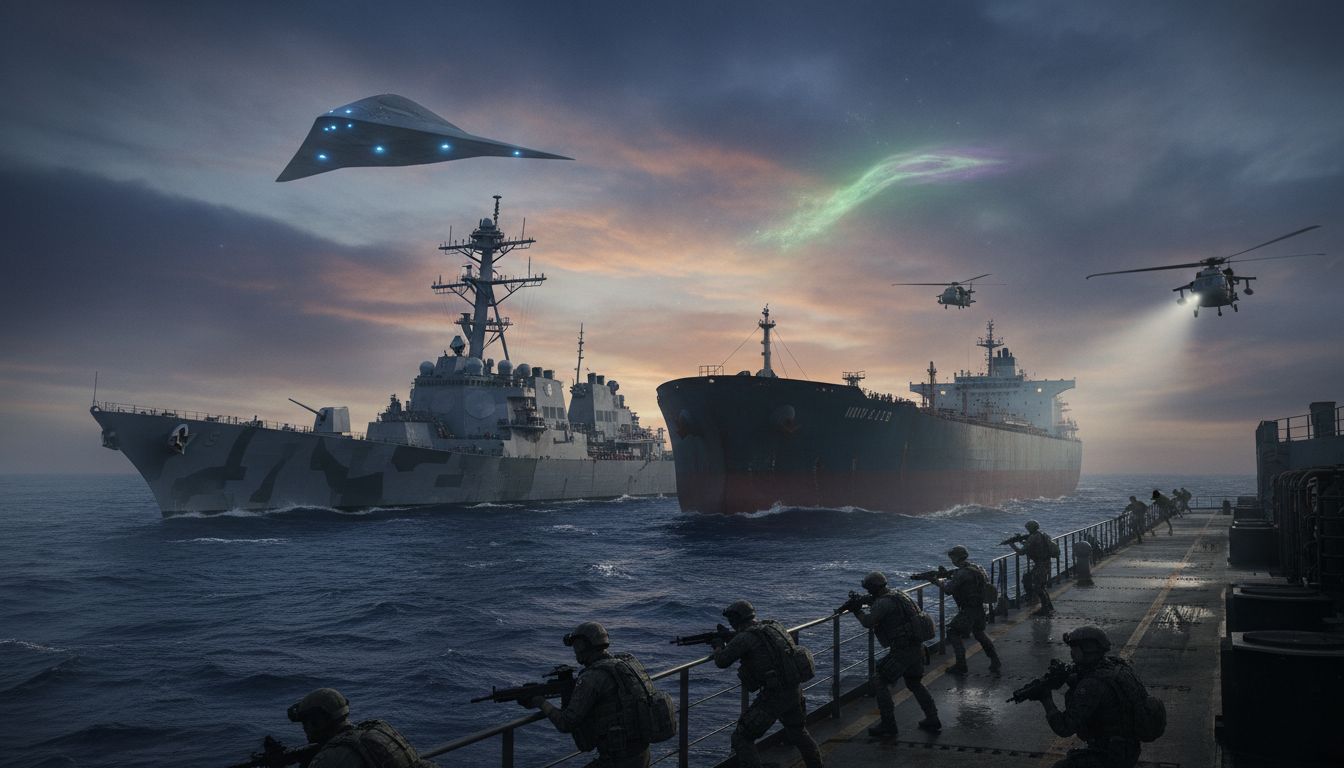
The U.S. Department of Defense confirmed on Tuesday that Navy and Coast Guard teams boarded an oil tanker sailing through the Indian Ocean after a unidentified aerial phenomenon (UAP) was detected tracking the vessel from the Caribbean Sea. The operation, carried out by a joint task force based out of the U.S. Indo‑Pacific Command, marks the latest instance in which U.S. forces have been able to follow a single anomalous object across more than 10,000 nautical miles of open water. Defense officials said the boarding was conducted under existing maritime‑security protocols and that the tanker, flagged to Venezuela, was escorted to a U.S.‑controlled quarantine zone for inspection.
Tracking the Phenomenon
According to a statement released by the Pentagon’s UAP Office, the aerial object was first logged by a U.S. Navy E‑2 Hawkeye operating out of Naval Air Station Key West on 9 February. Radar and infrared signatures indicated a high‑altitude, low‑observable platform moving at speeds inconsistent with known aircraft. “Our sensors picked up the anomaly over the Caribbean, and the data trail continued as it crossed the Atlantic, the equator and into the Indian Ocean,” said Rear Admiral James Miller, director of the All‑Domain Anomaly Resolution Office. The object maintained a steady course that intersected the projected path of the tanker MV San Juan, prompting the task force to maintain visual and electronic contact throughout the voyage.
The Boarding Operation
When the tanker entered the Indian Ocean’s “strategic monitoring zone” near the Maldives on 13 February, a U.S. Navy destroyer and a Coast Guard cutter intercepted it. Boarding parties, composed of maritime‑law enforcement officers and technical specialists, boarded the vessel without incident. “The crew was cooperative, and we found no evidence of contraband or weapons,” reported Lieutenant Commander Sarah Nguyen, commander of the boarding team. However, the UAP’s flight path was logged in the ship’s AIS (Automatic Identification System) data, providing a rare, continuous record that analysts can now compare with sensor readings from both the Caribbean and Indo‑Pacific theaters.
Implications for UAP Investigation
The incident underscores the Pentagon’s growing capacity to track anomalous objects over global distances, a capability that has only recently been formalized under the 2025 National Defense Authorization Act. The UAP Office, which reported 312 sightings in 2025, has been urging better inter‑agency data sharing. “Every time we can link a sighting in one theater to another, we move closer to understanding whether we’re dealing with advanced foreign technology, atmospheric phenomena, or something else entirely,” said Dr. Elena Vargas, senior analyst at the Office of the Secretary of Defense. The boarding also provided a controlled environment to test sensors against potential electromagnetic signatures that the UAP may have emitted.
Next Steps
The inspected tanker will remain under U.S. quarantine for up to 72 hours while forensic teams analyze its electronic logs, cargo manifests, and any residual radiation signatures. Simultaneously, the UAP Office will convene a multi‑service working group to assess whether the observed flight pattern aligns with any known foreign platforms. The Department of Defense has pledged to brief congressional oversight committees on the findings within the next month. As the investigation proceeds, officials stress that the focus remains on national security and maritime safety, rather than speculation, reinforcing a disciplined, evidence‑based approach to the increasingly frequent reports of unidentified aerial phenomena.