Overview
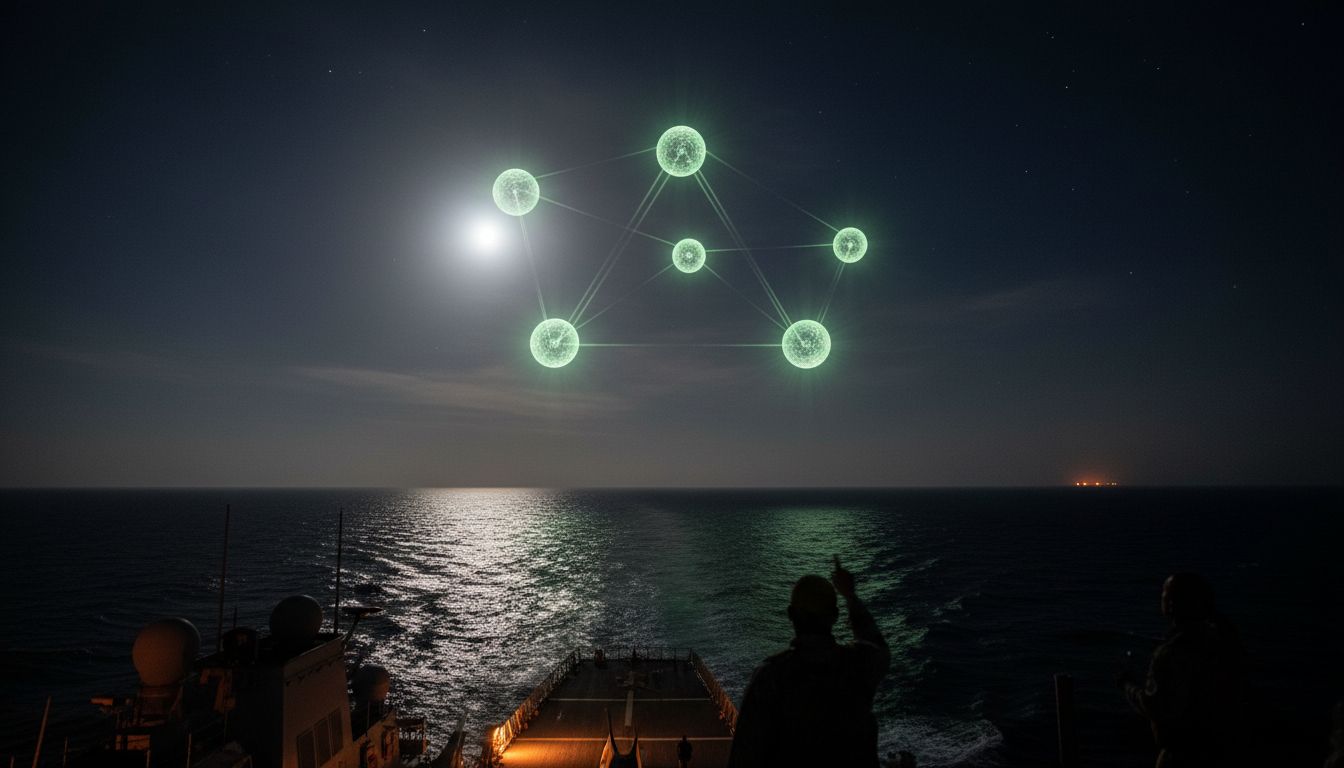
A newly released video captured by United States Navy pilots shows a series of luminous, spherical objects moving in a tight, coordinated formation over the Persian Gulf. The footage, posted by the Department of Defense’s Unidentified Aerial Phenomena (UAP) Task Force on February 5, adds to a growing repository of unexplained aerial sightings that the military has been systematically documenting since 2020. While the objects’ origin remains unknown, officials emphasize that the release is intended to increase transparency and support scientific analysis rather than to confirm extraterrestrial activity.
Video Details
The clip, recorded during a routine training sortie aboard the aircraft carrier USS Theodore Roosevelt, depicts three to four glowing orbs, each roughly the size of a small car, cruising at a steady altitude of approximately 15,000 feet. The objects maintain a constant separation of about 150 meters and execute synchronized maneuvers, including a brief acceleration followed by a smooth, level glide. The video’s metadata, verified by the Navy’s Office of Naval Intelligence, confirms the date of capture as January 28, 2026, and the geographic coordinates place the encounter roughly 120 nautical miles southeast of Bahrain.
In the accompanying de‑classified briefing, a Navy pilot, who requested anonymity, described the sighting as “unusual but not threatening,” noting that the orbs emitted a steady, white light and did not respond to radio communication attempts. The footage includes infrared and visible‑light recordings, allowing analysts to assess both thermal signatures and visual characteristics.
Official Response
The Pentagon’s UAP Task Force released a statement acknowledging the video and reiterating its mandate: “We continue to collect, analyze, and share data on aerial phenomena that cannot be readily identified, in order to assess any potential risks to flight safety and national security.” The statement, signed by Deputy Director Dr. Sean Kirkpatrick, clarified that the Department of Defense does not currently possess enough data to determine the objects’ nature, capabilities, or provenance.
A spokesperson for the U.S. Navy’s Office of Naval Intelligence added that the incident has been logged in the UAP Sightings Database, which is now accessible to accredited researchers under the UAP Transparency Act passed by Congress in 2024. “Our priority is to understand whether these phenomena represent advanced technology—whether foreign, domestic, or otherwise—and to ensure they do not pose a hazard to our personnel,” the spokesperson said.
Historical Context
The Persian Gulf sighting follows a series of high‑profile UAP disclosures, including the 2023 “Gimbal” and “GoFast” videos captured off the Atlantic coast, and the 2025 “Horizon” encounter over the South China Sea. Since the establishment of the UAP Task Force in 2020, the Department of Defense has released more than 30 vetted videos, prompting congressional hearings and a bipartisan push for greater scientific oversight.
Experts such as Dr. Jacques Vallée, a senior researcher at the UAP Research Center, caution against premature conclusions. “While the coordinated movement is intriguing, similar patterns have been observed in natural atmospheric phenomena and experimental drone swarms,” he explained. Conversely, aerospace analyst Lara Mitchell of AeroIntelligence notes that the objects’ lack of discernible propulsion signatures differentiates them from known military platforms, suggesting the need for further radar and electro‑optical correlation.
Next Steps
The Department of Defense has tasked the Joint Chiefs of Staff to allocate additional resources for high‑resolution sensor tracking of future UAP events in the region. A multidisciplinary panel comprising physicists, aerospace engineers, and intelligence analysts will convene in the coming weeks to review the Persian Gulf footage alongside other recent data sets.
Congressional oversight committees have scheduled a briefing for March 2026 to evaluate the progress of the UAP Task Force’s investigations and to consider amendments to the UAP Transparency Act that would expand data sharing with civilian scientific institutions. Until more conclusive evidence emerges, officials maintain a cautious stance, emphasizing that the primary concern remains flight safety and national security, not speculation about extraterrestrial origins.