Overview
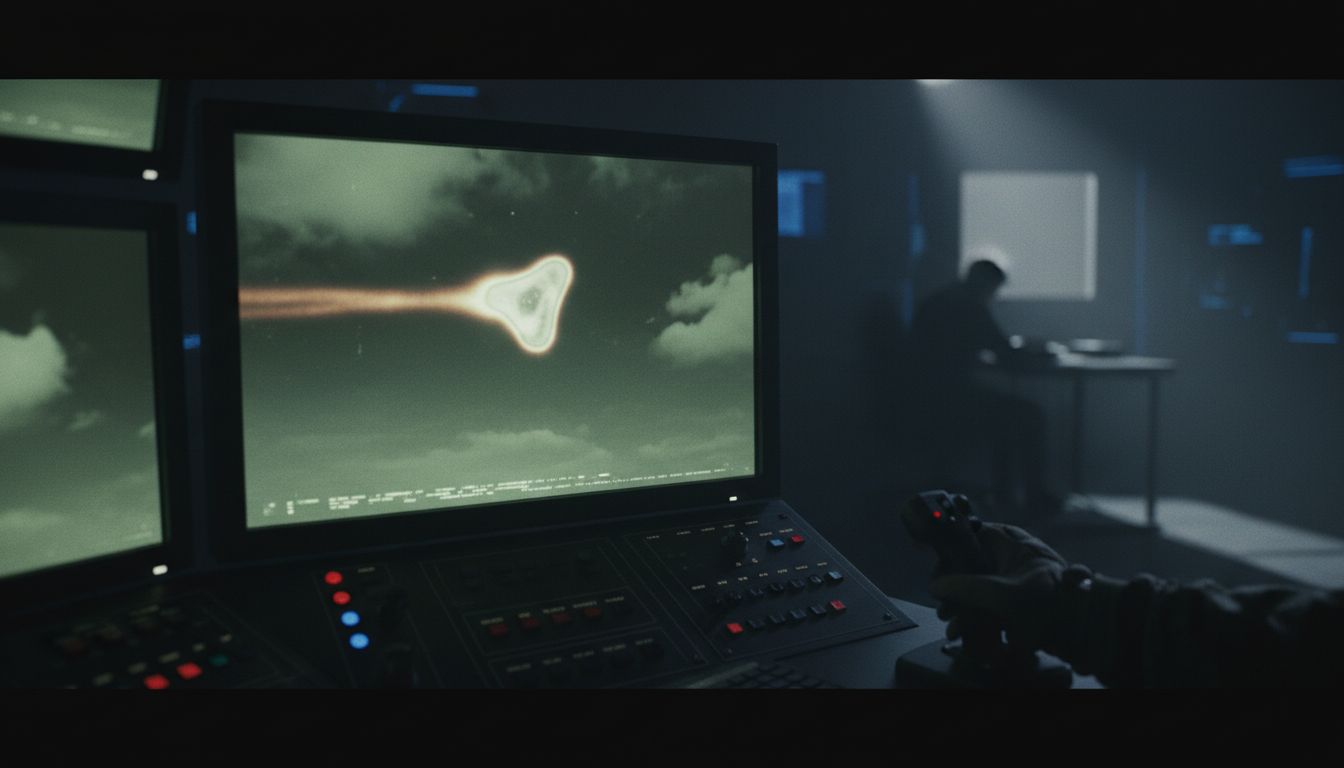
The Defense Visual Information Distribution Service (DVIDS) has published a new video, catalogued as DOW‑UAP‑PR069, that captures an unidentified aerial phenomenon (UAP) on the forward‑looking infrared (FLIR) sensor of an F/A‑18 fighter jet. The footage, released on the DVIDS portal, adds to a growing repository of military‑recorded UAP encounters that the Department of Defense (DoD) is reviewing as part of its ongoing effort to assess potential aerospace threats.
Video Details
The clip, recorded during a routine training sortie, shows a compact, glowing object traversing the sky at high speed. Unlike conventional aircraft, the object appears to execute abrupt changes in direction and altitude without visible propulsion signatures. The FLIR imagery, which renders heat signatures rather than visible light, highlights a distinct thermal contrast against the surrounding atmosphere, making the object's outline sharply defined. The video runs for roughly 30 seconds before the sensor loses lock, after which the object disappears from view.
Analyst Observations
A team of DoD analysts who reviewed the footage noted several unconventional flight characteristics:
- Rapid acceleration and deceleration that exceed known performance envelopes of current U.S. or foreign aircraft.
- Instantaneous vector changes that suggest a level of maneuverability not achievable with conventional aerodynamic control surfaces.
- Absence of a discernible propulsion plume in the infrared spectrum, raising questions about the energy source or propulsion method.
Lead analyst Lt. Col. James Whitaker (UAP Office, Pentagon) commented, “The thermal signature and kinematics observed in this recording do not match any known platform in our inventory. While we remain cautious, the data warrants further technical scrutiny.”
Official Response
The DoD’s UAP Task Force, established in 2022, has reiterated its commitment to a transparent, data‑driven investigation of such incidents. In a statement released alongside the video, the office said, “All credible reports of unidentified aerial phenomena are being catalogued and analyzed to determine whether they represent a potential national security concern.” The department has also encouraged service members to report similar encounters through established channels, emphasizing that the objective is safety and airspace integrity, not speculation.
Context and Implications
The release of DOW‑UAP‑PR069 follows a series of declassified videos—most notably the 2020 “GoFast” and “Gimbal” recordings—that sparked renewed public and congressional interest in UAPs. The Pentagon’s 2021 Preliminary Assessment on Unidentified Aerial Phenomena concluded that while most sightings could be explained, a fraction remained unexplained and required further study.
By providing raw FLIR data, the DoD offers researchers a technical baseline for independent analysis, potentially advancing understanding of sensor performance, atmospheric effects, and even novel aerospace technologies. The video also underscores the importance of infrared surveillance in modern combat aviation, where pilots rely on FLIR for threat detection in low‑visibility environments.
Next Steps
The UAP Task Force has logged the footage into its central database and will coordinate with the Air Force Research Laboratory and National Geospatial‑Intelligence Agency to conduct a multi‑disciplinary review. Expected actions include:
- Signal‑processing analysis to rule out sensor artifacts or electronic interference.
- Cross‑referencing with radar and other sensor logs from the same sortie.
- Comparative studies against known aerial platforms, including experimental drones and hypersonic vehicles.
As the investigation proceeds, the DoD has pledged to release further findings to the public, adhering to the transparency guidelines set forth by the 2022 UAP Reporting Act. Until then, DOW‑UAP‑PR069 remains a compelling piece of the broader puzzle surrounding unidentified aerial phenomena observed by U.S. military personnel.


