Overview
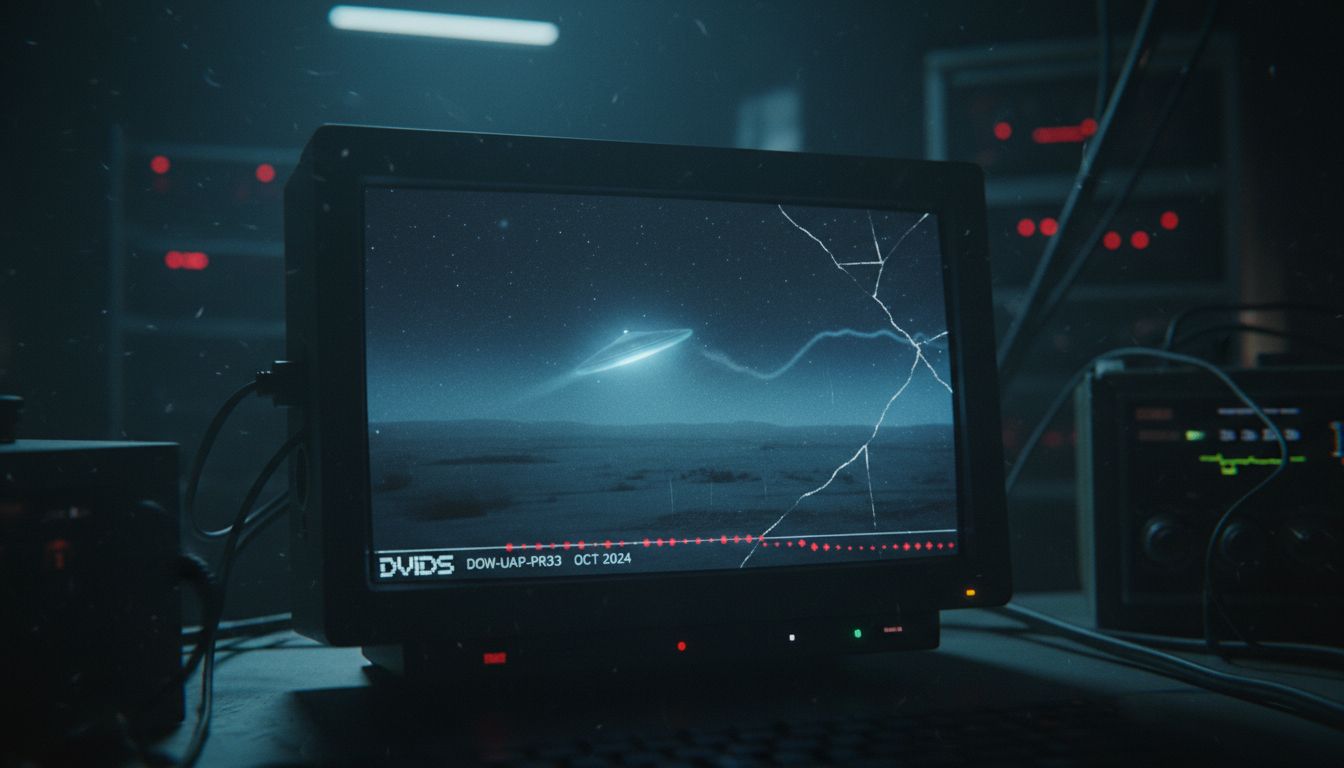
The Defense Visual Information Distribution Service (DVIDS) has posted a new video labeled DOW‑UAP‑PR33, documenting an unresolved unidentified aerial phenomenon (UAP) observed over Syrian airspace in October 2024. The short clip, released without accompanying analysis, shows a compact object executing rapid, erratic maneuvers at speeds that appear to exceed the capabilities of known aircraft in the region. The lack of an official explanation has sparked renewed discussion among defense analysts, UAP researchers, and policymakers about the frequency and nature of military‑observed aerial anomalies in contested zones.
Video Details
The footage, captured by an undisclosed U.S. or coalition sensor platform, runs for approximately 45 seconds. In the sequence, a luminous object—approximately the size of a small aircraft—appears near the horizon, accelerates vertically, then executes a series of abrupt turns and a sudden deceleration before disappearing from view. The video’s metadata, as provided by DVIDS, confirms the timestamp as 15 October 2024, with the location recorded as “Syria – operational theater.” No identifying markings, propulsion signatures, or pilot commentary are present. A DVIDS spokesperson noted that the material is “released for informational purposes only” and that “the incident remains classified as unresolved pending further analysis.”
Historical Context
Syria has been a focal point for aerial monitoring since the escalation of the civil war in 2011, with multiple nations operating surveillance assets to track both combatant and civilian activity. Over the past decade, the U.S. Department of Defense has publicly acknowledged a series of UAP encounters, most notably through the 2020 Unidentified Aerial Phenomena Task Force (UAPTF) report and the subsequent establishment of the All‑Domain Anomaly Resolution Office (ADARO) in 2022. Those reports highlighted a concentration of sightings in “high‑risk operational areas,” a category that includes the Middle East. The DOW‑UAP‑PR33 video adds to a growing archive of unexplained aerial events recorded by military sensors, reinforcing concerns that such phenomena may intersect with ongoing security operations.
Expert Commentary
Aerospace analyst Dr. Michael S. Harris, who advises the Pentagon’s ADARO, cautioned against premature conclusions: “While the maneuverability displayed in the DOW‑UAP‑PR33 clip is certainly atypical for conventional platforms operating in the region, we must consider sensor artifacts, atmospheric effects, and classified technology before assigning any extraordinary label.”
UAP researcher Luis Alvarez of the UAP Research Consortium emphasized the importance of transparency: “The release of raw video, even without analysis, is a positive step toward building a data set that can be examined by the broader scientific community. However, without corroborating radar data or sensor logs, the incident remains speculative.”
A senior official from the U.S. Central Command (CENTCOM), speaking on condition of anonymity, declined to comment on the specific video but reaffirmed the command’s ongoing commitment to “investigate any anomalous activity that could impact operational safety or national security.”
Next Steps and Implications
The DVIDS release underscores the need for systematic collection and cross‑domain analysis of UAP data, a priority repeatedly highlighted in congressional briefings since 2021. ADARO officials have indicated that forthcoming upgrades to sensor fusion capabilities—integrating visual, infrared, and radar feeds—will enable more rigorous assessments of future sightings. In the meantime, military units operating in the Syrian theater have been reminded to log any anomalous observations through established reporting channels.
For policymakers, the video adds pressure to allocate additional resources to the UAP investigative framework, especially as the National Defense Authorization Act (NDAA) for FY 2025 includes provisions for expanding the scope of ADARO’s mandate. As the DVIDS archive continues to grow, analysts anticipate that a clearer picture may emerge regarding whether such phenomena represent novel technology, natural atmospheric events, or other unknown factors—a question that remains at the intersection of national security and scientific inquiry.


