Overview
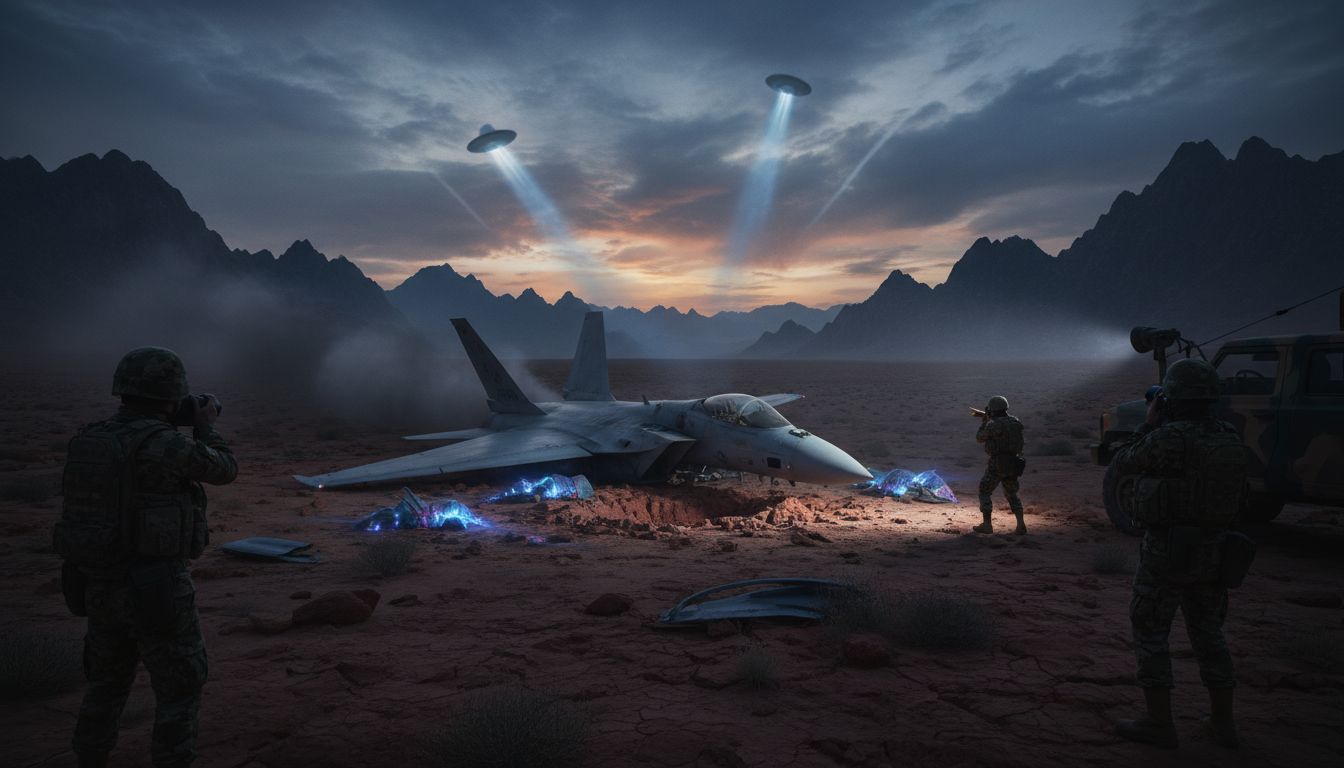
Iran’s state news agency released a short video and a series of photographs on Sunday, claiming that a United States F‑16 fighter jet was shot down after it entered Iranian airspace near the Persian Gulf. The footage, which shows what Iranian officials describe as wreckage on a desert runway, has been circulated on Iranian social‑media channels and quickly picked up by regional broadcasters. While Tehran’s narrative frames the incident as a clear violation of its sovereign airspace, no independent confirmation has emerged, and the United States has not yet responded publicly.
Iran’s Presentation of the Evidence
In the video, a dark‑colored aircraft is seen descending rapidly before a plume of smoke erupts from its wing. The accompanying still images depict twisted fuselage sections, a broken wing spar, and a U.S.‑style roundel that Iranian officials say matches the markings of an F‑16. Iranian Defense Minister Amir Hatami is quoted in the release: “The evidence is undeniable – a hostile aircraft was downed over Iranian territory, protecting our nation from unlawful intrusion.” The state‑run news outlet IRNA added that the aircraft was identified by serial numbers visible on the engine housing, though the footage does not allow external analysts to verify those details.
Independent Verification and Expert Assessment
U.S. and international observers have so far been unable to corroborate the claim. Open‑source analysts on platforms such as Bellingcat have noted that the video’s resolution and angle make it difficult to positively identify the aircraft type. Dr. Michael S. Hoffman, a senior researcher at the Center for Aerospace Studies, cautioned: “Without high‑resolution imagery or telemetry data, we cannot confirm whether this is an F‑16, a different platform, or even a non‑military aircraft.” The U.S. Department of Defense’s public affairs office declined to comment, citing standard protocol on ongoing operations. Satellite imagery of the alleged crash site, which would be a key source of verification, has not been released by either side.
Geopolitical Context
The alleged downing occurs against a backdrop of heightened U.S.–Iran tensions. In recent months, both nations have conducted aerial patrols near the Strait of Hormuz, and there have been several reported near‑misses involving drones and reconnaissance aircraft. Tehran has previously warned that “any unauthorized flight over Iranian airspace will be met with decisive action.” The claim, if substantiated, could mark the first confirmed shoot‑down of a U.S. combat jet by Iran since the 1988 incident that downed an F‑14 during the Iran–Iraq War, potentially prompting diplomatic protests or retaliatory measures.
Unidentified Aerial Phenomena (UAP) Angle
The release has also revived discussion about unidentified aerial phenomena in contested regions. Earlier this year, the U.S. Office of the Director of National Intelligence released a report acknowledging that a small percentage of UAP sightings remain unexplained, many of which occur near military training areas. Some analysts speculate that the Iranian footage could be an attempt to divert attention from recent UAP reports over the Gulf, though no concrete link has been established. Dr. Laura K. Miller, a UAP researcher at the National Institute for Aeronautics, noted: “Whenever there is a high‑profile military incident, it tends to spark renewed interest in anomalous sightings, but we must keep the two issues distinct until the facts are clear.”
Outlook
For now, the incident remains a claim without independent corroboration. International observers will be watching for any forthcoming statements from the Pentagon, as well as for additional evidence such as satellite passes, radar logs, or eyewitness accounts. Should the claim be verified, it could trigger a diplomatic flare‑up and intensify calls for clearer rules of engagement in the busy airspace above the Persian Gulf. Until then, analysts urge caution, emphasizing that the burden of proof lies with the claimant and that speculative links to UAP phenomena should be treated separately from the core issue of a potential breach of sovereign airspace.


