Overview
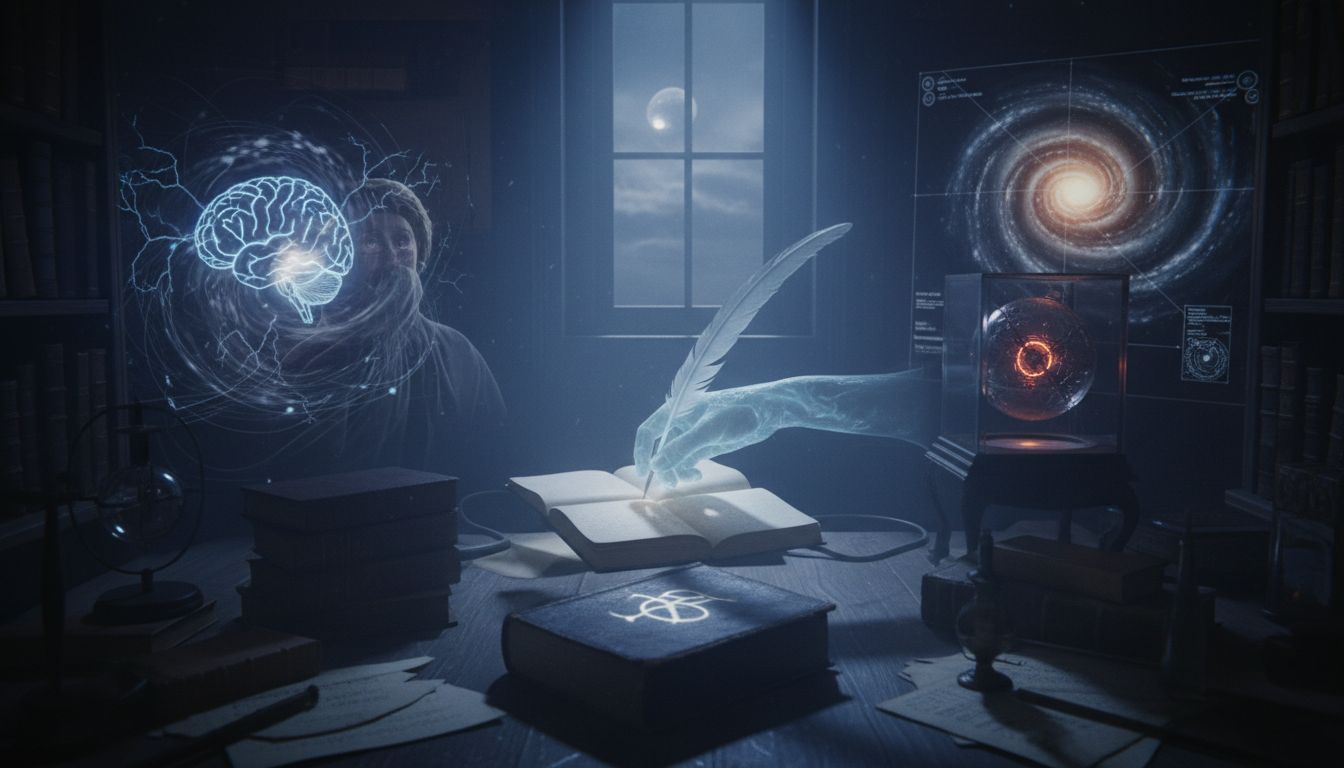
A recent article on White Crow Books revisits a long‑standing speculation: that Harriet Beecher Stowe’s 1852 anti‑slavery novel Uncle Tom’s Cabin may have been produced through automatic writing, a form of trance‑based composition traditionally associated with spiritualist mediums. The piece draws on an exchange with ChatGPT, which supplied quotations attributed to Stowe, and juxtaposes the claim with contemporary parapsychological ideas championed by biologist Rupert Sheldrake—most notably his hypothesis that consciousness can extend beyond the brain, a notion he illustrates with the phenomenon of phantom limbs. Readers are invited to explore the debate further through a linked article and the EyeSense Training phone app, which purports to let users test “paranormal” perception.
Claims About Stowe’s Creative Process
According to the AI‑generated response cited by the article, Stowe described the inspiration for Uncle Tom’s Cabin in terms that echo the language of divine dictation. She is quoted as saying, “I did not write it. God wrote it. I merely did his dictation,” and noting that vivid visions moved her to tears as she transcribed them. While mainstream biographies acknowledge Stowe’s deep evangelical faith and her belief that the novel was a moral mission, they do not record her as a medium or as employing trance‑writing techniques. The article notes that spiritualist circles of the late 19th century occasionally claimed Stowe’s work was “received” rather than invented, but such interpretations remain marginal in scholarly literature.
Historical Context of Automatic Writing
The article situates Stowe’s alleged trance‑state alongside documented cases of automatic writing from the 19th and 20th centuries. In 1957, English writer Grace Rosher reported hearing a clairaudient command—“Leave your hands there and see what happens”—that caused her pen to move unaided, producing messages from a deceased friend, Gordon Burdick. Similarly, Margaret Cameron’s 1918 memoir The Seven Purposes describes the sensation of “holding a quiet, live bird” while words flowed through her fingers. Perhaps the most renowned automatist, Irish medium Geraldine Cummins, was featured in the 1953 work The Road to Immortality, where contemporaries described her method of covering one eye and allowing the hand to write without conscious direction. These anecdotes provide a cultural backdrop for the suggestion that Stowe might have tapped into a comparable process.
Scientific Perspectives and Sheldrake’s Hypothesis
Rupert Sheldrake’s morphic resonance theory, which posits that patterns of organization can be transmitted across time and space, is invoked to bridge the historical accounts of automatic writing with contemporary neuroscience. Sheldrake frequently cites the experience of phantom limbs—where amputees feel sensations in missing body parts—as evidence that the mind can operate independently of the physical brain. Critics argue that such phenomena are more parsimoniously explained by cortical re‑mapping, yet Sheldrake maintains that they hint at a broader, non‑local consciousness. The White Crow Books article presents his ideas as a “speculative framework” for interpreting claims like Stowe’s, while emphasizing that empirical validation remains lacking.
Public Engagement and Further Exploration
To move the conversation beyond academic debate, the article promotes an interactive component: a linked feature article and the EyeSense Training mobile app, which claim to train users in perceiving subtle energetic cues often associated with mediumistic practice. The app’s developers describe exercises designed to heighten “inner awareness” and test for anomalous perception, encouraging participants to record any experiences that might parallel historical automatic‑writing accounts. While the initiative is marketed as a personal exploration tool, the article cautions readers to approach such apps with a critical mindset, noting that anecdotal reports do not substitute for controlled research.
Conclusion
The White Crow Books piece offers a balanced look at a fringe hypothesis that intertwines 19th‑century spiritualism, modern AI‑mediated research, and contemporary theories of extended consciousness. By presenting ChatGPT’s synthesis of Stowe’s own words, contextualizing automatic writing within a broader historical tradition, and outlining Sheldrake’s controversial scientific stance, the article invites readers to consider how cultural narratives about inspiration and the supernatural persist. Whether one views Uncle Tom’s Cabin as a product of earnest abolitionist fervor, divine inspiration, or an unverified trance‑driven process, the discussion underscores the enduring fascination with the sources of creative genius and the limits of empirical understanding.


