Overview
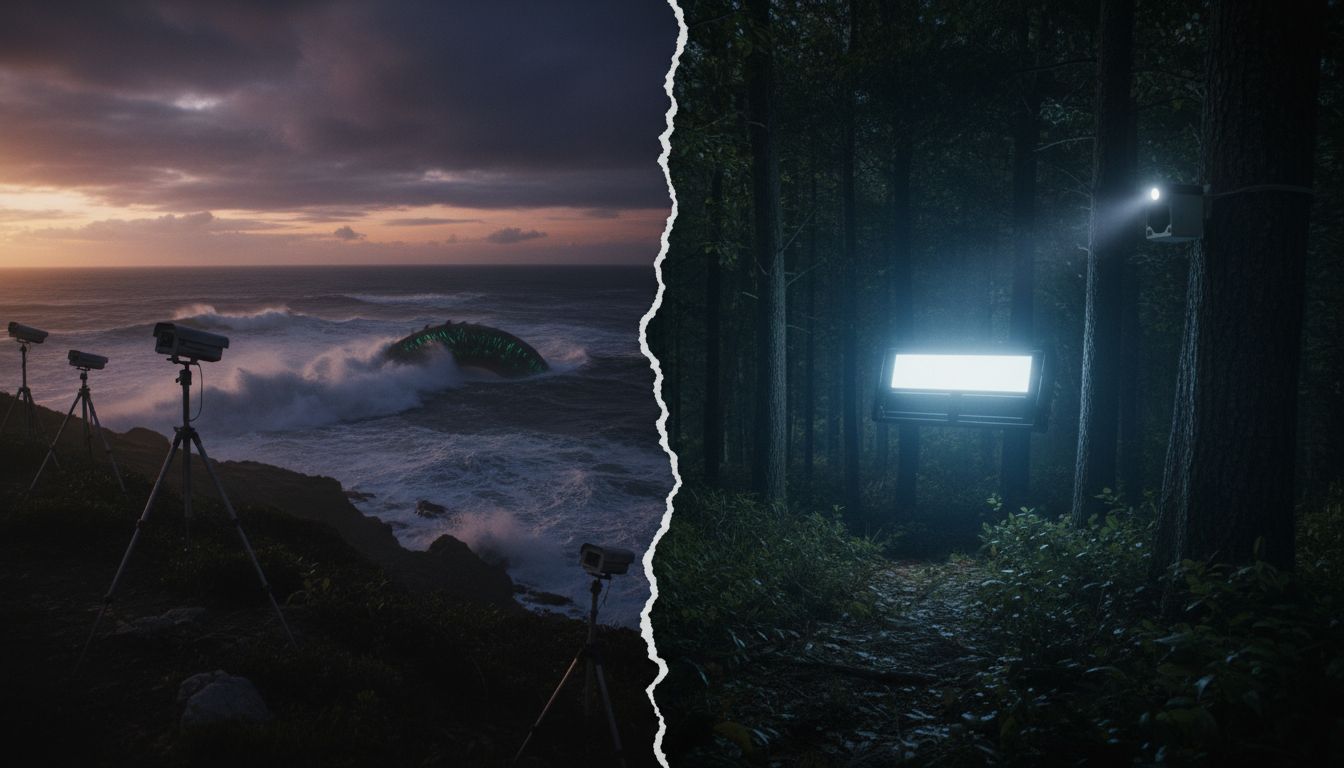
Automated surf‑camera footage captured off the coast of Western Australia has sparked renewed interest in unexplained marine phenomena. The video, released by the Australian Department of Fisheries and shown on the Coast to Coast AM program, depicts a large, fast‑moving silhouette gliding just beneath the surface. In a separate, unrelated incident, a motion‑activated game camera set in a rural Alabama hunting preserve recorded a bright, roughly 4‑by‑8‑foot orb hovering near a group of deer. Both clips have prompted cautious commentary from UFO/UAP investigators, who stress the need for rigorous analysis before assigning any definitive classification.
The Australian Surf‑Camera Footage
The Western Australian camera, part of a network that monitors surf conditions for safety and research, captured a dark shape that appears to be 10‑15 feet long, moving with a speed and agility not typical of known marine mammals. The footage shows the creature surfacing briefly, then disappearing beneath the waves. After reviewing the clip, local authorities issued a brief advisory urging beachgoers to stay out of the water until further investigation could determine whether the presence posed any risk. No known species—such as seals, dolphins, or large fish—match the observed size and swimming pattern, leading some observers to label it a “mystery creature.”
The Alabama Orb Capture
In the United States, a hunter’s trail camera set near a deer feeding area in Alabama recorded an unidentified luminous object measuring roughly four feet high by eight feet wide. The orb emitted a steady, white glow and hovered for several seconds before accelerating upward and vanishing from view. The video, also featured on Coast to Coast AM, was initially described by the uploader as a possible “large insect” due to its apparent hovering behavior, but the sheer dimensions and lack of identifiable limbs made that explanation unlikely. Researchers familiar with wildlife camera artifacts noted that while camera glitches can produce bright spots, the consistent shape and motion in this case warrant a more thorough review.
Expert Commentary
UAP analysts who contributed to the Coast to Coast AM segment emphasized a methodical approach. Dr. Michele R. Hsu, a marine biologist at the University of Western Australia, noted, “The footage could represent an undocumented marine animal, but without corroborating sonar data or physical evidence, we must remain cautious.” Similarly, John K. Baker, a senior investigator with the Mutual UFO Network (MUFON), said of the Alabama orb, “We have documented insects and birds appearing as bright blobs on motion‑triggered cameras, yet the scale here is extraordinary. It is premature to dismiss it as a simple misidentification.” Both experts called for additional data—such as multiple camera angles, environmental sensors, or eyewitness accounts—to move beyond speculation.
Context Within the Wider UAP Landscape
These incidents arrive amid a growing body of publicly released UAP material, including the U.S. Department of Defense’s recent “unidentified aerial phenomena” reports. While the Australian marine clip adds to a modest catalog of unexplained oceanic sightings—ranging from the 2015 “Megalodon‑like” footage off New Zealand to the 2021 “giant squid” video—its verification remains limited to a single camera angle. The Alabama orb, on the other hand, contributes to a less‑explored category of terrestrial luminous phenomena, which has historically received less scientific attention than aerial sightings. Both cases illustrate the challenges of interpreting low‑resolution, single‑source media in the age of ubiquitous surveillance equipment.
Next Steps and Public Response
Authorities in Western Australia have indicated that they will deploy additional sonar and aerial surveys in the area to ascertain whether any unusual marine activity is ongoing. In Alabama, the game‑camera owner plans to set up multiple synchronized cameras to capture any repeat appearances of the orb. Meanwhile, the public response on social media has been mixed, with some users expressing curiosity and others urging restraint to avoid “jumping to conclusions.” As the investigations proceed, experts agree that transparent data sharing and peer‑reviewed analysis will be essential for determining whether these sightings represent new biological entities, novel atmospheric phenomena, or artifacts of modern recording technology.


