Overview
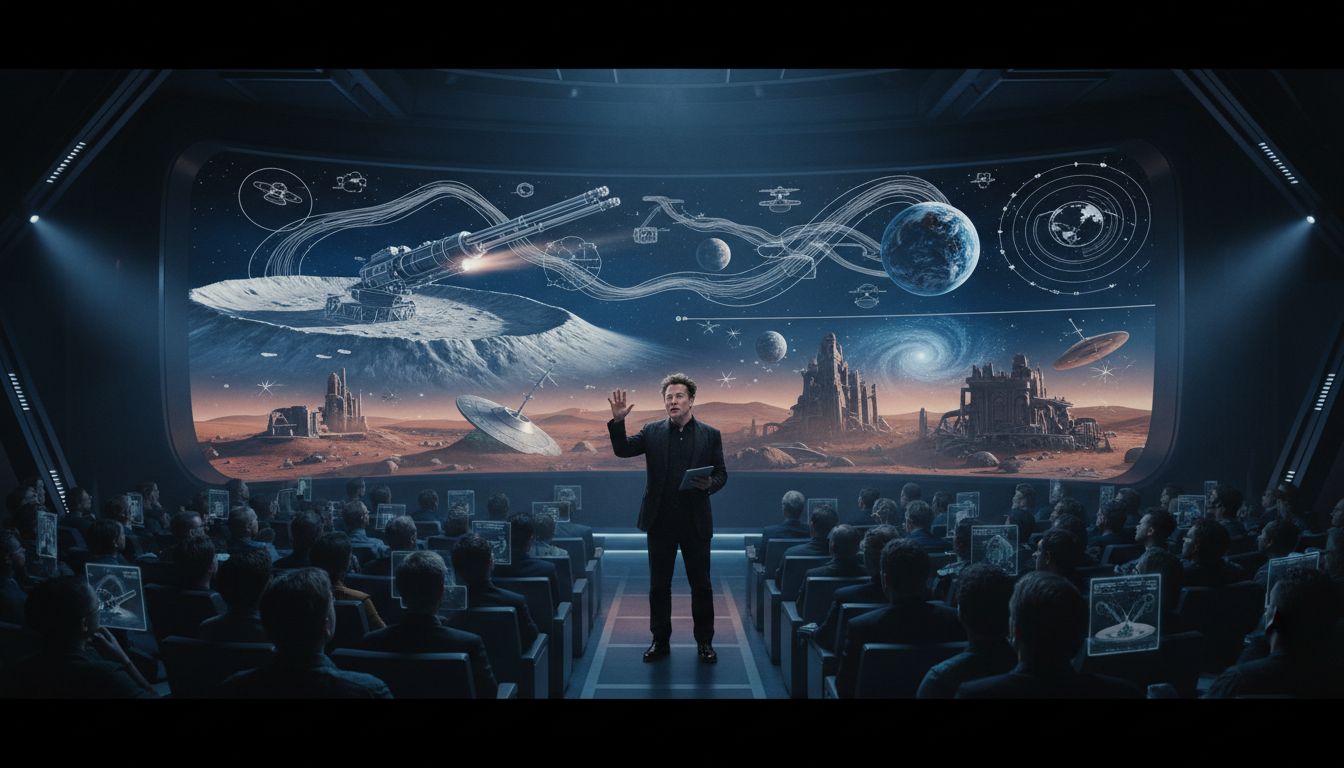
Elon Musk’s recent all‑hands meeting at xAI, the artificial‑intelligence subsidiary he founded in 2023, was posted in full on X earlier this week. In the hour‑long session, Musk outlined an ambitious roadmap that includes a lunar mass‑driver to launch AI‑enabled satellites, a renewed push to colonize the Moon and Mars, and a research program aimed at locating “remnants of ancient alien civilizations.” While the ideas echo Musk’s long‑standing vision of a multiplanetary future, investors and industry observers note that the delivery was unusually fragmented, raising questions about strategic focus as the combined SpaceX‑xAI enterprise prepares for a potential public offering.
Key Points from the Speech
During the meeting, Musk repeatedly returned to the concept of a mass driver on the Moon—a rail‑gun‑like system that would “shoot AI satellites into deep space, shoom, shoom, one after the other.” He described the device as a “sci‑fi catapult” that could dramatically reduce the cost of deploying orbital infrastructure. The plan, according to Musk, would involve leveraging lunar regolith as launch material and harnessing solar power to accelerate payloads to escape velocity.
Musk also reiterated his commitment to establishing a permanent human presence on both the Moon and Mars. He linked the lunar project to a broader “energy‑harvesting” strategy, suggesting that the Moon could serve as a staging point for solar‑collection arrays that would “consume an ever‑greater percentage of the Sun’s energy.” Although the technical specifics were sparse, Musk emphasized that the mass driver would be a critical step toward these goals.
Perhaps the most speculative element of the address was the proposal to search for “remnants of ancient alien civilizations.” Musk framed this as a scientific frontier that could be explored with advanced AI‑driven probes launched from the lunar mass driver. He did not provide concrete timelines or partnerships, but the statement aligns with his previous public interest in the possibility of extraterrestrial intelligence.
Corporate Context
The meeting took place against a backdrop of significant personnel turnover at xAI. More than half of the company’s original eleven co‑founders have resigned in recent months, including senior engineer Tony Wu, whose departure was announced just yesterday. Analysts at Bloomberg and Reuters have flagged the exodus as a potential risk factor for the upcoming fundraising round.
Musk has indicated that, once SpaceX and xAI become a publicly traded entity, he aims to raise $50 billion from institutional investors. A Reuters report from January 2026 suggested that the combined valuation could exceed $15 trillion, attracting pension funds and sovereign wealth funds. The all‑hands session, therefore, served not only as a technical briefing but also as a morale‑building exercise ahead of what Musk describes as “the next big capital event.”
Market and Industry Reactions
Wall Street analysts have responded cautiously. JPMorgan’s technology sector lead, Sarah Patel, noted that “the vision is bold, but the execution roadmap remains vague, especially regarding the lunar infrastructure and the alien‑search program.” Venture capital firms that have previously backed xAI expressed optimism about the mass‑driver concept, citing recent advances in electromagnetic launch technology demonstrated by private firms in 2025.
Competitors in the commercial space sector, notably Jeff Bezos’s Blue Origin, have historically issued “bizarre statements” about space colonization, but have generally paired them with detailed engineering milestones. Industry observers therefore view Musk’s current rhetoric as a mix of genuine ambition and marketing flair, emphasizing the need for clear milestones and transparent budgeting before large‑scale capital commitments are made.
Outlook
As the combined SpaceX‑xAI entity moves toward a potential IPO later this year, the company’s ability to translate Musk’s expansive ideas into actionable projects will be closely scrutinized. The lunar mass driver, if realized, could reshape satellite deployment economics and enable deeper space missions, while the search for extraterrestrial artifacts remains a long‑term scientific endeavor with uncertain payoff.
Stakeholders will likely watch for concrete engineering timelines, budget allocations, and talent retention strategies in the months ahead. Until then, Musk’s all‑hands meeting offers a glimpse into an ambitious roadmap—one that blends cutting‑edge AI, space infrastructure, and speculative science—while underscoring the challenges of aligning visionary goals with operational reality.