Overview
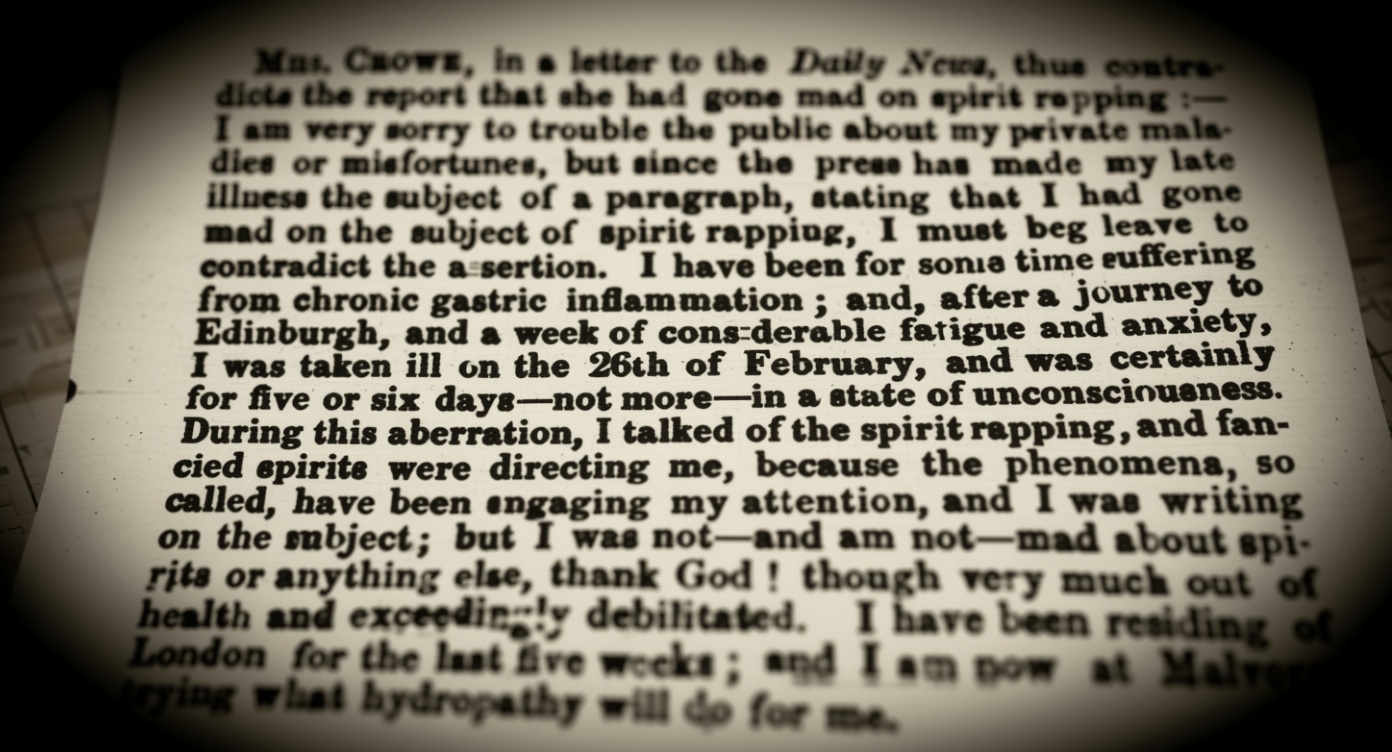
Victorian author Catherine Crowe (1790–1872) is best known today as an early and influential writer on supernatural phenomena, but a recent post from Brom Bones Books argues that one of the strangest parts of her legacy remains frustratingly difficult to verify: her own ghost hunt. Author and researcher Tim Prasil has been methodically digging into the case, yet so far the trail leads back to Crowe’s own account and little else. That scarcity of evidence is notable in itself, given Crowe’s importance to the history of ghost literature and her inclusion in Prasil’s Victorian Ghost Hunter’s Casebook.
What Crowe Claimed
According to the post, Crowe learned of an allegedly haunted house from a lawyer who managed the property. The house, she wrote, had gained a reputation for being “troubled,” bad enough that it had not been successfully rented or sold for years. Crowe is careful, however, to say very little about the exact nature of the disturbances. The clearest reported complaint was that “unaccountable lights” had been seen. Another recurring concern involved the back parlor, which the lawyer said was the room where previous occupants had experienced “most annoyance.” Beyond that, the evidence remains thin, and Crowe’s knowledge of the case appears to have come largely through the lawyer’s recollections rather than direct documentation from residents or outside observers.
The Investigation
Even with limited information, Crowe assembled what the post describes as a small investigative team: herself; the lawyer, identified only as “Mr. Mc N.”; a young girl who, when mesmerized, was said to be a “good clairvoyante”; and two acquaintances described as “very eminent men, with honest, inquiring minds.” The house itself was not some isolated country manor, but rather a modest urban building: a narrow-fronted structure with one window and a door on the ground floor, two windows above, and three stories over a kitchen, scullery, and cellars. Crowe’s account even indicates the property stood in a city, suggesting a dense neighborhood rather than a remote rural setting. That detail may matter, since many Victorian haunting narratives were shaped by the social pressures of urban life as much as by claims of the paranormal.
What the Night Produced
Prasil’s broader point, as reflected in the post, is that Crowe’s investigation yielded very little in the way of dramatic evidence. She herself reportedly said the expedition “resulted in almost nothing,” though the account does include at least one unexplained occurrence: a metallic sound at the door, “like the striking of two pieces of iron,” heard by everyone present. Crowe stopped short of claiming certainty about its cause, leaving open the possibility of an ordinary explanation. That restraint is part of what makes her account valuable to historians: it documents not only supernatural curiosity, but also the limits of what such investigations could establish.
A Brief Modern Echo
The post then shifts away from Crowe and into a separate paranormal anecdote from Ghana, where a hunter reportedly described seeing a ghostly dinner party in the night. Though brief, the story adds another example of how ghost narratives continue to circulate across cultures and eras, often with little verifiable evidence but strong local resonance. Taken together, the two accounts highlight a familiar pattern in supernatural reporting: the tension between testimony, interpretation, and proof. In Crowe’s case, that tension is especially important, because it shows how even a pioneering writer on the occult could be left with more questions than answers.