Overview
Recent online postings on the forum Phantoms and Monsters have revived a long‑standing claim: that the U.S. government possesses undisclosed physical evidence of Sasquatch, commonly known as Bigfoot. The site’s author cites eyewitness testimony from a 1980‑era “Western Bigfoot Meeting,” a Vietnam‑era helicopter pilot’s recollection, and a document from the International Bigfoot Society (IBS Report #3493). While the narratives are vivid—describing charred, hairy humanoid bodies recovered after the Mount St. Helens eruption and mysterious sightings at Edwards Air Force Base—the material remains uncorroborated by official records, scientific analysis, or independent verification.
Government‑Linked Allegations
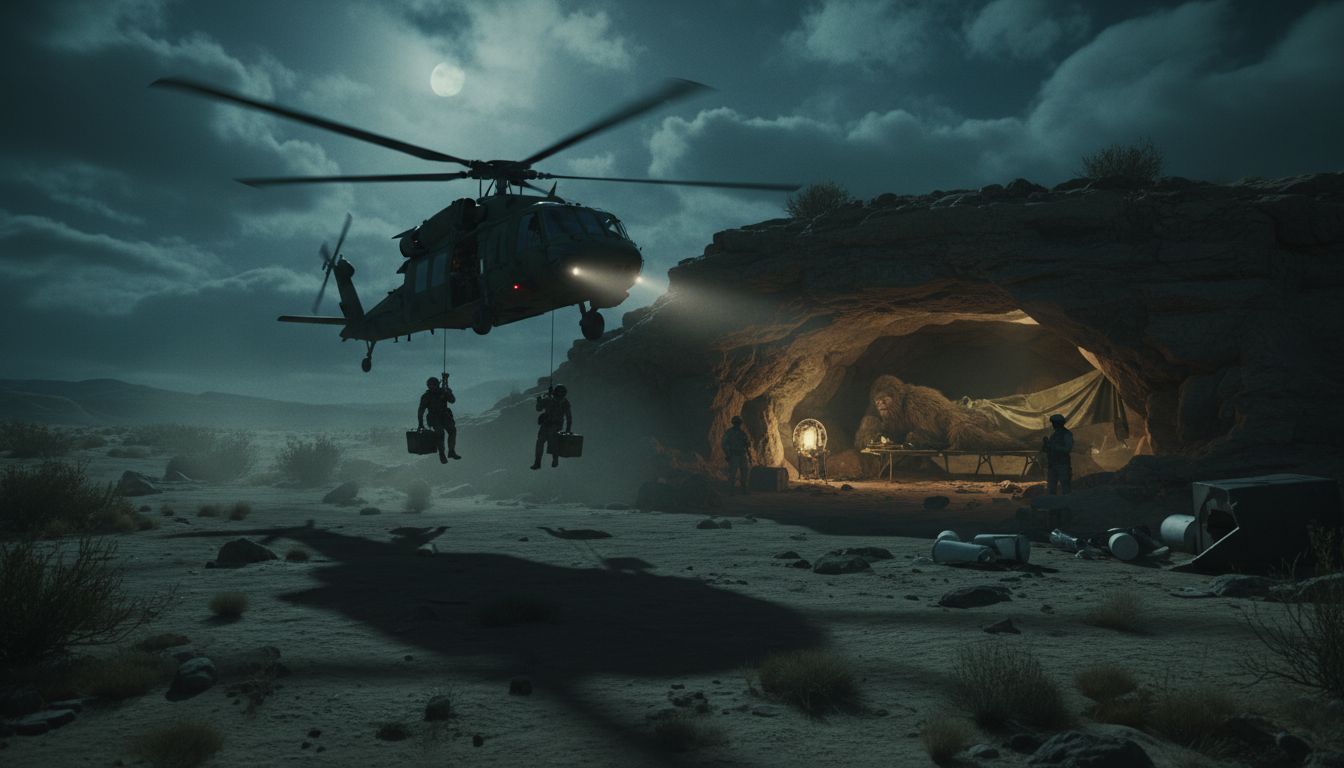
According to the forum post, two separate accounts claim that the U.S. Army Corps of Engineers and the National Guard recovered large, partially burned bodies in the Cowlitz River valley following the May 18, 1980 eruption. One witness, identified only as a veteran helicopter pilot, told researcher Bobbie Short that military helicopters lifted “nets filled with burned and partially burned wildlife, including at least one unidentified, heavily charred, hairy humanoid form” and later incinerated the remains to avoid contamination. A second account, recorded in IBS Report #3493, recounts a forest‑service worker who saw “several large, humanoid creatures, some badly burned, others largely intact” being loaded onto a truck under armed guard. The post notes that “no official record of these bodies has ever surfaced,” and that the stories exist in multiple, slightly divergent versions.
Context and Prior Claims
The Mount St. Helens narrative is not the first instance where government activity has been linked to alleged Sasquatch evidence. Over the past three decades, independent researchers have documented occasional reports of bipedal silhouettes detected by motion sensors and perimeter cameras at restricted sites such as Edwards Air Force Base. Although the Air Force has never confirmed such sightings, the clustering of anecdotal reports near sensitive installations has fueled speculation that a covert research program could exist. Scholars of cryptozoology caution that “the absence of verifiable data makes it impossible to distinguish between genuine anomalies and misidentified wildlife or equipment artifacts,” a sentiment echoed by Dr. Elaine Ramirez, professor of anthropology at the University of Washington.
Independent Research Community
Amid the sensational claims, a modest but organized group of investigators in New York’s Hudson Valley has been working to document Bigfoot sightings using standard field‑research protocols. The collective, which calls itself the Hudson Valley Sasquatch Consortium, emphasizes “peaceful coexistence” and prioritizes safety for both observers and any potential wildlife. Members report dozens of nighttime visual sightings, footprints measured with calibrated tools, and audio recordings of low‑frequency vocalizations. Consortium spokesperson Maya Levine stresses that “our approach is evidence‑based; we record GPS coordinates, environmental conditions, and use peer‑reviewed methods to avoid the pitfalls of anecdotal storytelling.” While the group acknowledges the allure of government‑related conspiracy theories, they stress that “credible science requires transparent data, not hidden files.”
Assessment
Journalists and scientists evaluating these claims face a familiar dilemma: balancing public curiosity with the need for rigorous verification. The Phantoms and Monsters article presents a compelling narrative but offers no primary documents, forensic reports, or corroborating photographs that meet scholarly standards. Government agencies, including the Department of Defense and the U.S. Forest Service, have issued no statements confirming the existence of Sasquatch specimens or related research programs. In the absence of tangible evidence, the prevailing consensus among mainstream scientists remains skeptical, viewing the stories as part of a broader folklore tradition rather than proof of a concealed cryptid program. Nevertheless, the continued interest from both fringe investigators and organized citizen‑science groups ensures that the debate over what, if anything, the government knows about Sasquatch will persist in the public sphere.


