Overview
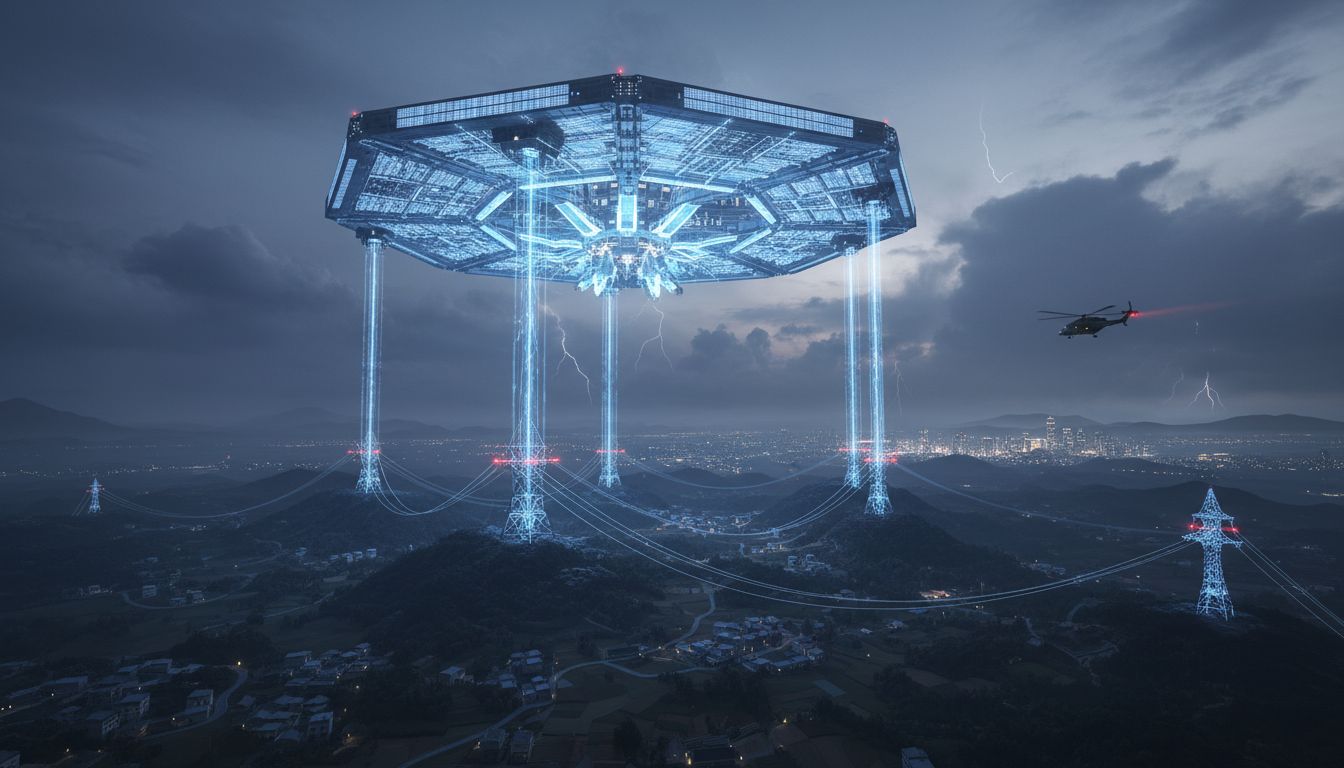
In late January 2026, residents of Yibin, a city in Sichuan Province, reported seeing a large, silently hovering object that resembled a futuristic blimp or, to some, a UFO. The sighting quickly spread on Chinese social media, prompting a flurry of speculation. A popular automotive‑technology blog, Supercar Blondie, later claimed the craft was not an extraterrestrial vehicle but a prototype airborne wind‑energy system—dubbed the “S2000 Stratosphere”—that allegedly fed electricity directly into China’s national grid.
The Alleged Event
According to the blog post, the object ascended to roughly 2,000 metres during a scheduled energy‑test on 3 January 2026 and hovered in place while tethered to the ground by a power cable. The article states the platform generated 385 kilowatt‑hours of electricity and transmitted it to the local distribution network, presenting the sighting as a “secret” demonstration of next‑generation renewable technology. Photographs accompanying the piece show a helium‑filled airship with turbine blades integrated into its envelope, reminiscent of concepts promoted by companies such as Kite Power Systems and Makani (now defunct).
Technical Claims
The S2000 Stratosphere, as described, is an airborne wind energy (AWE) system that seeks to capture stronger, more consistent winds at higher altitudes than conventional tower‑mounted turbines. Proponents of AWE argue that operating at 2 km can increase capacity factors by 30‑40 percent. The blog’s claim that a single tethered platform supplied 385 kWh during a test aligns with early‑stage results from laboratory prototypes, which have demonstrated power outputs in the 200‑500 kW range for short durations. However, the post offers no independent data, telemetry, or third‑party verification of the test conditions, nor does it disclose the identity of the organization behind the S2000.
Expert Analysis
Energy researchers caution against treating the Supercar Blondie article as evidence of a breakthrough. Dr. Li Wei, professor of renewable energy systems at Tsinghua University, said, “Airborne wind turbines are still experimental. While the concept is sound, we have yet to see a commercially viable, grid‑connected system operating at the scale suggested in that blog.” Similarly, Dr. Emily Hart, a senior analyst at the International Renewable Energy Agency (IRENA), noted, “Claims of a single platform powering a regional grid are extraordinary and would require rigorous validation. To date, no peer‑reviewed study has documented such performance.” Both experts emphasized that sensational headlines often outpace the underlying science, especially when originating from entertainment‑focused outlets.
Context and Outlook
China continues to expand its renewable portfolio, targeting 1,200 GW of non‑fossil generation by 2030. Airborne wind energy is among the technologies being explored, with several domestic pilots receiving modest funding from the Ministry of Ecology and Environment. Nonetheless, the sector remains nascent, and large‑scale integration faces challenges—including airspace regulation, tether durability, and grid interconnection standards.
The Yibin sighting underscores how quickly novel technology can become entangled with UFO folklore, especially on platforms that prioritize viral content over rigorous reporting. While the S2000 Stratosphere concept is intriguing, the current evidence—limited to a single, unverified blog post—does not substantiate the claim that the object “powered the entire grid.” As the renewable energy community watches AWE developments closely, any future demonstrations will need transparent data and independent verification to move beyond speculation.


