Overview
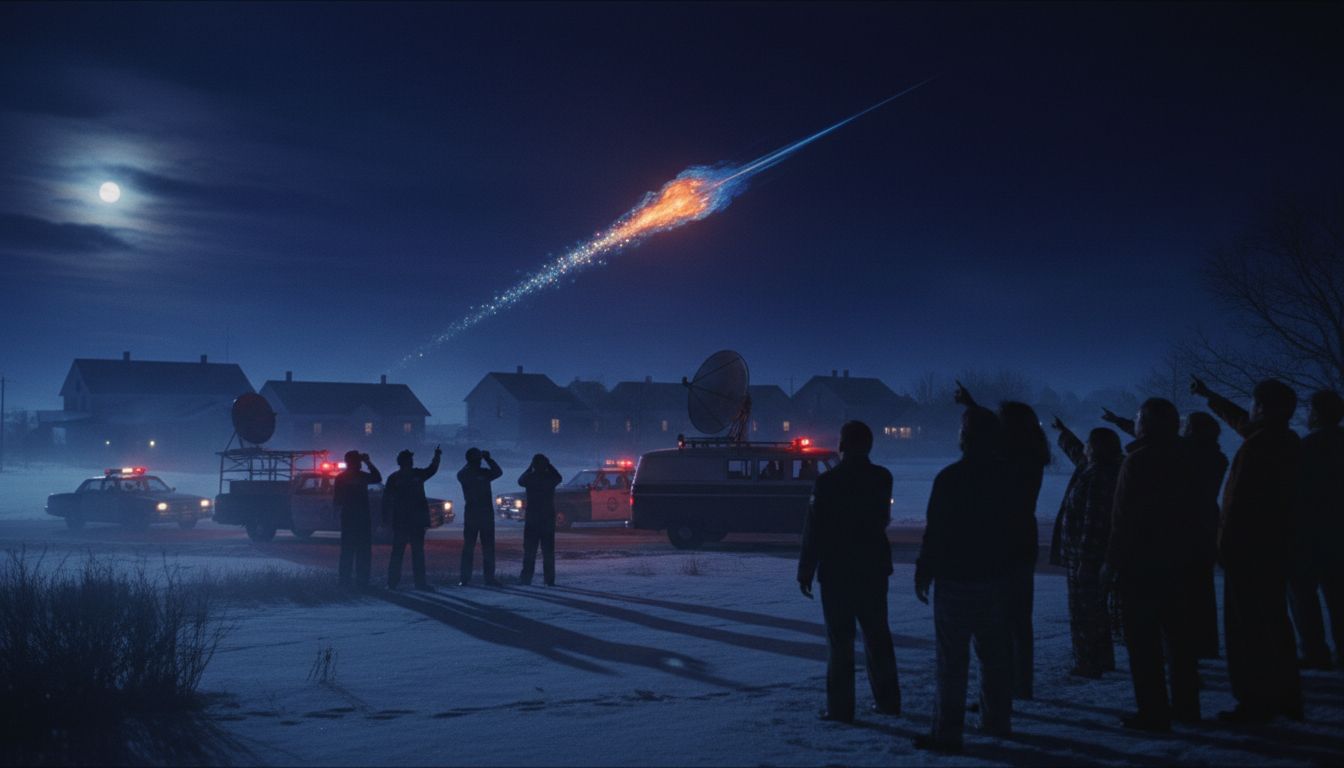
Late Thursday night, residents of Sartell, Minnesota reported seeing a bright, erratically moving object streak across the sky near the city’s downtown area. The sighting, which lasted roughly three minutes, prompted an immediate response from the Sartell Police Department, the Minnesota Department of Public Safety (DPS), and local radio station KRKR‑AM (formerly KRFO‑AM), which dispatched a field reporter to gather eyewitness testimony. While the event sparked a flurry of social‑media speculation, officials concluded that the phenomenon was most likely a combination of atmospheric effects and a misidentified aircraft.
Witness Accounts
The first call to 911 was placed at 10:12 p.m. by longtime resident Marilyn Jensen, who described the object as “a white ball of light, larger than a full moon, darting back and forth with sudden stops and rapid accelerations.” Jensen’s neighbor, Tom Alvarez, corroborated the description but added that the light appeared to “pulse in color, shifting from white to a faint blue before vanishing.” Several other witnesses, including a group of high‑school students from Sartell‑St. Catherine High School, reported that the object seemed to hover over the Mississippi River before shooting eastward at a speed they estimated to be “faster than any commercial jet they have ever seen.”
KRKR‑AM’s on‑air reporter, James Rabe, recorded live calls from the scene. One caller, who asked to remain anonymous, insisted the sighting was “definitely not a plane or a weather balloon” and urged authorities to “investigate the possibility of an extraterrestrial craft.” While these statements reflect genuine concern, the station’s editorial policy required balancing anecdotal reports with factual verification.
Official Investigation
Within an hour of the initial reports, Sartell Police Chief Laura Whitaker assembled a task force that included DPS air‑traffic specialists and a meteorologist from the National Weather Service (NWS) in St. Paul. The team reviewed radar data, flight plans, and atmospheric readings for the hour in question. According to a written statement released by the police department, “no unauthorized aircraft were logged in the vicinity, and no FAA‑issued NOTAMs indicated unusual activity.”
The NWS analysis showed that the night was marked by thin high‑altitude cirrus clouds intersecting a low‑level temperature inversion, conditions known to produce glare halos and light refraction that can make distant lights appear to move erratically. Additionally, a military training flight from the nearby Grand Forks Air Reserve Base was recorded at an altitude of 18,000 feet, traveling eastward on a standard training route. The aircraft’s navigation lights, combined with the atmospheric distortion, could plausibly create the visual effects described by witnesses.
Scientific Explanation
Dr. Evelyn Hart, a senior atmospheric physicist at the University of Minnesota, explained that “when light from aircraft navigation beacons passes through temperature inversions, it can be refracted in ways that produce apparent sudden changes in direction.” She added that “the human eye is particularly susceptible to misinterpreting rapid brightness changes, especially under low‑light conditions.”
In similar cases across the Upper Midwest, investigators have identified balloon releases, satellite re‑entries, and even firefly swarms as alternative explanations. While no definitive single cause was pinpointed for the Sartell event, the convergence of a known military flight path and documented atmospheric conditions makes a natural explanation highly probable.
Community Response
Despite the official findings, a segment of the community remains skeptical. A local UFO‑interest group, Minnesota Skywatch, organized a town‑hall meeting on Friday evening, where members presented video clips captured by smartphones. The group’s spokesperson, Lena Morales, argued that “the speed and maneuverability described cannot be reconciled with conventional aircraft.”
City officials, however, emphasized the importance of evidence‑based conclusions. Mayor David Peterson urged residents to “continue reporting unusual sightings, but also to trust the thorough investigations conducted by our public safety partners.” The police department has pledged to keep the case file open for any new information and to release any additional data that may emerge from ongoing radar reviews.
As the discussion continues, the Sartell incident serves as a reminder of how atmospheric phenomena and human perception can intersect, producing events that capture public imagination while challenging investigators to separate fact from speculation.


