Overview
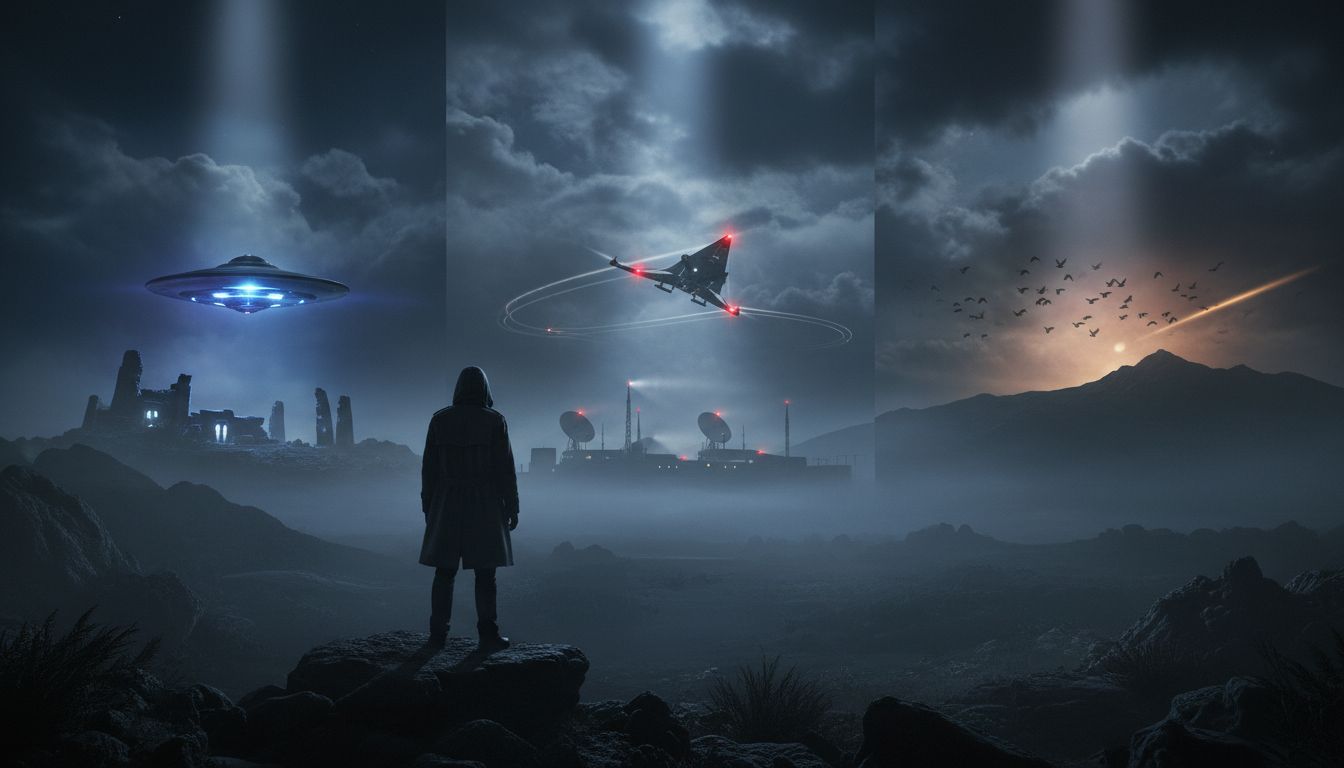
On April 15, 2026, the U.S. government released a trove of previously classified documents on unidentified aerial phenomena (UAP), the first major declassification since the 2021 ODNI report. The files, compiled over two decades by the All‑Domain Anomaly Resolution Office (AARO), contain sensor data, pilot testimonies, and intelligence assessments from more than 400 incidents. Journalists, scientists, and policymakers are now sifting through the material to determine what, if anything, it confirms about the nature of these sightings. Analysts have distilled the possibilities into three broad scenarios: confirmation of extraterrestrial technology, identification of advanced but terrestrial craft, or attribution to natural and conventional sources. Each outcome carries distinct ramifications for public perception, national security policy, and the direction of scientific inquiry.
Scenario 1 – Evidence of Extraterrestrial Technology
If the declassified records contain unambiguous signatures of non‑human propulsion or materials, the implications would be historic. Several entries describe objects executing accelerations beyond known aerodynamic limits, performing instantaneous direction changes, and emitting radiation spectra that do not match any cataloged aircraft or satellite. A senior official at the Office of the Director of National Intelligence, speaking on condition of anonymity, said, “We have data points that, taken together, challenge our current physics models. Whether that points to foreign adversary tech or something else remains to be seen, but the evidence is compelling enough to warrant a deeper, interdisciplinary review.” Confirmation of extraterrestrial origin would likely trigger congressional hearings, a re‑evaluation of the 2022 National Defense Authorization Act provisions on UAP, and a surge in funding for astrophysics and aerospace research aimed at reverse‑engineering any recovered technology.
Scenario 2 – Advanced Terrestrial Craft
A more conservative interpretation is that the files reveal cutting‑edge, but human‑made, platforms—potentially hypersonic drones, high‑altitude balloons, or experimental aircraft being tested in secrecy. The documents reference multiple sightings over restricted airspace that align with known test ranges in Nevada and the Pacific. Dr. Maya Patel, a senior researcher at the Smithsonian’s National Air and Space Museum, noted, “Historically, many UAP reports have been traced to classified military programs. The patterns we see here—high‑speed, low‑observable objects—fit that narrative.” If this scenario prevails, the primary impact would be a recalibration of how the Department of Defense manages classified testing, with possible calls for greater transparency to avoid public confusion and to maintain trust in civilian oversight mechanisms.
Scenario 3 – Misidentifications and Natural Phenomena
A third, and perhaps most likely, outcome is that the majority of the cases will be explained by conventional sources—weather balloons, atmospheric plasma, or optical artifacts caused by sensor anomalies. Several entries include corroborating radar data that later matched commercial air traffic, while others note rare meteorological events such as “sprites” and “ball lightning.” Professor Luis Hernández of the University of Colorado Boulder, who leads a UAP‑focused atmospheric physics group, explained, “Our atmosphere can produce visual and electromagnetic effects that look extraordinary to an observer without specialized training. The new files give us a valuable dataset to refine our models of these phenomena.” Validation of this scenario would reinforce the need for improved sensor calibration and could lead to new standards for reporting anomalous observations in both civilian and military contexts.
Implications for Policy, Science, and Public Opinion
Regardless of which scenario ultimately dominates, the release marks a turning point in how the United States addresses UAP. If extraterrestrial evidence emerges, lawmakers may push for an international framework akin to the Outer Space Treaty, while scientific agencies such as NASA and the NSF would likely receive a boost in grant funding for exobiology and high‑energy physics. Conversely, confirmation of advanced terrestrial technology could prompt tighter export‑control regimes and renewed debate over the balance between secrecy and democratic accountability. Even a conclusion that most sightings are natural would underscore the importance of standardized data collection and could improve aviation safety by reducing false alarms. Public opinion, currently split—according to a recent Pew Research Center poll, 48 % believe UFOs are evidence of alien life—may shift toward greater skepticism or, alternatively, heightened curiosity, depending on the narrative that emerges from the files.
In the weeks ahead, congressional committees, scientific panels, and independent watchdogs will convene to parse the data. As the nation watches, the declassified UFO files stand as a rare opportunity to move the conversation from speculation to evidence‑based discourse, whatever the final verdict may be.