Overview
For more than half a century, the Search for Extraterrestrial Intelligence (SETI) has scanned the heavens for the faint, narrow‑band radio beacons that would betray the presence of technologically capable civilizations. Yet despite ever‑more sensitive arrays—from the Arecibo Observatory’s historic surveys to today’s Breakthrough Listen program—those tell‑tale signals remain elusive, a phenomenon dubbed the “Great Silence.” In a recent paper, researchers at the SETI Institute suggest a terrestrial‑independent factor may be at work: space weather generated by the host stars of potential transmitters could be distorting, or “smearing,” alien signals before they ever reach Earth‑based receivers.
The Space‑Weather Hypothesis
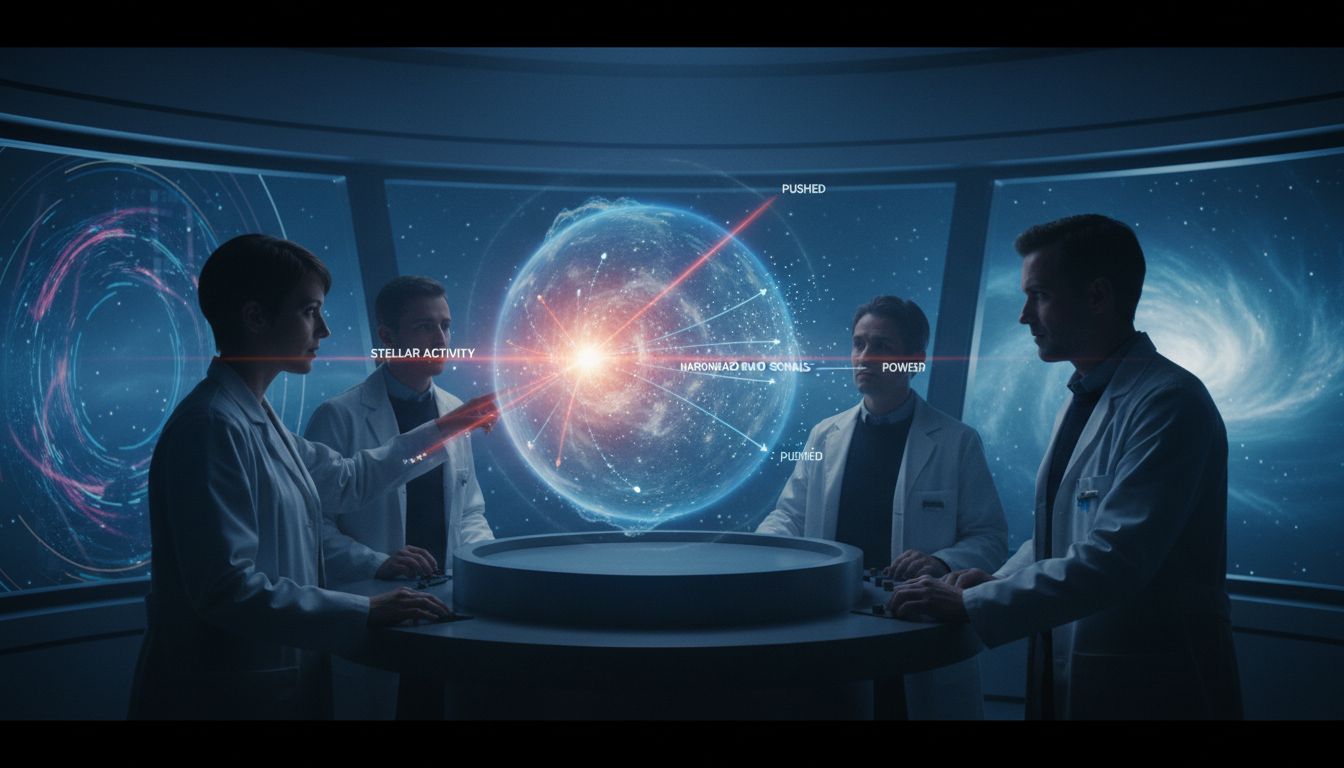
Stellar activity—solar‑like flares, coronal mass ejections (CMEs), and continuous stellar winds—creates turbulent plasma environments around a star. When a narrowband radio transmission passes through such plasma, its frequency can be broadened and its power redistributed across a wider bandwidth. The SETI team, led by Dr. Jenna Morales, explains that “a signal that would be detectable in a pristine vacuum can drop below our detection thresholds after being scattered by a star’s energetic outflows.” Their calculations indicate that even modest flares from Sun‑type stars can increase a signal’s linewidth by factors of ten to a hundred, effectively diluting its intensity below the sensitivity limits of modern radio telescopes.
Technical Details
The researchers modeled the propagation of a 1 kHz‑wide artificial carrier through plasma densities typical of M‑dwarf flare events, which are known to be more frequent and energetic than those of our Sun. Using magnetohydrodynamic simulations, they found that electron density fluctuations of 10⁸ cm⁻³ can broaden a carrier to several hundred kilohertz within minutes of a flare. This broadening spreads the signal’s power across a larger spectral window, reducing the signal‑to‑noise ratio (SNR) by an order of magnitude. In practical terms, a transmission that would have registered at a 10σ confidence level in a quiet environment could fall to 1σ—well within the noise floor of instruments such as the Green Bank Telescope or the MeerKAT array.
Implications for Ongoing Searches
If space‑weather smearing is common, it may partially explain why Breakthrough Listen’s exhaustive surveys of nearby Sun‑like stars have yet to produce a confirmed technosignature. “We’ve been looking for the needle in the haystack, but the haystack itself may be shifting,” notes Dr. Morales. The hypothesis urges a reassessment of detection algorithms, which traditionally assume that extraterrestrial transmitters emit stable, narrowband carriers. Adaptive techniques that search for temporally broadened or frequency‑drifted patterns could recover smeared signals that current pipelines discard as noise.
Looking Ahead
The SETI Institute plans to test the theory by coordinating simultaneous observations of active stars with both radio telescopes and space‑based X‑ray monitors, which can flag flare events in real time. By correlating flare timestamps with any anomalous broadening in the radio band, researchers hope to quantify the effect directly. Moreover, upcoming facilities such as the Square Kilometre Array (SKA), with its unprecedented sensitivity and wide frequency coverage, will be better positioned to detect faint, broadened emissions. As Dr. Morales cautions, “Even if space weather is dimming alien beacons, it doesn’t mean they aren’t there—it just means we need to listen smarter.”
The findings, detailed in a pre‑print submitted to The Astrophysical Journal Letters, add a nuanced layer to the ongoing debate over the Fermi paradox and underscore the importance of interdisciplinary approaches—combining astrophysics, plasma physics, and signal processing—to refine humanity’s search for cosmic neighbors.


