Overview
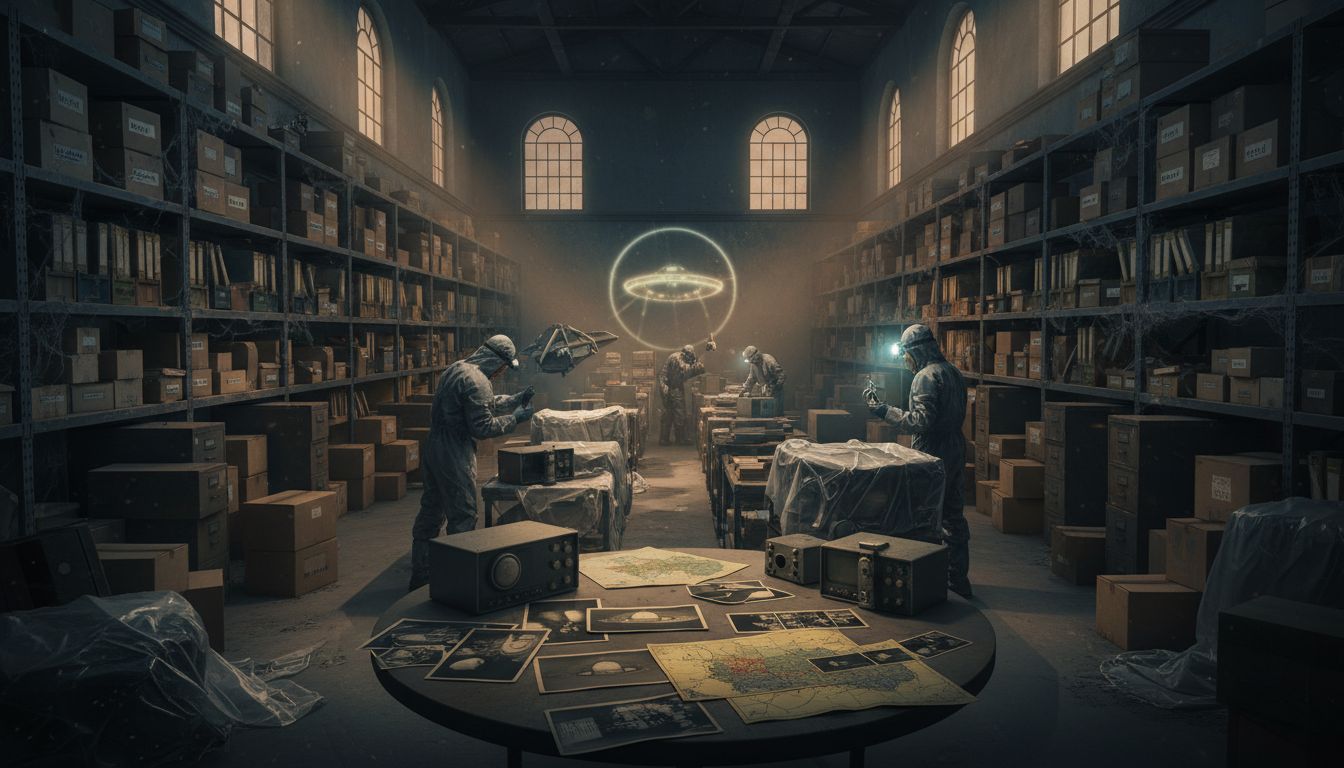
A trove of decades‑long UFO and Unidentified Aerial Phenomena (UAP) research collected by Canadian government agencies has been discovered stored in a nondescript warehouse on the outskirts of Vancouver. The material, which includes photographs, radar logs, interview transcripts and internal memoranda dating back to the 1950s, was uncovered during a routine inventory by the Public Services and Procurement Canada (PSPC) office responsible for federal records. According to CTV News, the archive has remained largely untouched because of bureaucratic inertia and a historically low level of public demand for the information.
Historical Context
Canada’s interest in aerial anomalies can be traced to the Cold War era, when the Department of National Defence (DND) and the Royal Canadian Air Force (RCAF) launched several covert projects—most notably Project Magnet in the 1950s and the later UFO Desk in the 1970s—to assess whether sightings posed a security threat. Over the ensuing decades, additional data were gathered by Transport Canada, the Canadian Space Agency and provincial police forces, each contributing reports that were eventually funneled into a centralized repository. However, unlike the United States, which recently declassified portions of its UAP files, Canada never issued a comprehensive public release, leaving the bulk of the material to languish in storage.
What the Archive Contains
The Vancouver warehouse inventory lists approximately 12,000 individual items, ranging from grainy black‑and‑white film strips of night‑time lights over the prairies to detailed radar sweeps captured during the 1990s over the Arctic Circle. Among the documents are:
- Official DND assessments that classified several incidents as “unexplained” after exhaustive analysis.
- Correspondence between senior officials debating whether to forward certain cases to the United States’ Advanced Aerospace Threat Identification Program (AATIP).
- Witness statements from commercial pilots, First Nations communities and civilian sky‑watchers, many of which were never entered into the public domain.
A former DND analyst, who requested anonymity, told CTV News, “We were told to keep these files under wraps unless a direct threat was identified. Over time, the files just accumulated, and no one was assigned to sort them out.”
Why the Files Stayed Hidden
Government insiders point to a combination of resource constraints and shifting priorities as the primary reasons the archive never left the warehouse. A spokesperson for PSPC said, “When the inventory was conducted, the items were catalogued under a generic ‘Aviation Records’ heading. No dedicated team was tasked with reviewing or releasing the content, and the cost of digitising thousands of analog documents was deemed non‑essential.”
The lack of public pressure also played a role. Unlike the surge of interest sparked by the U.S. Pentagon’s 2020 UAP report, Canadian media coverage of aerial phenomena has remained sporadic. As a result, the files were never subject to the same level of parliamentary scrutiny or Freedom of Information requests that have forced other governments to be more transparent.
Implications and Next Steps
The revelation has reignited debate within Canada about government transparency on national‑security‑related phenomena. Opposition members in the House of Commons have called for a formal review, urging the DND to produce a public summary of “any credible incidents that may affect airspace safety.” Meanwhile, academic researchers at the University of British Columbia’s Institute for Space Studies have expressed interest in collaborating with the government to digitise and analyze the material, noting that “even historical data can help us understand patterns and improve current monitoring technologies.”
If the archive is fully examined, it could provide valuable insights into how Canada has historically approached UAP sightings and whether any patterns emerge that align with recent U.S. findings. For now, the warehouse remains a quiet repository, but its contents may soon move from obscurity to the forefront of Canada’s ongoing conversation about the skies above.