Overview
A newly released interview on Whitley Strieber’s Unknown Country platform has reignited debate over why UFO sightings are frequently accompanied by reports of paranormal activity. In a brief, rapid‑fire conversation with journalist Grant Cameron, Strieber argues that consciousness, not material technology, underlies the UFO phenomenon. The discussion is framed alongside an Australian essay by Bill Chalker on the “UFO‑religion nexus,” and scholarly references to Jacques Vallée’s control‑system hypothesis and D.W. Pasulka’s analysis of social‑engineering tactics. Together, these sources suggest that the prevailing narrative of extraterrestrial craft may be more a product of Western technological culture than evidence of alien visitation.
Interview Highlights
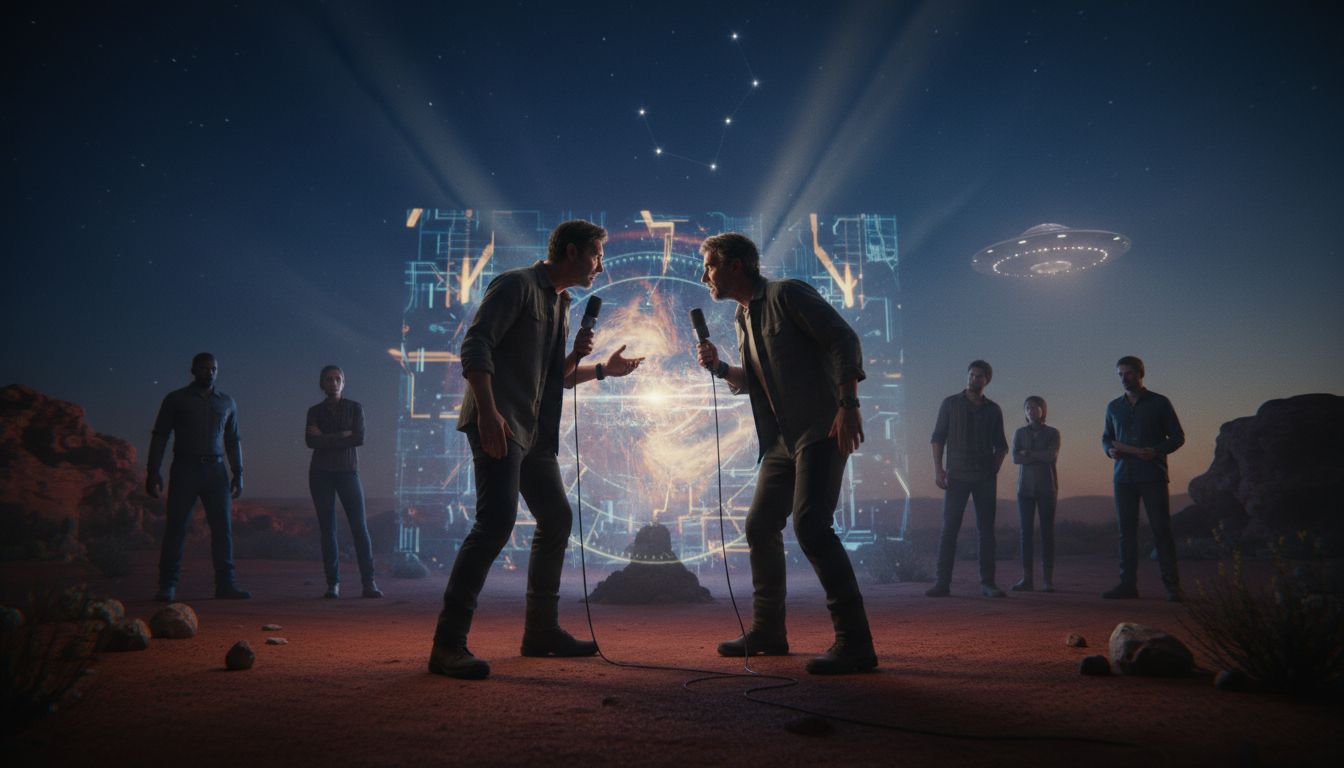
During the 12‑minute interview, Strieber posits that “the mind precedes the matter we observe,” implying that UFOs act as catalysts for altered states of awareness rather than physical objects. Cameron pressed for clarification, asking whether the phenomenon could be “demonic, angelic, or something else.” Strieber replied, “It’s none of the traditional labels; it’s a field of consciousness that can be interpreted through cultural lenses.” The interview also referenced Vallée’s idea that UFO reports function as a feedback loop, shaping public perception while being shaped by it—a view echoed in Pasulka’s recent work on how elite networks may use UFO narratives to influence belief systems.
Academic Perspectives
Bill Chalker’s essay, published in the Australian Journal of Parapsychology, expands on this cultural framing, tracing how UFO lore intertwines with religious motifs from apocalyptic prophecy to New Age spirituality. He argues that “the symbolic resonance of lights in the sky fills a mythic void left by declining institutional religion.” Vallée’s control‑system hypothesis, originally articulated in the 1970s, is revisited in light of modern data‑analytics, suggesting that UFO reports may serve as information‑filtering mechanisms that guide collective attention. Pasulka’s 2024 monograph adds a sociological dimension, documenting how certain governmental and corporate actors allegedly employ UFO stories to test public receptivity to unconventional technologies and to obscure policy agendas.
Historical Cases
The article cites the 1966 “swamp‑gas” sightings in the southeastern United States as a precedent for how environmental explanations can quickly be supplanted by extraterrestrial speculation. Witnesses initially described a faint, luminous haze, which local media later labeled “alien craft” after a surge of national coverage. Similar patterns emerged during the 1980s “Phoenix Lights” event, where mass hysteria, media amplification, and a lack of scientific follow‑up transformed ambiguous visual phenomena into a cornerstone of modern UFO folklore. These cases illustrate how Western technological optimism can reframe natural or unknown occurrences as evidence of advanced alien engineering.
Implications
The convergence of Strieber’s consciousness‑first hypothesis, scholarly critiques, and historical precedents points to a broader conclusion: the extraterrestrial technology narrative is deeply entangled with Western cultural and technological expectations. As Pasulka notes, “UFOs function as a social laboratory, allowing institutions to probe the limits of belief without overtly revealing intent.” While the interview does not provide empirical proof of non‑material origins, it underscores the need for interdisciplinary research that includes psychology, sociology, and media studies alongside traditional aerospace analysis. Until such a framework is adopted, the link between UFOs and paranormal events will likely remain a contested arena, shaped as much by human perception as by any unknown external agency.


