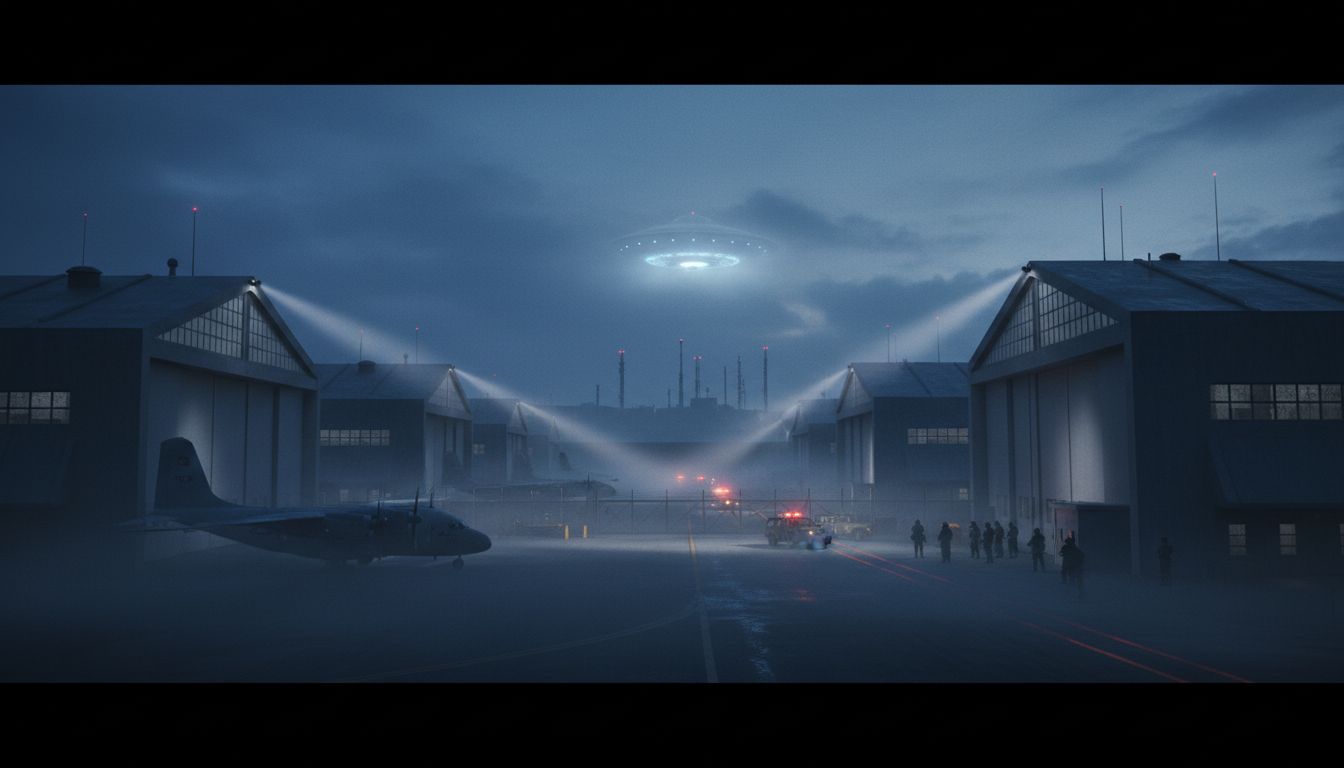
Historical Roots
Wright‑Patterson Air Force Base, located near Dayton, Ohio, has been intertwined with the United States’ official response to unidentified aerial phenomena (UAP) since the post‑World War II era. In 1947, the Air Force transferred a cache of recovered material—later alleged to be of extraterrestrial origin—to the base’s Air Force Research Laboratory (AFRL). The move cemented Wright‑Patterson’s reputation as the “repository of the unknown,” a perception reinforced when the Air Force established Project Blue Book there in 1952. Over the next two decades, the base’s analysts catalogued more than 12,000 sightings, a record that still informs contemporary investigations.
The Archive and Its Role
The base houses the National Archives of the Air Force, a climate‑controlled vault that stores declassified documents, flight logs, and photographic evidence from the Cold War period. Researchers from the Pentagon’s UAP Task Force routinely request access to these files, noting that the collection offers the most comprehensive chronological view of UAP reports in U.S. military history. “Wright‑Patterson’s archives are a critical evidentiary backbone for any serious study of aerial anomalies,” said Brig. Gen. David Grusch, a former intelligence officer who testified before Congress in 2023. The base’s custodians, however, stress that the majority of the material consists of mundane explanations—instrument malfunctions, weather balloons, or classified aircraft testing.
Secret Projects and Public Perception
Beyond its archival duties, Wright‑Patterson has been the launch point for several classified programs, including the Advanced Aerospace Threat Identification Program (AATIP), which operated from 2007 to 2012. Although the program’s budget was modest—approximately $22 million over five years—its mandate to investigate “unexplained aerial observations” kept the base in the public eye. The 2020 release of three Navy videos showing “unidentified objects” reignited interest, prompting journalists to trace the footage’s analytical chain back to Wright‑Patterson’s National Air and Space Intelligence Center (NASIC). “The base’s involvement is procedural, not conspiratorial; it simply follows the chain of command for any anomalous data,” explained Dr. Sean O’Keefe, a former NASA administrator now consulting for the Air Force.
Conspiracy Theories and Ongoing Scrutiny
Wright‑Patterson’s secretive reputation inevitably fuels speculation. Online forums routinely cite the base as the “home of the alien autopsy” and the alleged storage of a “Roswell fragment”. While no credible evidence supports these claims, the base’s limited public disclosures create a vacuum that conspiracy narratives fill. Recent congressional hearings have sought to increase transparency, urging the Department of Defense to publish a comprehensive inventory of all UAP-related material held at Wright‑Patterson. In response, the Air Force released a redacted summary in early 2024, confirming that over 800 incidents from 2004‑2022 remain under investigation, with 13% classified as “potential threats.”
Looking Ahead
The Pentagon’s newly formed All‑Domain Anomaly Resolution Office (AARO), headquartered at Wright‑Patterson, signals a shift from ad‑hoc investigations to a systematic, cross‑service approach. AARO’s director, Lt. Gen. James “Jim” McInerney, emphasized that the base’s existing infrastructure—its data centers, scientific staff, and secure storage—makes it the logical hub for the next phase of UAP research. “Our goal is rigorous scientific analysis, not sensational headlines,” he told a press briefing in February. As the U.S. government moves toward greater openness, Wright‑Patterson’s dual legacy—as both a guardian of classified aerospace work and a magnet for public curiosity—is likely to persist, shaping the discourse on unidentified aerial phenomena for years to come.


