Overview
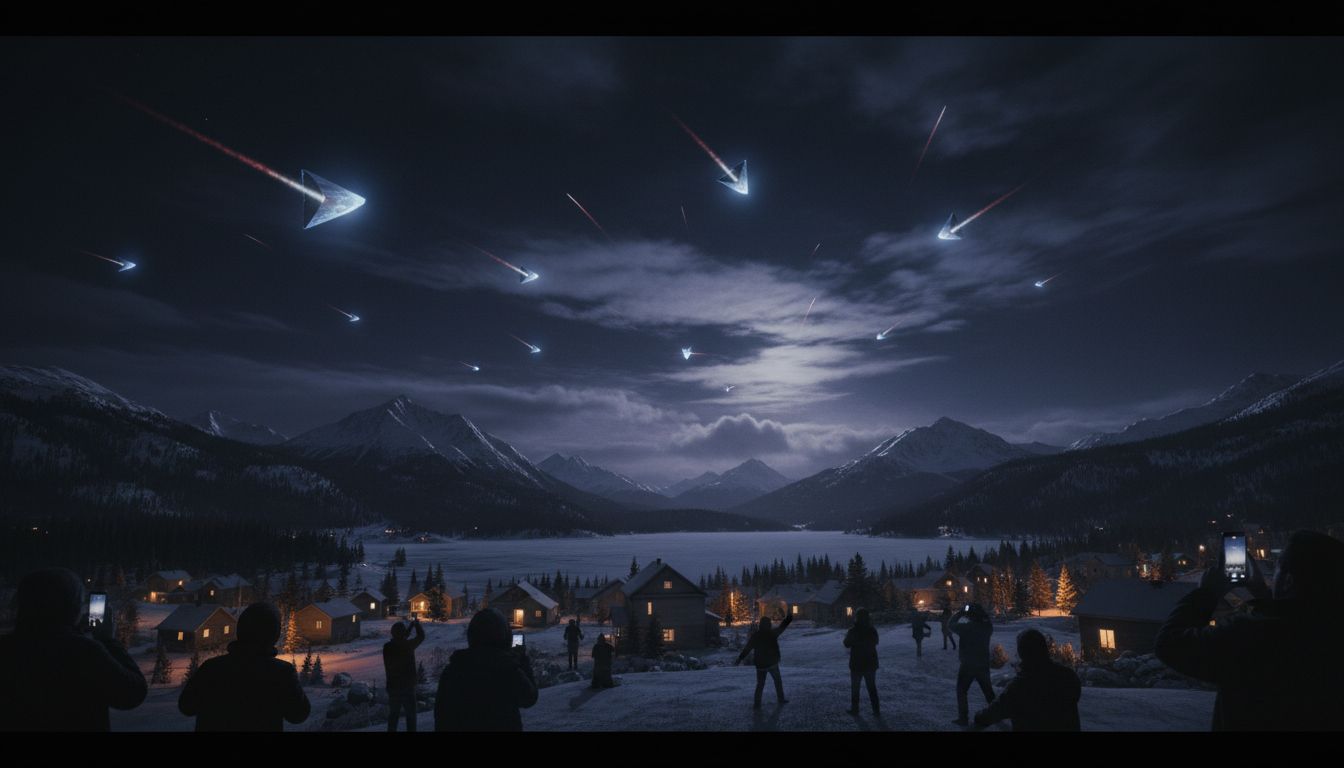
On the night of May 5, residents from Ontario, Quebec, Manitoba and Nova Scotia reported a series of bright, cone‑shaped lights moving erratically across the sky. The objects, described as hovering for several minutes before accelerating in unpredictable directions, sparked a wave of alarm on social‑media platforms, with some users dubbing the phenomenon “the Canadian cone invasion.” Within hours, local news outlets amplified the reports, prompting a brief surge of public concern and speculation about possible extraterrestrial activity.
Eyewitness Reports
Witnesses described the lights as “large, luminous cones, roughly the size of a small house, glowing white‑blue and occasionally pulsating.” In Toronto, 34‑year‑old software engineer Maya Patel said, “It was like a traffic cone turned into a beacon and floated above the city. It didn’t make any sound, but it felt… unsettling.” Similar accounts came from a farming community near Winnipeg, where farmer Luis García noted that the objects “hovered low enough that I could see the underside, which seemed to be made of some reflective material.”
The sightings coincided with a clear, moonless night, and many observers captured brief video clips that quickly spread on Twitter and TikTok. Hashtags such as #ConeUFO and #CanadaSkyLights trended locally, drawing attention from both amateur astronomers and UFO‑enthusiast forums. While the majority of the footage showed indistinct shapes, the consistent description of a conical silhouette prompted a surge of online speculation.
Expert Analysis
A joint statement released Monday by the Royal Canadian Air Force’s (RCAF) Aerospace Surveillance Centre and senior analysts from the Department of National Defence identified the phenomenon as “most likely high‑altitude unmanned aerial systems (UAS) or controlled test flights.”
“The radar signatures captured by our northern tracking stations match those of large, low‑observable drones operating at altitudes between 30,000 and 45,000 feet,” said Lt. Col. James Morrison, lead aerospace analyst. “These platforms can appear as bright points when illuminated by the sun below the horizon, and their aerodynamic shape can produce the cone‑like visual effect reported by witnesses.”
Independent aerospace consultant Dr. Elena Kovacs of the Canadian Institute for Aeronautics added, “Recent advances in commercial and defense drone technology have yielded vehicles with tapered fuselages to reduce drag. When such a craft is illuminated from below, it can create a glowing cone silhouette, especially under low‑light conditions.”
Both agencies emphasized that no unauthorized or hostile activity was detected, and that the objects adhered to standard flight corridors used for testing emerging aerospace technologies.
Government Response
Following the public outcry, Transport Canada issued an advisory confirming that several aerospace companies were conducting scheduled test flights in the affected airspace on May 5, as part of a coordinated program approved earlier in the year. The advisory noted that the tests involved “large, experimental high‑altitude platforms designed for atmospheric research and communications relay.”
Prime Minister Justin Trudeau’s office released a brief statement urging calm: “The safety of Canadians remains a top priority. The recent aerial displays were the result of legitimate, regulated testing activities, and no threat to public safety was identified.”
The incident also revived discussion around Canada’s newly established UAP (Unidentified Aerial Phenomena) task force, which, under the 2024 Defense Policy Review, is tasked with collecting and analyzing anomalous aerial reports. The task force’s preliminary report on the May 5 events will be submitted to Parliament later this year.
Context and Implications
Canada has a long history of public UFO reports, but the cone‑shaped sightings stand out for their visual distinctiveness and the rapid mobilization of official explanations. Analysts note that the episode underscores the growing intersection between emerging drone technology and public perception. As high‑altitude UAS become more common, distinguishing between experimental aircraft and genuinely unexplained phenomena will require robust data sharing between civilian observers, aviation authorities, and defense agencies.
For now, the consensus among experts is clear: the dazzling cones lighting up the Canadian night sky were human‑made test platforms, not extraterrestrial craft. Nonetheless, the episode serves as a reminder of the importance of transparent communication during unusual aerial events, to prevent panic and ensure that curiosity is guided by accurate information.


